PHOTO
INSERT CREDIT HERE
flat whites are fast replacing the wares found at that
other kind of coffee shop. Indeed, a recent tightening of
legislation means that by 31 August 2015, 26 of the red light
district’s original 76 marijuana-dispensing coffee shops
will have had to shutter up.
In certain respects, these changes have been a long
time coming. De Wallen, which means ‘the walls’ in
Dutch, is the oldest part of Amsterdam and derives its
name from the medieval ramparts that were the city’s
first line of defence against invasion. But for centuries it
served as a bawdy pleasure dome, ready to quench the
myriad thirsts of the homecoming sailors who funded
Amsterdam’s remarkable Golden Age expansion.
The Dutch have long been famed for their enlightened
approach to what others might see as the seedier side of
life. But, by the end of the 20th century, there was a
growing, uneasy sense that, somewhere along the way,
the neighbourhood that had come to personify a certain
kind of easy-going tolerance had morphed into a no-
holds-barred hotbed of criminality and exploitation.
Local papers were full of tales of innocent-looking
doughnut shops doubling as hard-drugs dens, tourists
succumbing to ever-more potent forms of weed and the
tyranny of the ‘loverboys’: young men who romance
underage girls before turning them into prostitutes.
So the local authorities started to act. In 2005, the
Netherlands’ government took decisive action as the sale
of alcohol was outlawed in Holland’s marijuana-selling
coffee shops. Then, in 2008, hallucinogenic mushrooms
were banned altogether. Prostitution also faced a
crackdown, amid fears that the EU’s open-borders policy
was enabling criminal gangs to traffic vulnerable women
from Europe and beyond to work in Holland’s windows.
But, by far the most controversial move to date came
when Amsterdam’s City Hall decided to grease the wheels
of reinvention with Project 1012, named after the
district’s infamous postcode. A first wave of ‘creative
renewal’ came via initiatives such as the now-defunct
Redlight Fashion, which pimped up-and-coming
designers in the recently vacated windows that had
previously been controlled by actual pimps.
Cynics pointed out that these state-funded
dressmakers were unlikely to find custom among the
neighbourhood’s traditional clientele. But, as Tahira
Limon, spokesperson for the mayor’s office, puts it,
“There are few places in the world that boast such an
impressive footfall. Of course,
things have changed since the
global economic downturn, but
we’re learning by doing. These
days, we’re looking to encourage
the kind of business that can set
up shop and stay active because
of popular demand.”
THIN RED LINE
06
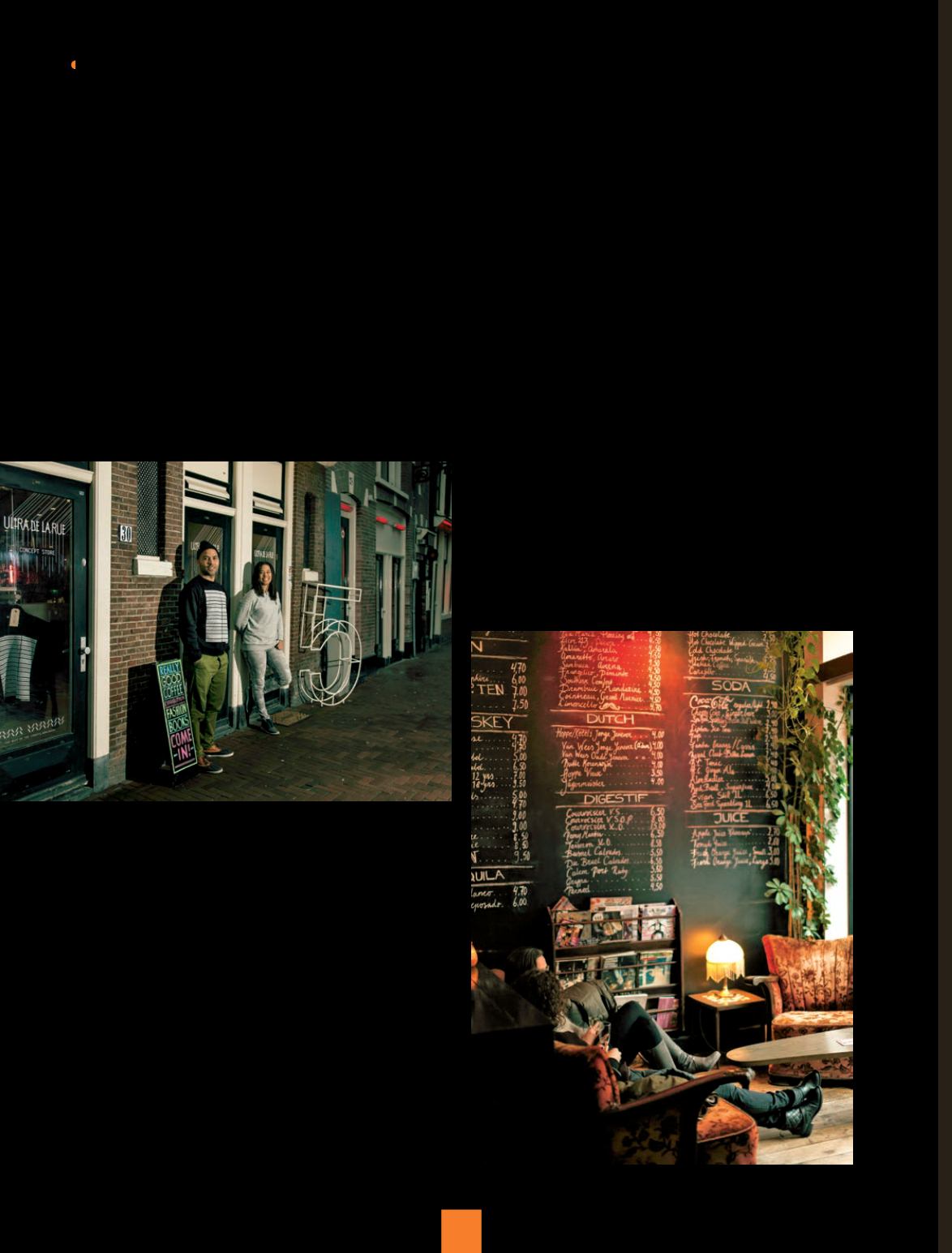
Ultra de la Rue’s
Egbert (left) and
Afaina de Jong
07
Not a space cake
in sight on Mata
Hari’s menu
08
Quartier Putain
»
06
07
0 5 0
X X X F A C T O R
A M S T E R D A M


