PHOTO
INSERT CREDIT HERE
test of time have always tended to be very provocative,”
Sheik responds, eagerly. “
West Side Story
was about
interracial romance,
Porgy and Bess
deals with drug
addiction, and
Ghosts
dealt with syphilis at a time you
definitely couldn’t talk about that.”
American Psycho
might seem to be a story as
morally vacuous as its main protagonist, but Sheik is
adamant that, beneath the Armani suits and Oliver
Peoples glasses, it too has a serious message.
“We’re hopefully going to be making a kind of
trenchant point about how dangerous it is when your
culture is really only ever paying attention to the
surfaces of things. [The musical will be] skewering a
crazily materialistic ethos that cropped up in the 80s
and now seems to be going on in full force.”
Looking around the north LondonTheatre’s cafe, it’s
easy to see what he means. The menu alone (£5 for a
bowl of spiced parsnip and apple soup… yoghurt coated
ginger... organic salted caramel ice-cream… gin from the
local microbrewery with fairtrade tonic) reads like a
Batemanesque wish list, while the wayfarer-wearing
clientele – proof of the staying power of 80s culture – act
as reminders that we live in a world created by his
ideological offspring.
“It was probably the first novel about a metrosexual,”
Ellis admitted to
Publishers’ Weekly
on the 20th
anniversary of the book’s publication, “Bateman seems
to embody something about the obsession with male
narcissism and beauty. Now that’s everywhere.”
Of course, not all of the serial killer’s obsessions have
stood the test of time so successfully. One of Bateman’s
more amusing interests – especially given his penchant
for murders and executions – is for uber-earnest
monolithic musicals – particularly
Les Miserables
.
In the 80s, these grand Andrew Lloyd Webber
productions dominated the West End and Broadway,
but in recent years this monopoly has been undermined
by a chorus line of new, irreverent shows of which
American Psycho
is just the latest.
“There’s been quite a strong backlash against the
mega musical,” says Dr Dominic Symonds, editor of the
journal
Studies in Musical Theatre
. It all started in 2003,
when the controversial
Jerry Springer The Opera
opened, setting a controversial benchmark for bawdy,
borderline musical theatre. Since then London’s
theatregoers have been treated to a parade of raucously
tuneful satires.
From long-running puppet extravaganza
Avenue Q
to
Enron
and its tap-dancing fraudsters, then OTT
modern tragedy
Anna Nicole,
a two-act opera based on
the life
of the deceased Playboy centrefold, and
“religulous” sell-out
Book of Mormon,
this new breed
use music to mock elements of modern society.
Musicals can do this better than plays, says Symonds.
“It’s like the music is winking,”
Of course, the satire in
itself isn’t anything new. It goes back to the dawn of
musical theatre, where saucy double-entendres could be
implied both with puns and tunes. What’s changed is
KILLER TUNES
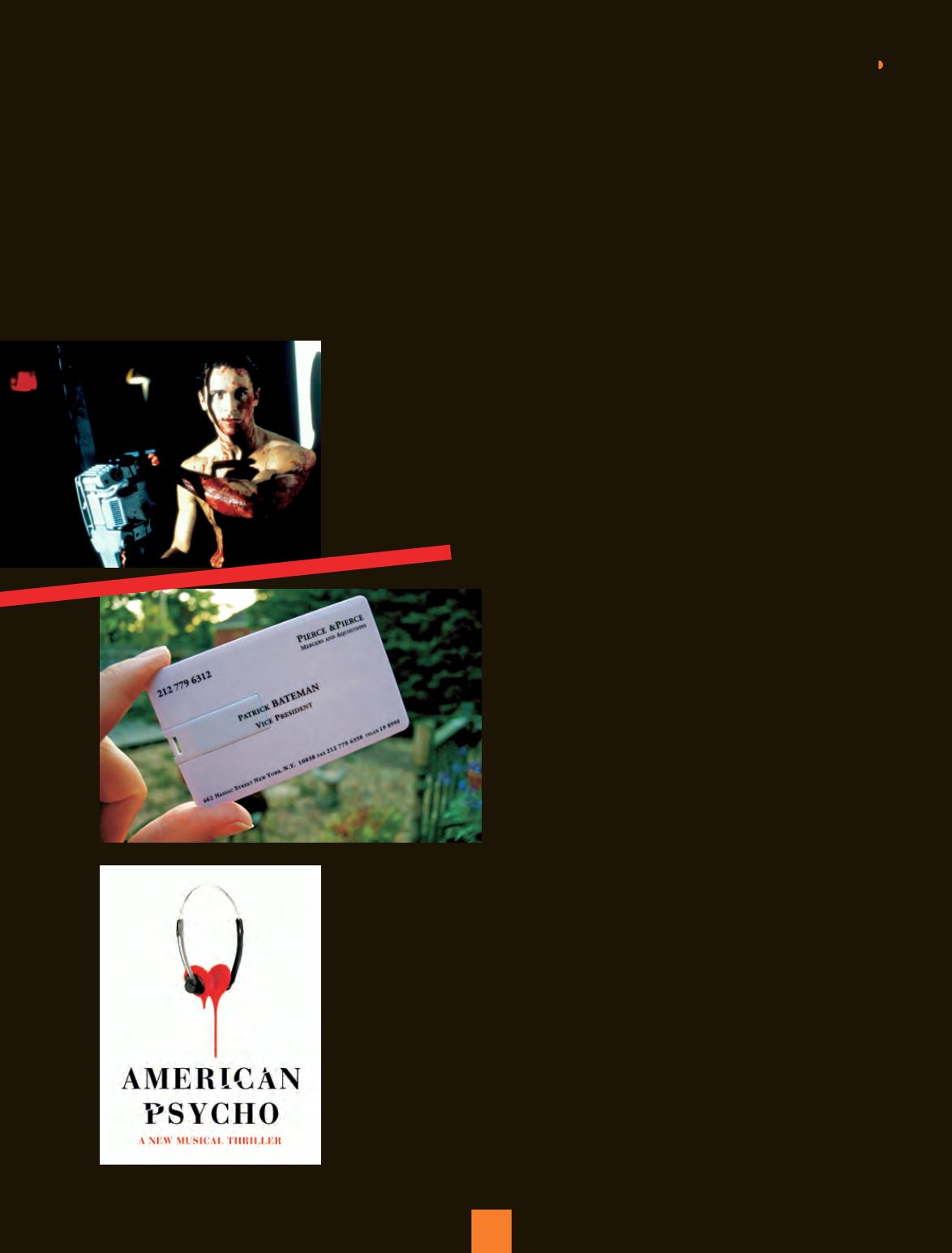
01
Matt Smith as
Bateman in
rehearsal
02
Christian Bale as
Bateman in 2000
03
Kickstarter memento
04
The new poster
»
02
03
04
0 8 7
A L T P A N T O
L O N D O N


