65
de Santo Domingo. A former monastery,
foundedinthe16thcentury,SantoDomingostill
holdsservices,and it’salsohometoamuseum—
the highlight of which is an ancient crypt, its
disintegrating tombs stacked likebunkbeds—
and a luxury hotel.Wewander the courtyard,
past bright macaws on perches hung from
avocado trees, then find a candle shop inback,
wherewewatchwax being hand-twisted into
resplendent centerpieces.
We’re barely able to walk another block
before I’m hooked again, this time by the
chocolatey smell wafting fromChocoMuseo.
A fast-talking employee namedPablo leads us on a tour
of the shop, complete with a brief history of chocolate,
which, he tells us, started as a humble Mayan drink
(
chocolatl
translatesas“spicybitterhotwater”)andbecame
an increasingly valuable commodity.Mayanswould trade
more than100,000beans fora jaguarskin,whileEuropeans
would later exchange just 100 beans for a human slave.
Pablo punctuates his lessonwith samples of candy and
spicy tea that I can’t help but accept, despitemy recent,
weightybreakfast.
We continue on across town—spanning the city on
foot takes just 15 or 20minutes—tomeet a friend of
Norman’s,Fausto Sicán, a guide from the nearby village
ofSan JuandelObispo.“Heknows everythingabout this
city,”Norman tellsme.Sicán began leading tour groups
as a kid to help pay for school.He studied law, but to
be a student duringGuatemala’s violent civil war was
a risky proposition, so he left school and now uses his
considerable intellect to educate people likeme.
“Thiscity isconsideredthebestexpressionoftheSpanish
presence inGuatemala,”Sicánsays.“My favoriteplace isthe
Conventode lasCapuchinas.It’soneof themost important
places inthecity.Itwasthe last[major]buildingconstructed
herebefore the capitalmoved toGuatemalaCity.”
Sicán agrees to show us Capuchinas, a fortresslike,
carved-stone convent that was consecrated in 1736.He
leads us into themain hall, light streaming down from
above,where a huge dome once rose, then through the
sanctuary,wherenunswould fastand flagellate themselves,
and finally into a circular subterranean room. It’s chilly
downhere,andwith just twowindowsa littledark,but it’s
strangelypeaceful.Standing in the slanting light,Norman
nods atme.“This is thebest place,”hewhispers.
This room,Sicán tells us,managed to escape
the ravages of earthquakes, and there aremany
theories about what it was used for. “The best
version,”hesays,“isthatthis is liketheGregorian
places,where the peoplewent to sing, thinking
that their voices go directly to heaven.”He
demonstrates bywalking around the perimeter
oftheroom,singing inadeepvoicethatresonates
throughout the chamber.
Beforehe leaves,Sicántellsusweshouldcheck
outareligiousprocessionhappening in theadja-
cent village of Jocotenango.We takehis advice,
hailing one of the ubiquitous three-wheel
tuk-
tuks
,and10bumpyminutes laterwe’re stepping
out into the central square of the village,which
is likea smaller, less touristyversionofAntigua.
The streets aredecoratedwith colorful
alfom-
bras
,orcarpets,painstakinglypiecedtogetherfrom
dyed sawdust and fruit.Over these decorations
passes the procession.First come the
cucuruchos
,
men inpurple robes carryingagiant casket,atop
whichstandsaneffigyofChrist.Asmallercasket
for theVirginMary, borne by solemn teenage
girls in black skirts, follows.The floats sway as
thepallbearers, someweeping, rotate in andout.
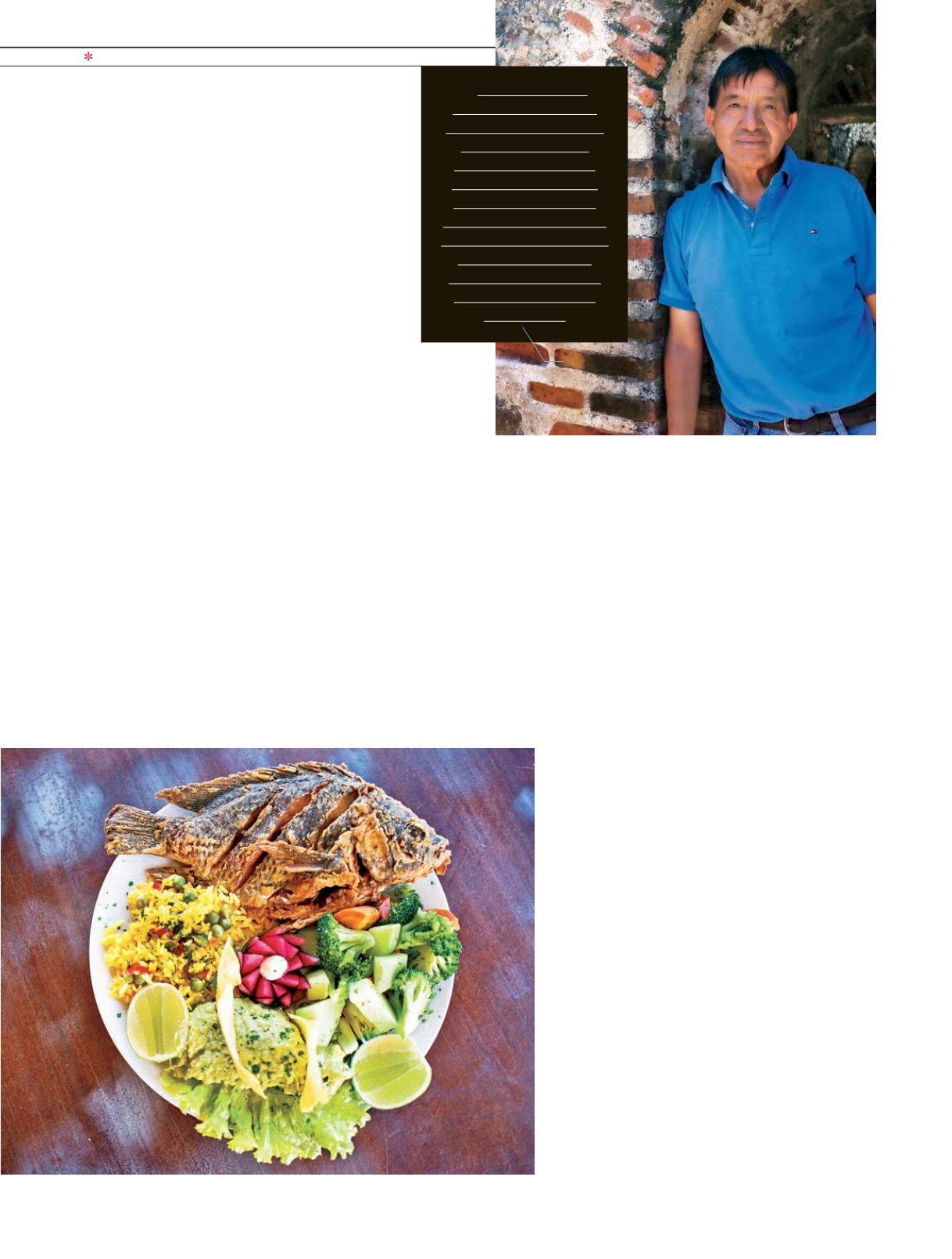
“GUATEMALA’S
HERITAGEDERIVES
FROMTWODISTINCT
SOURCES:MAYAN
CIVILIZATIONAND
SPANISHPRESENCE.
VESTIGESOFBOTH
THESECULTURESARE
FOUNDTHROUGHOUT
THECOUNTRY.SO
GUATEMALANOW IS
AMULTICULTURAL
COUNTRY.”
FAUSTOSICÁN
Guide,Antigua
(atConvento de
lasCapuchinas)
37 VOLCANOES INGUATEMALA (FOURARECURRENTLYACTIVE)


