


Page 207 - TransportationPlanUsetsGuide
P. 207
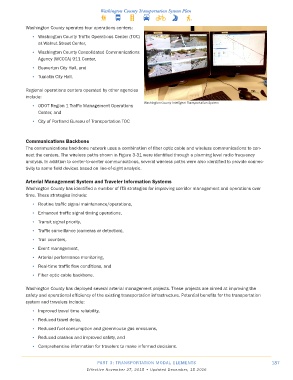
Washington County operates four operations centers:

              •  Washington County Traffic Operations Center (TOC)
                 at Walnut Street Center,

              •  Washington County Consolidated Communications
                 Agency (WCCCA) 911 Center,

              •  Beaverton City Hall, and
              •  Tualatin City Hall.


            Regional operations centers operated by other agencies
            include:
                                                             Washington County Intelligent Transportation System
              •  ODOT Region 1 Traffic Management Operations
                 Center, and

              •  City of Portland Bureau of Transportation TOC


            Communications Backbone
            The communications backbone network uses a combination of fiber optic cable and wireless communications to con-
            nect the centers. The wireless paths shown in Figure 3-31 were identified through a planning level radio frequency
            analysis. In addition to center-to-center communications, several wireless paths were also identified to provide connec-
            tivity to some field devices based on line-of-sight analysis.

            Arterial Management System and Traveler Information Systems
            Washington County has identified a number of ITS strategies for improving corridor management and operations over
            time. These strategies include:
              •  Routine traffic signal maintenance/operations,

              •  Enhanced traffic signal timing operations,
              •  Transit signal priority,
              •  Traffic surveillance (cameras or detection),

              •  Trail counters,
              •  Event management,
              •  Arterial performance monitoring,
              •  Real-time traffic flow conditions, and

              •  Fiber optic cable backbone.

            Washington County has deployed several arterial management projects. These projects are aimed at improving the
            safety and operational efficiency of the existing transportation infrastructure. Potential benefits for the transportation
            system and travelers include:
              •  Improved travel time reliability,
              •  Reduced travel delay,

              •  Reduced fuel consumption and greenhouse gas emissions,
              •  Reduced crashes and improved safety, and
              •  Comprehensive information for travelers to make informed decisions.


                                          PART 3: TRANSPORTATION MODAL ELEMENTS                                   187
                                     Effective November 27, 2015 • Updated December, 15 2016

