


Page 179 - TransportationPlanUsetsGuide
P. 179
For those cyclists needing to dress more formally, travel longer distances, or cycle during wet or hot weather, the ability
            to shower, change, and store clothing can be as critical as bicycle storage. Larger employers may choose to provide ad-
            ditional amenities as part of the Department of Environmental Quality’s Employee Commute Options (ECO) program.

            Bicycles and Transit
            Another important factor in encouraging bicycle travel is the connection
            between the bicycle and transit systems. Linking bicycles with transit
            mitigates some obstacles to bicycling such as lengthy trips, personal
            security concerns, riding at night, poor weather, or steep topography.
            Using a combination of bicycling and transit can enable a cyclist to avoid
            barriers, or facilitate longer-distance trips. Several options are available
            for combining bicycle and transit trips. Bike parking is available at most
            MAX and WES stations. Secure, enclosed parking with keycard access
            is provided at Sunset and Beaverton transit centers, and bicycle racks
            are provided at transit stations. TriMet and SMART buses have bike
            racks on the front of the buses that can carry two bikes; and bicyclists
            can bring their bike onboard MAX, WES, and the Portland Streetcar, if
            room is available in one of the designated bike spaces. Connections to
            WES and MAX are as important as connections to regional bus routes.
            Table 4.21 in the Existing Conditions Report (page 4-61 – 4-66) provides
            an assessment of bicycle accessibility to MAX and WES stations within
            Washington County, including stops within incorporated cities, along with
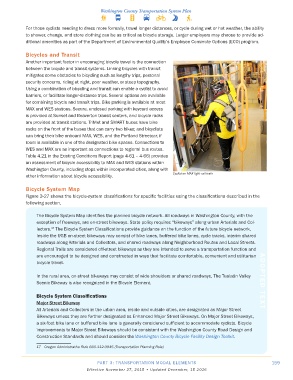
                                                                         Cyclist on MAX light rail train
            other information about bicycle accessibility.
            Bicycle System Map
            Figure 3-27 shows the bicycle-system classifications for specific facilities using the classifications described in the
            following section.

                The Bicycle System Map identifies the planned bicycle network. All roadways in Washington County, with the
                exception of freeways, are on-street bikeways. State policy requires “bikeways” along urban Arterials and Col-
                lectors.  The Bicycle System Classifications provide guidance on the function of the future bicycle network.
                      17
                Inside the UGB on-street bikeways may consist of bike lanes, buffered bike lanes, cycle tracks, interim shared
                roadways along Arterials and Collectors, and shared roadways along Neighborhood Routes and Local Streets.
                Regional Trails are considered off-street bikeways as they are intended to serve a transportation function and
                are encouraged to be designed and constructed in ways that facilitate comfortable, convenient and utilitarian
                bicycle travel.

                In the rural area, on-street bikeways may consist of wide shoulders or shared roadways. The Tualatin Valley
                Scenic Bikeway is also recognized in the Bicycle Element.                                     ADOPTED TEXT

                Bicycle System Classifications
                Major Street Bikeway
                All Arterials and Collectors in the urban area, inside and outside cities, are designated as Major Street
                Bikeways unless they are further designated as Enhanced Major Street Bikeways. On Major Street Bikeways,
                a six-foot bike lane or buffered bike lane is generally considered sufficient to accommodate cyclists. Bicycle
                improvements to Major Street Bikeways should be consistent with the Washington County Road Design and
                Construction Standards and should consider the Washington County Bicycle Facility Design Toolkit.

                17   Oregon Administrative Rule 660-112-0045 (Transportation Planning Rule)


                                          PART 3: TRANSPORTATION MODAL ELEMENTS                                   159
                                     Effective November 27, 2015 • Updated December, 15 2016

