HEMISPHERESMAGAZINE.COM
•
NOVEMBER 2013
•
ILLUSTRATION BY JAMES PROVOST
61
2
3
INNOVATION BUSINESS GADGETRY
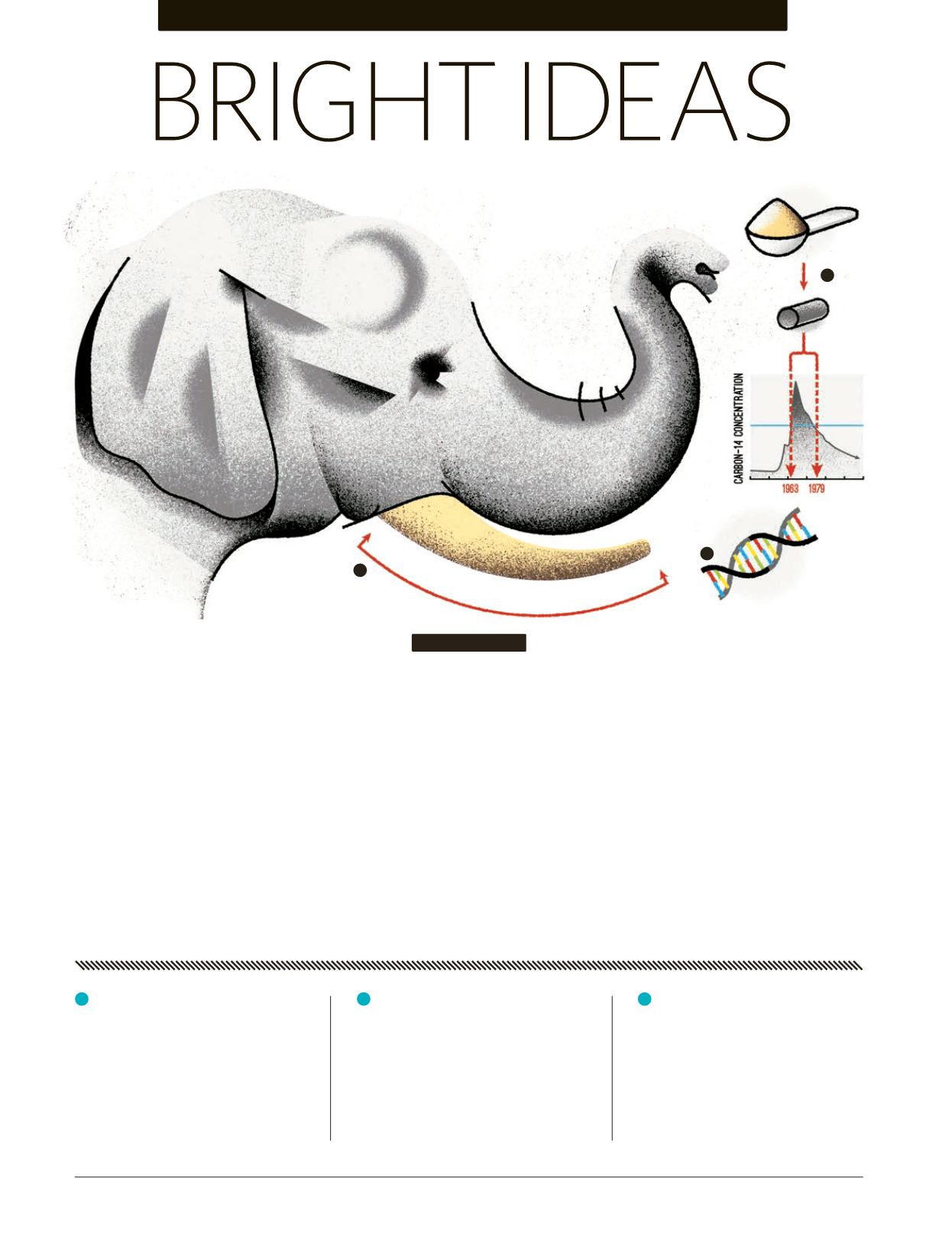
NAILING POACHERS WITH RADIATION
You rarelyhear folks praisenuclear radiation these days, butKevinUno—apostdoctoral research
scientist at Columbia University who has a bone to pick with ivory poachers—is doing just that.
A er World War II, when the U.S. and the Soviet Union started testing nuclear weapons, the
atmospheric levels of an unstable isotope known as carbon 14 shot up dramatically, peaking in
themid-’60s, and then fell steadily in a pa ern known as the “bomb curve.” Carbon 14 is the same
isotope thathasbeenused incarbondating techniques foryears, butwiththisbombcurve—linked
to historical records—the ages of plants and animals that died within the last 60 or so years can
nowbe estimatedwith greater accuracy. With poaching on the rise in recent years and criminals
claiming that they’re selling ivory only from elephants hunted years ago, Uno hopes to use his
bomb-curvedating technique todetermine the real age of elephant tusks and catch the traffickers
in the act. Here’s howhe’ll do it.
—JACQUELINE DETWILER
1
Luckily for researchers, there’s lots
of carbon in collagen, one of the primary
materials in a tusk. To measure the
carbon 14, the scientists collect a tiny
amount of ivory—less than a pinch of
salt—burn it to release carbon dioxide,
and then turn that carbon dioxide into
a carbon pellet. A lab then estimates
howmuch of the carbon in the pellet is
carbon 14.
2
Because the bomb curve is, well,
a curve, many carbon 14 levels can
correspond to two different ages—the
year on the way up the curve, and the year
on the way down. How can scientists tell
the difference? Tusks grow outward, so
by testing an older sample at the tip of the
tusk and a younger sample at the base,
they can tell whether carbon 14 was rising
or falling while the tusk was growing.
3
Finally, Uno and his colleagues are
hoping to collaborate with another scien-
tist who focuses not on when elephants
were killed, but where. Together, they
would analyze DNA to find out which
population the elephant came from,
and carbon to find out when it died. The
combination of information would lead
to knowledge about poaching hotspots,
and hopefully crackdowns.
HOW IT’S DONE
1


