HEMISPHERESMAGAZINE.COM
•
OCTOBER 2013
59
By April of last year, with rules set and
teams in place, the AUDL was ready for
opening day. The next six months were a
whirlwind, equal parts glory and tumult.
While some teams drewa endancefigures
in the thousands, others struggled to hit
triple digits. By midseason, the Connecti-
cut Constitution was forfeiting games as
it ba led the league in court over a pro-
posedexpansionteamthat theowners said
would encroach on its territory. Then, in
October, just twomonths a erwinning the
inaugural AUDL championship, Philadel-
phia Spinners owner Jeff Snader shocked
the ultimate world: His team was leaving
the AUDL to start its own league.
“The beginning of all this sparked a
vision, and I wanted to see the Spinners
get to that vision,” Snader said a er the
announcement, according to
Ultiworld
, a
website that covers ultimate news. “The
only way to do that was to take them in a
new direction.”
That was a nice way of saying he
thought the AUDL was poorly run. “The
lawsuit and the drama that came with
it led Jeff to consider that he had a great
teamandwasinaleaguethatwasge ingin
its ownway,” says
Ultiworld
editor in chief
Charlie Eisenhood. “I thinkhe sawa league
thatwasn’t a stable operation and thought
he could do a be er job.”
The result was a new league with
centralized ownership, the opposite of
the hands-off, team-owned AUDLmodel.
“In the AUDL, you buy a franchise and
you earn money based on your sales. In
the MLU, you invest in the league,” Eisen-
hood says.
Competing leagues that force eachother
to innovate might be good for fans, says
Moore, but he adds that he ultimately
regrets the split, and in the off-season he
addressed many of the problems that led
Snader to leave—chiefly, himself.
“I didn’twant to be the reason theAUDL
failed,” he says, explaining his decision to
sell a majority stake of the league and
reduce his role to board member.
As of opening day 2013, America had
two professional ultimate leagues. On
the surface, they are rivals, competing for
players, fans and the scarce sponsorship
dollars from the few companies that see
value in the game. But their overarching
goal remains the same: turn the common
sports fan into a paying customer.
“For ultimate, it’s not ‘If you build it
they will come.’ We have to get out and
show people,” says Moore. That’s why he
wanted team owners with strong roots in
their communities.
MLU is be ing more on digital distribu-
tion.Eachweek,oneofitsgamesisstreamed
live inhighdefinition. Every so o en, those
highlights landonESPN’s “SportsCenter”—
a cause for celebration in both leagues.
“It legitimizes us both,” Moore says.
More important, it gets the game in
front of fans, especially young fans, who
Held thinks should be the game’s target
market. “We need to build our base off of
14-, 15- and 16-year-olds, kidswhowill grow
up and know ultimate as a pro sport, kids
who will grow up playing it,” Held says.
By the look of the crowd at Kuntz
Stadium, he’s succeeding at this. Preteens
and teenagers cluster in groups during the
game, cheering on their favorite players.
But if their presence in the stands indi-
cates marketing success, their ability to
play on the field during hal ime (as adult
fans sit bored in the bleachers) is a sign of
how far this pro sport still has to go.
ADAMK. RAYMOND
is a writer based in
Oakand, Calif. He recently added ultimate
to the long list of sports that he’s better at
watching than playing.
THE FAN
||
culture
Located at 1001 N.E. 125th Street, Miami, Florida,
The Center For
Regenerative Medicine
includes a team of professionals that are
dedicated to improve your quality of life, paving the way to enhance
the science of non-surgical orthopedic medicine. World champions,
sports legends, professional and amateur athletes, dancers, and
people with just plain pain and arthritis go to
The Center For
Regenerative Medicine
for non-surgical orthopedic care. Using the
facility to improve their condition, thousands of successful cases
have been treated over the past 12 years.
A
NON-SURGICAL
TECHNIQUE TO FIGHT
AGAINST ARTHRITIS AND SPORTS INJURIES
For more information please visit:
or call (305) 866-8384
International: (305) 891-4686
THE CENTER FOR REGENERATIVE MEDICINE
The Knee Diaries:
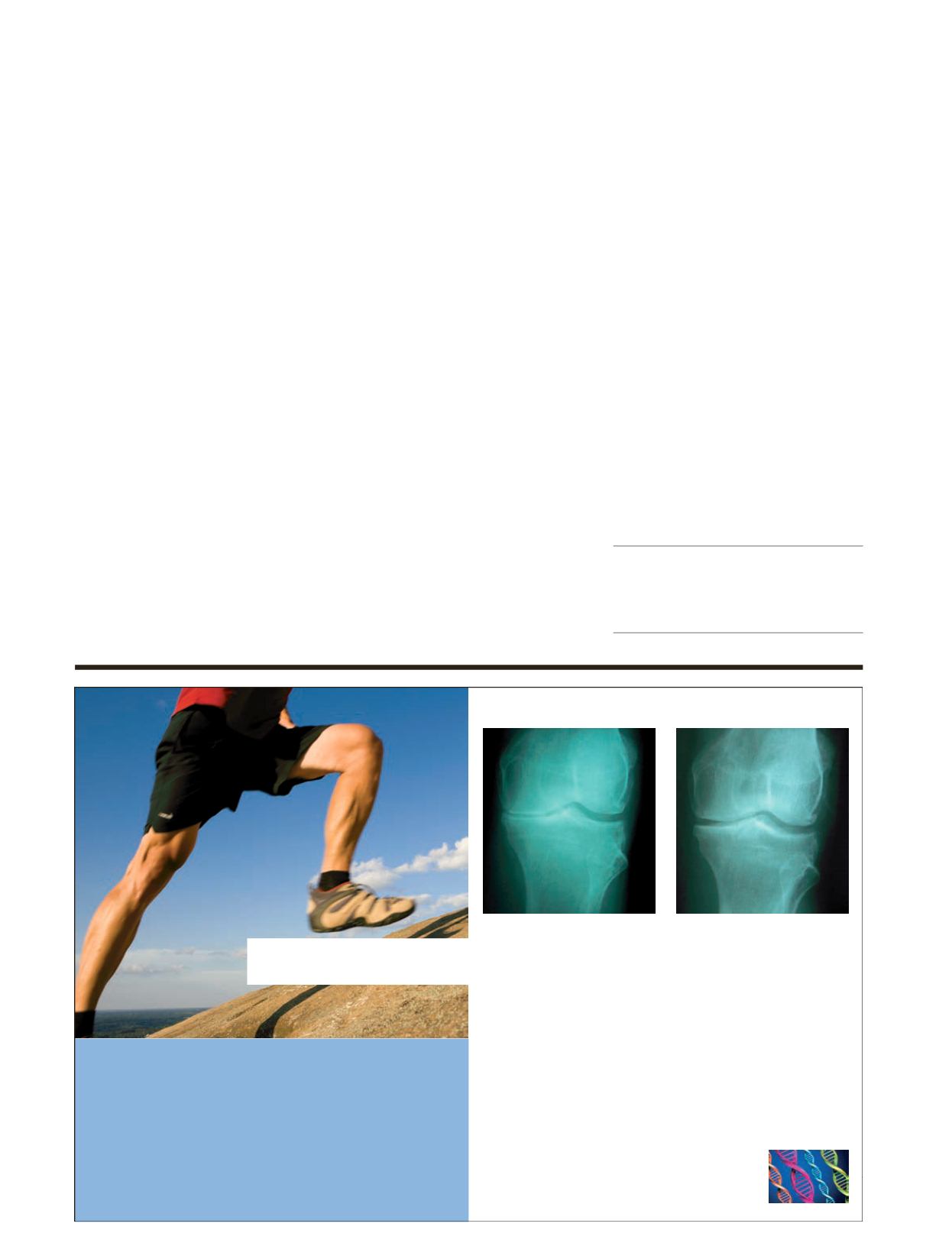
SJ is a 60-year-old male with bone on bone osteoarthritis of the left
knee. An X-ray showed arthritis of the knee (X-ray on the left). Patient started receiving
treatments at The Center For Regenerative Medicine. Today he is feeling better (X-ray
on the right).
This is how it works:
The physician introduces
Cell Therapy
into damaged, arthritic
cells by means of a precise injection. This process is followed by infrared laser as well
as several other modalities including Collateral Artery Flow Exercises (C.A.F.E.), in
order to accelerate the process. Depending on tissue damage, severity of the condition
and the size of the joint that needs to be injected, people usually need a series of 1 to
6 treatments to improve. There is usually no down time, and people can go back to
their usual activities or work immediately. The treatments can help most musculoskel-
etal problems such as low back pain, neck pain, knee pain, shoulder pain, whiplash,
sciatica, tendinitis, sprain, strains, torn ligaments and cartilage damage.


