V A N T A G E P O I N T
AMERICANWAY
JULY 1 2007
14
PHOTOGRAPHBYCHETSNEDDEN
We’d love to hearwhat you think about our
airline and our employees. Pleasewrite to us
atwww.aa.com/customerrelations.
everyone. Makes sense, right? Unfortu-
nately, the business-aviation community
— thecompaniesand individualsoperating
private jets— are vigorously opposing this
idea, because under the current system,
theyaregettinganearly free ride.
It’s important tounderstand that a small
business jet carryinga fewpeopleposes the
same challenge toATC as the large aircraft
you’re sitting in right now. To a beacon, a
satellite, and a computer, a blip is a blip,
and ATC’s costs are determined by the
number of blips being managed. Under
the current system, airlines and their cus-
tomers use about two-thirds of the ATC
system’s services, butpay (through taxeson
tickets, fuel, and other things) 94 percent
of the cost.What thatmeans, as crazy as it
sounds, is that airlines and our customers
(that’s you!) are paying a subsidy— to the
tune of $1.5 billion a year — to the com-
paniesand individualswhocanafford their
ownaircraft.
In coming months, Congress will have
an opportunity to address this inequity
when it considers the reauthorization of
legislation that funds the Federal Aviation
Administration. If you agree that we need
anATC system capable ofmeeting the de-
mandsofourcountryanda fundingsystem
that does not force passengers to subsidize
corporate aircraft, I hope youwill let your
elected representatives know.
In the meantime, thank you for flying
withus today.Haveagreat flight.
Let’sFixATC
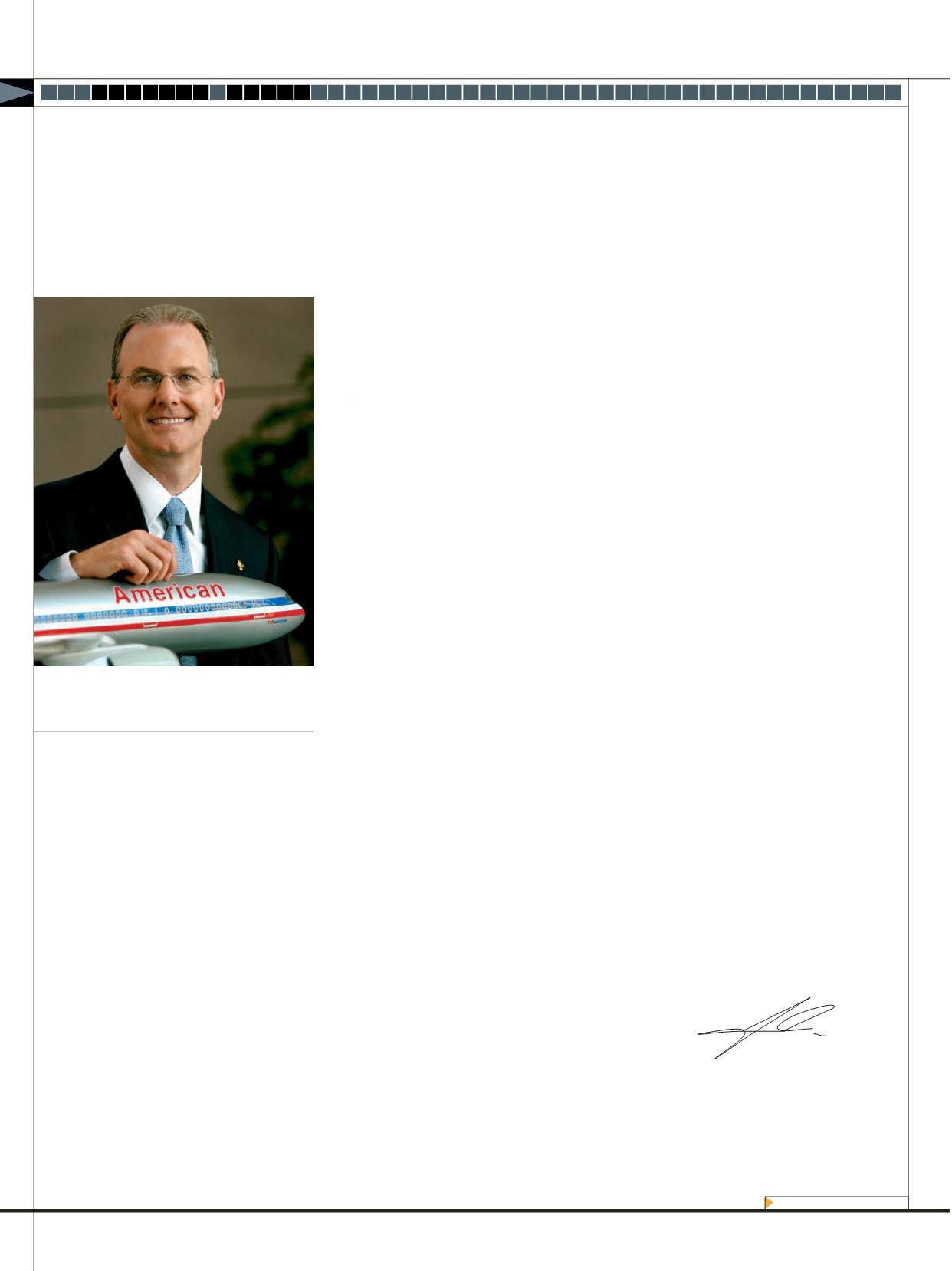
Gerard J. Arpey
Chairman&CEO
AmericanAirlines
S
SinceJuly isoneof thebusiesttravelmonths
of the year, I thought I would devote this
column to an issue that has an enormous
and growing impact on the airlines’ ability
to sustain the flow of people and products
that drives our economy. The issue is our
aviation infrastructure, and, in particular,
the air-traffic control (ATC) system, which
is operatedby theFederal AviationAdmin-
istration (FAA). U.S. airlines carry about
740million passengers a year and are on a
path to accommodate a billion passengers
annuallyby2015.ThedemandsonourATC
system are enormous, and unfortunately,
the system’s capabilities are not keeping up
with thosedemands.
Today’s air-traffic controllers rely onout-
dated technologies that routinelybogdown
the system and compel airlines tofly ineffi-
cient, indirect routes.The results:more fuel
burned,moreemissions, andmoreof every-
body’s time andmoneywasted.We need to
fundamentally reform thewaywemove air
traffic around the country because the ex-
isting system is approaching overload. The
goodnews is thatnearlyeveryexpert agrees
on the steps that must be taken to address
the issue. We need to shift from analog to
digital technologyand fromaground-based
toa satellite-based systemwitha fullymod-
ernizedair-trafficmanagement system.The
fact is, we’ve known for many years what
changesneed tobemade, but very littlehas
beendone because of adispute over how to
pay for those changes.
The system by which ATC activities are
funded is just asoutdatedasATC’s technol-
ogy.We support a common-senseapproach
that would allocate costs to all ATC system
users inproportion to the services theycon-
sume. The money collected would be used
to sustain and improve theATC system for


