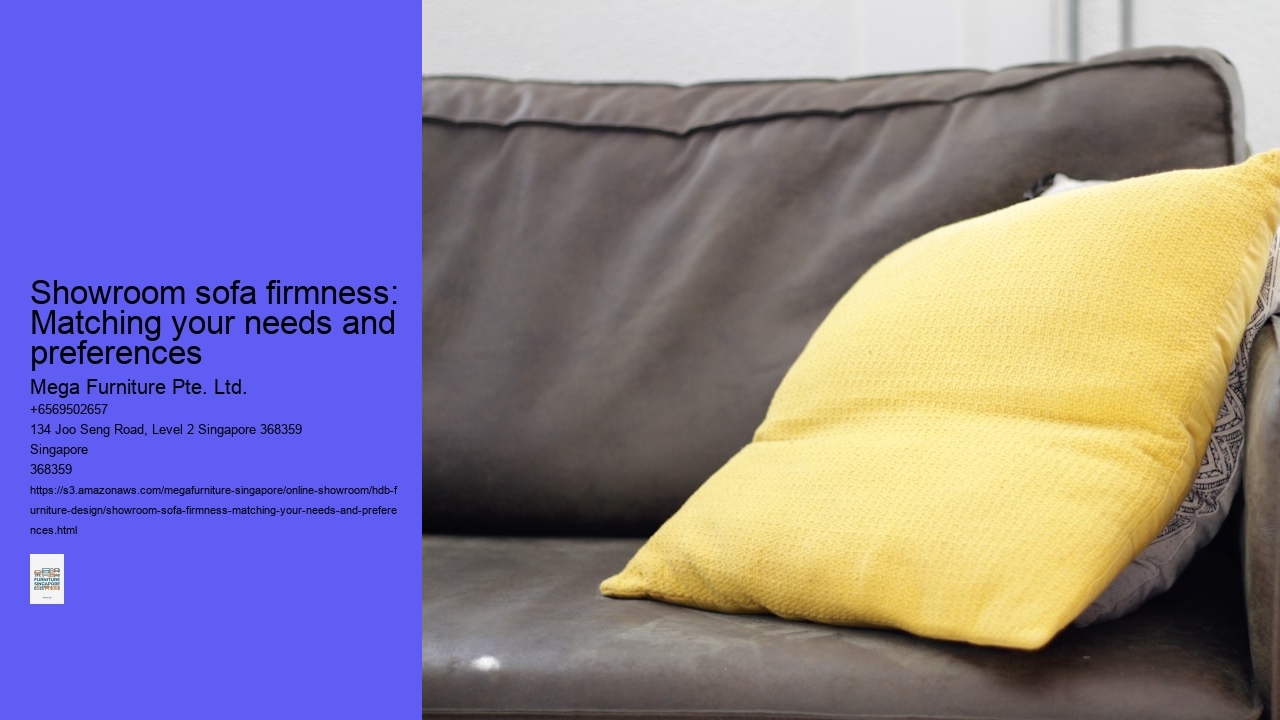
A sofa’s firmness is a tactile truth—it’s not something you can gauge from a picture on a screen. You see a plush-looking seat online and imagine sinking into soft comfort, but when it arrives in your 4-room BTO, it might feel like a rigid bench. That initial disappointment often stems from a simple mismatch: your bodyweight and the foam’s response, a relationship photos can’t convey.
In a showroom, you get to settle into that relationship. You’ll feel how your hips drop into the cushion, whether your back gets proper support, and if the seat depth suits your height. Under the typical 2.6-metre ceiling of an HDB living room, a sofa’s proportions change; a deep, low-slung model can dominate the space visually, while a firmer, upright design might keep the room feeling open. You need to test that in person.
The real test is time. Sit for a full five minutes, not just a quick perch. Shift positions—lean back, sit upright, slouch a little like you would on a Sunday evening. Notice if the cushion compresses too much, leaving you feeling unsupported, or if it stays too firm, becoming uncomfortable after a while. A sofa that feels perfect for a minute might be a torture device after an hour of watching television.
There’s one exception, of course. If you’re buying a strictly decorative piece—something meant for a seldom-used corner or purely for aesthetic balance—then firmness might be secondary. But for the main living room sofa, where you’ll spend hours each week, assuming comfort from a photo is a gamble you’ll likely regret. The showroom visit is your only chance to verify it before the delivery truck arrives at your doorstep.
A performance velvet that feels cool and crisp under your hand in a chilled showroom can turn into a clingy, warm blanket on your skin once it’s installed in a non-airconditioned HDB living room. That’s not a defect in the fabric—it’s physics. Singapore’s relentless humidity, often pushing past eighty percent, changes how materials interact with your body. In a dry, air-conditioned space, velvet’s dense fibres feel insulating but breathable. In a humid environment, those same fibres trap moisture against your skin, making the seat feel noticeably warmer and less comfortable over long sitting sessions. It’s a shift you won’t notice during a quick five-minute test in a climate-controlled retail space.
This means your fabric test should match your flat’s actual conditions. If your main living area relies on natural ventilation and ceiling fans, don’t judge materials solely in a cool showroom. Seek out a piece on display near a doorway or in a less-chilled section of the store and sit on it for a proper ten minutes. Pay attention to how the fabric feels against your bare arms and legs. That sticky, slightly damp sensation is what you’ll get at home during the year-end monsoon months. For west-facing units, also consider how afternoon sun might compound the heat retention over time.
The exception is if your home is consistently climate-controlled. If you run the aircon whenever you’re using the living room, then the showroom conditions are a fair match. For everyone else, leaning towards performance fabrics designed for breathability—even if they feel a bit less luxurious in the moment—is a smarter long-term bet. They’re engineered to manage moisture and heat better. A traditional plush velvet in a humid 4-room BTO? That’s a recipe for discomfort.
One counterintuitive tip: don’t just trust the label. Some “performance” velvets are more about stain resistance than thermal comfort. Ask specifically about breathability and moisture wicking properties. A fabric that resists spills but still feels warm won’t solve the core problem. Your best test is your own skin in a realistic environment—so find a showroom that lets you simulate your home’s climate, even if it’s just by choosing a seat away from the direct blast of the aircon.
At the three thousand dollar mark, you'll start seeing descriptions like 'eight-way hand-tied' and 'double-cone coil'. These aren't just marketing buzzwords; they refer to a specific, labour-intensive method of securing springs within the frame. Each spring is individually anchored in eight directions with twine, creating a network of support that moves and flexes together. This contrasts sharply with simpler S-shaped springs clipped to a grid, which offer a more uniform, less responsive feel. For a landed home where a sofa might host larger gatherings or serve as a daily relaxation hub for years, that difference in construction translates directly into longevity and comfort. You can't gauge that resilience from a product page photo.
The physical test is non-negotiable here. In a spacious showroom, you can sit properly, lean back, shift your weight, and even lie down across the seat. You'll feel how the hand-tied system provides graduated support—firm where your spine needs it, softer where you sink in. Compare that sensation directly to a cheaper model with standard springs; the latter often feels uniformly hard or develops a noticeable dip after a few minutes of pressure. This hands-on comparison reveals whether the premium construction actually aligns with your body's preferences. Without it, you're buying a promise, not a proven product.
A sofa's feel evolves over its first few years of use. Hand-tied springs are designed to maintain their supportive character, resisting that permanent sag in the centre that plagues cheaper units. In a landed property, where furniture isn't shuffled as often and may bear more consistent weight, this durability is crucial. You're investing in a piece that should feel nearly the same after five years as it did on day one. Testing in a showroom lets you assess the initial depth and resistance, giving you a baseline for that long-term performance. It's about predicting how it will age, not just how it arrives.
The magic of a properly executed hand-tied system lies in its interconnectedness. When you sit on one side, the entire spring grid adjusts subtly, preventing that isolated collapse that leads to uneven wear. This creates a more stable seating plane, especially important for wider sofas in open-plan landed home layouts. It's a feature that genuinely justifies the price premium, but its benefits are entirely tactile. You need to experience the way the seat cushions work with the underlying structure, not just rest on it. That integrated support is what turns a sofa into a reliable centrepiece for your living room.
Spending this amount on a sofa shifts the purchase from a functional need to a long-term investment. The showroom visit becomes the due diligence. You're verifying that the claimed engineering delivers tangible comfort that matches your lifestyle—perhaps for hosting during CNY or for nightly family movie sessions. It's the step that separates buying a luxury label from acquiring a genuinely superior product. If the sit-test doesn't reveal a clear advantage over a two-thousand-dollar alternative, then the premium isn't justified. But if the support feels distinctly deeper and more adaptive, you'll know the cost translates directly into daily value.
The worst time to realise your sofa bed's mattress is too firm is when your mother-in-law is already lying on it, complaining about her back. Most convertible sofa mattresses are thin slabs of foam that feel okay for a quick sit, but they're downright punishing for a proper night's sleep. That's why a showroom visit that lets you test the actual mattress firmness is a genuine advantage—you're not just buying a sofa, you're vetting a guest bed.
A sofa bed's primary job might be seating, but its secondary role is crucial. When relatives visit during CNY or friends stay over, you'll need that mattress to be supportive enough for a decent rest. In a typical 4-room BTO, where spare bedding often gets shoved under the main bed, having a sofa that doubles as a proper sleeping surface saves space. But you can't gauge mattress comfort from a photo or a description; you've got to lie down on it. The difference between a supportive foam and a cheap, unforgiving one is something you feel in your spine after eight hours.
Some showrooms have the integrated mattress models on display, ready for you to unfold and try. You can test the firmness options yourself—from a softer feel to a firmer support. This hands-on check avoids the classic blunder: buying a sleek sofa bed only to discover its mattress is too thin for anyone over thirty. The only exception is if you're truly only using it for seating, and the occasional overnight guest is a teenager who'll sleep on anything. Otherwise, you'll regret not testing it.
There's a practical rhythm to it. You sit on the sofa first, checking the cushion depth and fabric. Then you ask to see the bed mechanism, and you actually lie down on the unfolded mattress for a minute. Does your hip sink too far? Does it feel like you're on a board? That minute of testing tells you more than any sales brochure. It's a small step in the showroom that prevents a big headache later, when you've got a real person needing a real bed in your living room. So don't just sit—lie down. Your future guests will thank you lah.
Walk into a showroom with a cat in the house and you’ll face the real choice straight away. You want that light linen look, the airy feel that fits a modern five-room flat. But you know the claws and the occasional furball won’t respect the aesthetic. That tension isn’t just about colour; it’s about weave density and stain resistance claims, things you can only verify under real lighting.
The performance fabrics—think Crypton or similar—are engineered to repel spills and wipe clean. Their weave is tight, almost synthetic in feel, and they often come in darker tones or patterns that hide everyday marks. They’re steady for the long haul. The linen-look fabrics, with their looser, natural texture, bring that soft, lived-in elegance you’re after. But that same texture is a trap for pet hair and a snag point for claws. You’ll see the difference side-by-side in a good showroom; run your hand over both, press a damp cloth onto a sample to test the claim. The performance one might feel a bit plasticky, but it won’t kena stain so easily.
My advice leans heavily toward the tougher fabric for any household with pets. The aesthetic sacrifice is real, but the practical peace is worth it. You won’t be worrying about every little accident or scratch. There’s one exception: if your cat is famously chill, never claws furniture and you’re committed to regular, careful maintenance, then the linen-look can work. But that’s a rare scenario. For most, the trade-off tips decisively toward durability.
A specific point buyers often miss: check the fabric sample under different lights. Showroom lighting can be bright and flattering, making a performance fabric’s slightly dull sheen look acceptable. Ask to see it near a window or under a softer lamp. Sometimes that slight synthetic look becomes more obvious in your own living room’s evening light. That’s where the real choice settles.
So prioritise cleanability and density. You can find performance fabrics in textures and colours that aren’t purely utilitarian—some even mimic a linen look now. Your sofa will last longer, look decent for years, and you’ll avoid that sian feeling when a new stain appears on your favourite piece. The showroom visit is your chance to test this, not just imagine it.
A 2.4-metre sofa sounds perfectly reasonable on a website, a clean number next to a pristine image. In a Tagore Lane showroom, you get the real story. You see the 50 sqm condo layout traced out on the floor, and suddenly that L-shaped sectional isn't just a piece of furniture—it's a landmass. You realise you've got to leave space for the walkway to the balcony, for the inevitable foot traffic to the kitchen, and maybe for a side table if you're lucky. That's the first lesson a physical showroom teaches: the footprint on the floor is the only measurement that counts.
Warehouse-style outlets, with their cavernous ceilings, can distort your sense of scale. Everything looks compact, almost dainty, because there's so much empty air around it. Bring those same dimensions home to a typical 4-room BTO living room, and the proportions shift dramatically. The sofa that felt modest now consumes the entire visual field, pressing right up against the media console and leaving just a sliver of floor. You start calculating clearance not in centimetres, but in practical terms—can you still vacuum behind it comfortably, or will it become a permanent dust trap?
Then there’s the buffer zone. In a condo near the MRT line, for instance, you might want that extra metre of open floor between the sofa and the window wall to act as a psychological cushion against the train rumble. A 2.4-metre unit placed flush against the wall eliminates that possibility entirely. You need to walk around the actual piece in a showroom, not just past it, to feel how much air it displaces. Sit on one end and gauge the reach to a hypothetical coffee table; you'll know instantly if the depth is a cosy nest or an awkward sprawl.
The single case where a large sectional still works is in an open-plan layout where the living area is clearly defined and you're intentionally using the sofa to zone the space. Even then, measure the delivery path. Check the lift door width—often around 90cm—and your own corridor turns. A rigid frame that’s 2.4 metres long won't bend, and navigating a tight corner might mean paying a surcharge for staircase hauling. The showroom lets you confirm these practicalities with your own eyes, turning a speculative online purchase into a verified spatial plan.
Stepping into a showroom, you’re armed with a list of fabrics and dimensions, but the real questions that bubble up are often the ones you hesitate to ask outright. They’re the practical, sometimes slightly awkward, queries that can make or break your purchase experience.
**Sofa showroom price include GST or not?** Prices displayed on tags usually don’t show the GST—it’s added at the final invoice. That’s a standard practice across most retail spaces, from the multi-brand warehouses in Sungei Kadut to the flagship stores along Tagore Lane. You’ll want to factor that 9% into your final budget, especially if you’re eyeing a premium piece over two thousand dollars. The only exception might be if a specific promotion explicitly states ‘GST-inclusive’, but that’s rare and usually shouted from the banners.
**Can test sofa with whole family or not?** Absolutely, you can. In fact, you should. A showroom is the one place where everyone—from grandparents to kids—can pile onto a sectional and see if it truly fits the family’s habits. Staff in these spaces expect it; they know a sofa is a communal decision. Just be mindful of others browsing and avoid treating it like a playground. The real test isn’t a five-second sit; it’s spending ten minutes mimicking how you’ll actually use it at home, sprawled out or perched upright.
**Buy from showroom better or IMM outlet better?** This one hinges entirely on what you’re after. A flagship showroom often carries the full, current range, with more fabric options and the latest designs. The IMM or warehouse-style outlet might have older stock, clearance items, or simpler configurations at a lower price point. If you’re set on a specific model and want to verify every detail on a premium piece, the showroom is your best bet. For a simpler, budget-conscious purchase where you’re happy with a standard fabric, the outlet can offer solid value.
**Delivery to 4th floor HDB got extra charge?** Most free delivery offers apply only if there’s straightforward lift access. For a fourth-floor flat, that’s usually fine—the lift door width, around 90cm, is the real hurdle. If your sofa can clear that, you’re good. However, if the piece is oversized or the lift is unusually small in an older block, you might face a staircase carrying surcharge. Always confirm this before paying; a reputable retailer will outline these conditions clearly. Don’t assume, just ask—it’s a standard question they hear every day.
You’ve settled on the sofa. The colour works, the price is within your budget, and you’re ready to pay. That’s when you need to do the quiet, boring work that saves you from future regret. The showroom is your one chance to catch what a website photo can’t show. Sit on your chosen piece for a full fifteen minutes, not just a quick plop. Your body will tell you if the seat depth is truly comfortable or if that plush cushion starts to feel too firm after ten.
Get down to the details most people skip. Check the stitching on the underside and along the back—loose threads or uneven seams are a sign of rushed workmanship. If it’s a recliner, open and close the mechanism ten times. Listen for any grinding or hesitation; feel if it moves smoothly or fights you. Rest your elbow on the armrest. Is the height natural for holding a phone or a book, or does your shoulder hunch up? These are the small ergonomics that turn a showroom star into a daily nuisance.
Now, confirm the practicalities. Under the showroom’s bright lights, double-check the exact finish code on your order form against the tag on the display model. That “warm grey” can look completely different in your north-facing HDB living room. Ask about the delivery lead time for your specific neighbourhood—what’s standard for a landed house in Bukit Timah might be different for a high-floor flat in a mature estate like Bedok. Get it in writing.
The only time to rush this final check is if the showroom is about to close and the deal is a genuine, limited-time clearance. Even then, at least confirm the finish and delivery. For everything else, especially for a piece over two thousand dollars, this firming-up is non-negotiable. It’s the difference between buying a sofa and buying the right one.