CREATIVE SPACE
Aung Soe Min and
Nance Cunningham
host events at
Pansodan Gallery
CLOSEUP
yangon’s artistic revival
FAHTHAI
59
Mo Hom’s high-end creations under
the Mon Précieux label include evening
gowns that fuse traditional weaves from
various minority groups. Her offerings
include a Chin shawl transformed into
a bustier and sewn onto a flowing Shan
silk skirt and a knee-length Burmese
longyi
(sarong) that defies the centuries-
old ankle-length tradition. Mo Hom also
caters for the local market with a range
of men’s, women’s and children’s outfits
that are priced from US$7-$35. And yet
she share’s Pun’s sentiments as to the
state of the domestic industry: “Myanmar
doesn’t have a fashion industry or if it
does, I’m unaware of it.”
During the half-century Myanmar spent
under military rule, Yangon was a city
frozen in time. From 1962 to 1993, not
a single fashion show was held. The fine
arts were also suppressed, with exhibitions
requiring vetting by a censorship board.
Any works deemed unacceptable – such
as nudes or the depiction of poverty – was
simply confiscated by the authorities. Yet
behind closed doors, contemporary artists
continued to hone their craft, even though
the odds of any financial gain were slim
to none.
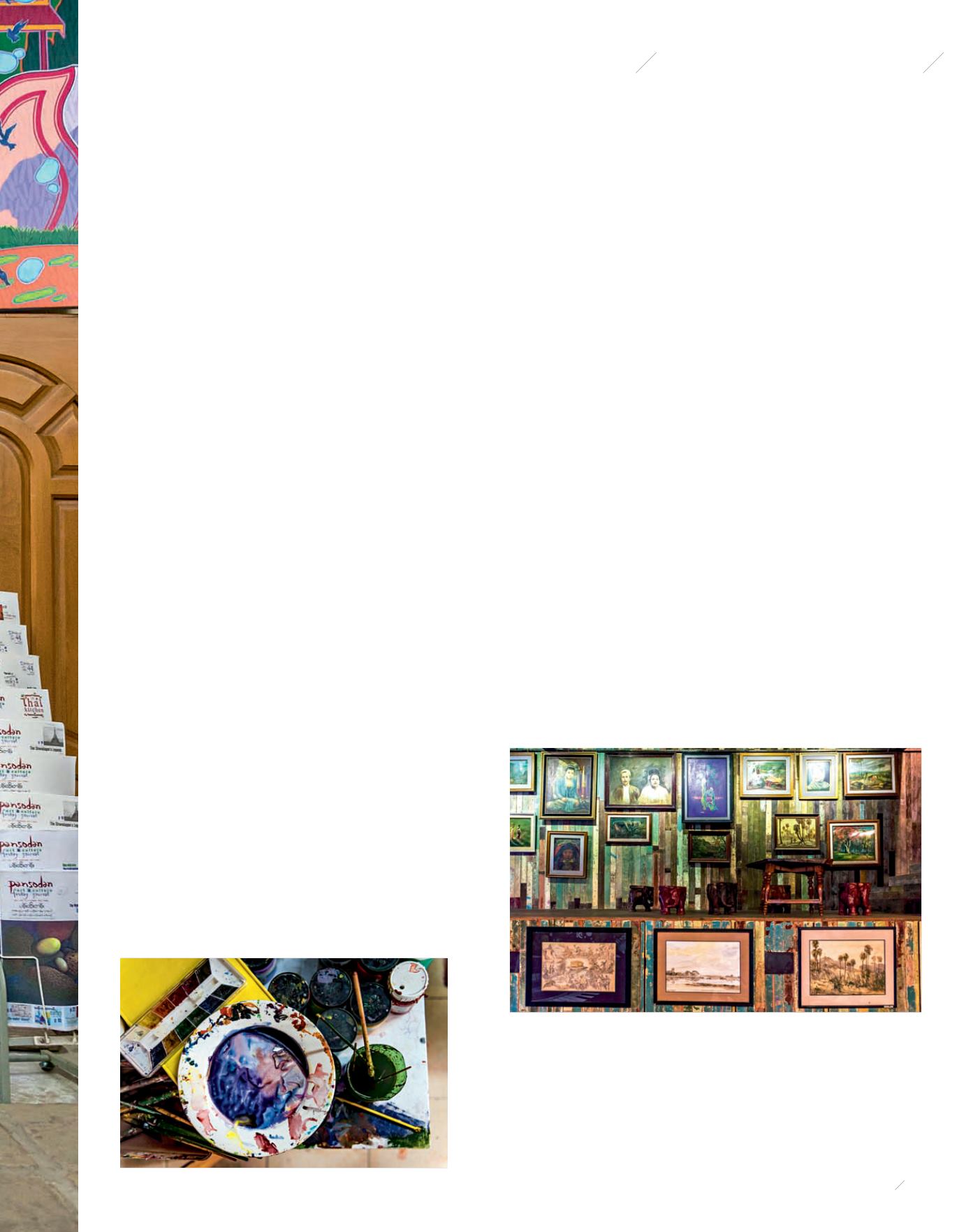
Driven by the desire to improve
the outlook for artists, Aung Soe Min
founded Myanmar’s first contemporary
art gallery six years ago. “For years after
I opened Pansodan Gallery, Myanmar’s
art market was driven by tourists and
collectors, with the latter only interested
in very famous artists,” he says. “So the
only way for artists to make a living was
to create ‘souvenir art’. I wanted to give
artists a space to do something different.”
Contemporary artist Phyoe Kyi says
the abolition of strict censorship laws in
2012 paved the way for artists to become
commercially successful. “I always made
my art freely; no government could stop
my inspiration because my approach to
art is just to do it,” he says. “But until
recently, exhibitions were scrutinised by
the censorship board before opening so
we had to follow their rules.”
Virtually every art form was repressed
during the years of socialist military rule.
“Burmese films, music and literature were
stuck in a rut because the environment
was highly restrictive and there was so
much propaganda,” Aung Soe Min says.
“Some started following international
trends such as hip hop. No one was doing
their own thing because there wasn’t a
platform for them.”
However, the recent liberalisation of
the rules has led to the blossoming of
the contemporary art scene. Gesturing
towards a collection of sculptures
adorned with welded silver spoons, Aung
Soe Min says, “These were made by a
construction worker who’s now a full-
time artist. I never saw this kind of thing
five years ago.”
Last September, Aung Soe Min and
his partner Nance Cunningham opened
a second gallery called Pansodan
Scene. In addition to art exhibitions,
the space hosts music performances by
international and homegrown artists
along with public lectures by visiting
academics. A recent lecture by Yale
political scientist James C Scott, who
wrote
Two Cheers for Anarchism
,
attracted more than 200 people.
“Lectures are free so that everyone
“For years the only
way for artists tomake
a livingwas to create
‘souvenir art’. I wanted
to give artists a space to
do something different”


