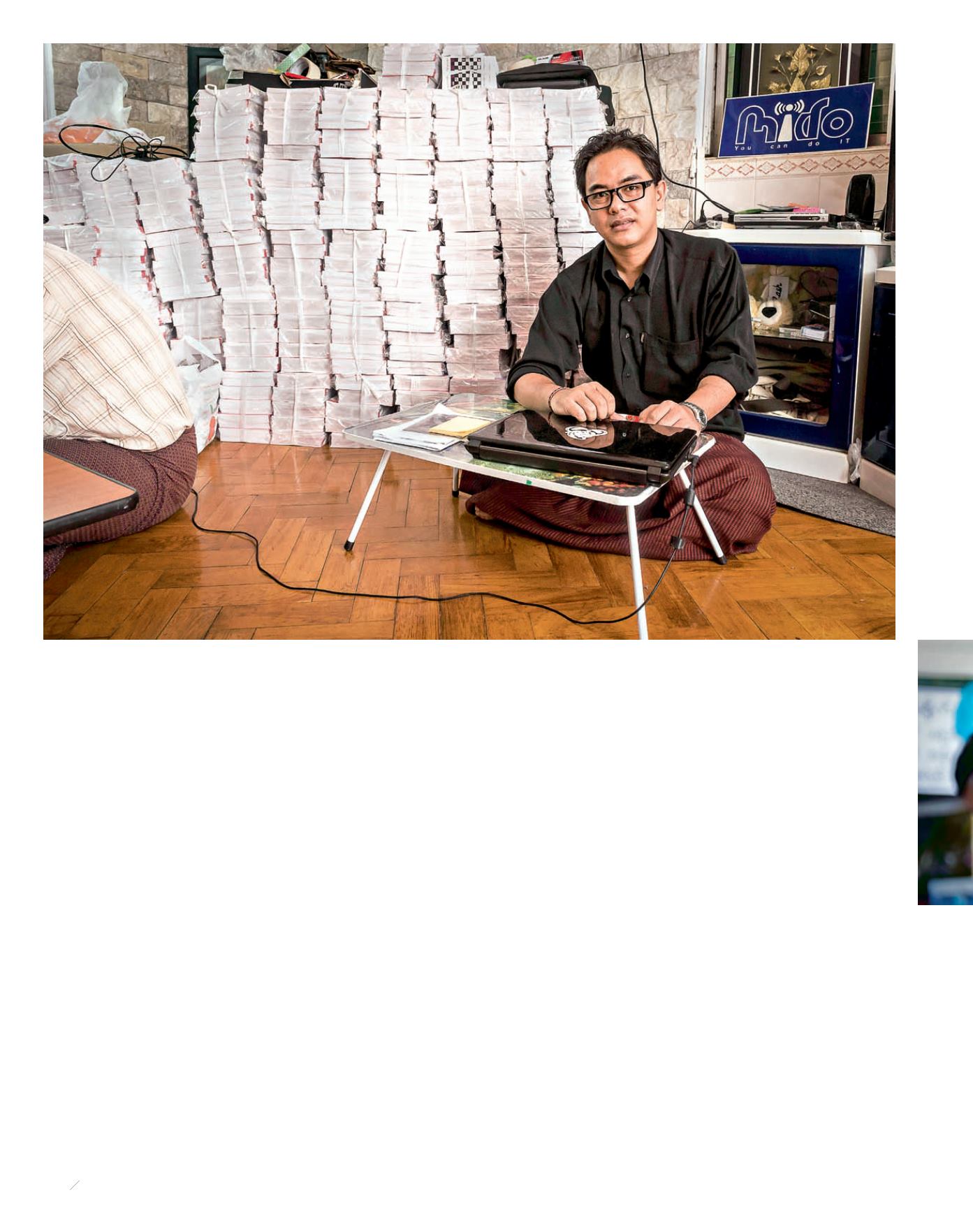
BURMESE BLOGGER
Activist Nay Phone
Latt made it onto
Time
magazine’s list
of 100 Heroes
56
FAHTHAI
stagnating,” he recalls. But when Pun
came back to stay in 2011, a wave of
change had started to break over Yangon.
“The city itself didn’t look so different; the
buildings and roads were the same but the
atmosphere had completely changed.”
Earlier this year, Pun, now 29,
launched Yangon’s first pop-up project,
Transit Shed 1 (also known as TS1) under
his firm Pun+Projects, which showcases
what’s termed as “the best of Burmese
art, food, furniture and fashion.”
“The great thing about living in
Yangon is the opportunity to do
something that might not be possible
elsewhere,” he says. “There’s still so
much that doesn’t exist here, whereas in
other cities in the region there’s already so
much of everything.”
TS1 features a contemporary art
gallery, a store selling Myanmar Made
products, international fashion brand
shops and a chic Burmese restaurant
called Port Autonomy. The TS1 gallery
has quickly established itself as the city’s
edgiest, with avant-garde installations,
performance art and open-mic nights.
The aim of Myanmar Made is to
create locally made products that fall
outside the traditional Burmese aesthetic,
which tends to be ornate, gilded and,
at times, downright gaudy. “I hate the
traditional Burmese aesthetic because I’ve
seen so much of it but I love the idea of
making things locally,” Pun says. “In an
emerging market, it’s easy to fall into the
trap of doing something that’s just good
enough. But for me there’s no fun in that.
Circumstances brought me here but I
could be living anywhere, so it would be
a mistake to compromise on what I want
to achieve.”
However, Pun is keenly aware that
rank-and-file Burmese might not be ready
to embrace all things artistic. “Some are
receptive, but not all,” he says. “Though
we’ve had a lot of really good feedback,
Yangon hasn’t matured in terms of artistic
sophistication. Certain things are more
appealing but most people are more into
food than going to a gallery. We’re just at
the tip,” he says.
This hasn’t stopped Pun from seeking
out like-minded creatives for collaborative
efforts. A serendipitous occurrence was
fashion designer Mo Hom’s return
to Yangon from New York in 2012.
She’s one of just a handful of Burmese
designers who blends the traditional with
the contemporary. One of her collections
was featured in TS1’s inaugural
Myanmar Made exhibition.
“Clothes made in Myanmar are almost
always exported and the local market
is flooded with poor-quality clothing
from China,” Mo Hom says. “There are
some local designers but their focus is
on traditional Burmese attire. I thought,
‘Why not create something using locally
woven textiles that has international
appeal?’” The designer is a member of
the Shan minority who has been based in
Yangon since 2012. She continues to sell
her Mon Précieux New York and Lotus
Hom collections in New York.


