FAHTHAI
33
STOPOVER
people
SHAPIRO'S ORIGINAL
dances have been
performed worldwide at
Vienna’s New Crowned
Hope Festival, the Hong
Kong Arts Festival, LA’s
Walt Disney Concert Hall
and New York’s Joyce
Theater among others.
SHE WAS NAMED
last year as a McKnight
International Artists
Fellow and was a recipient
in 2009 of a National
Heritage Fellowship and a
USA Knight Fellowship.
IN 2006,
she was awarded
the Nikkei Asia Prize.
PERFORMANCES CAN
be seen Tuesdays to
Sundays at the Khmer
Arts Theatre, Street 115,
Takmao, Kandal Province.
khmerarts.org
Founding
facts
Bangkok Airways
offers daily direct
flights to Phnom
Penh and Siem
Reap
Could you tell us about Khmer Arts?
I moved to California in 1991 to study dance
ethnology at UCLA and went on to meet my
husband, John. In 2002, we set up Khmer
Arts in Long Beach with the aim of helping
young Cambodian-Americans discover their
culture. At the time, I felt guilty about leaving
Cambodia because my teacher, the great Soth
Sam Om, wanted me to stay and help revive
the arts. So in 2006, we launched a new branch
called Sophiline Arts Ensemble in Cambodia.
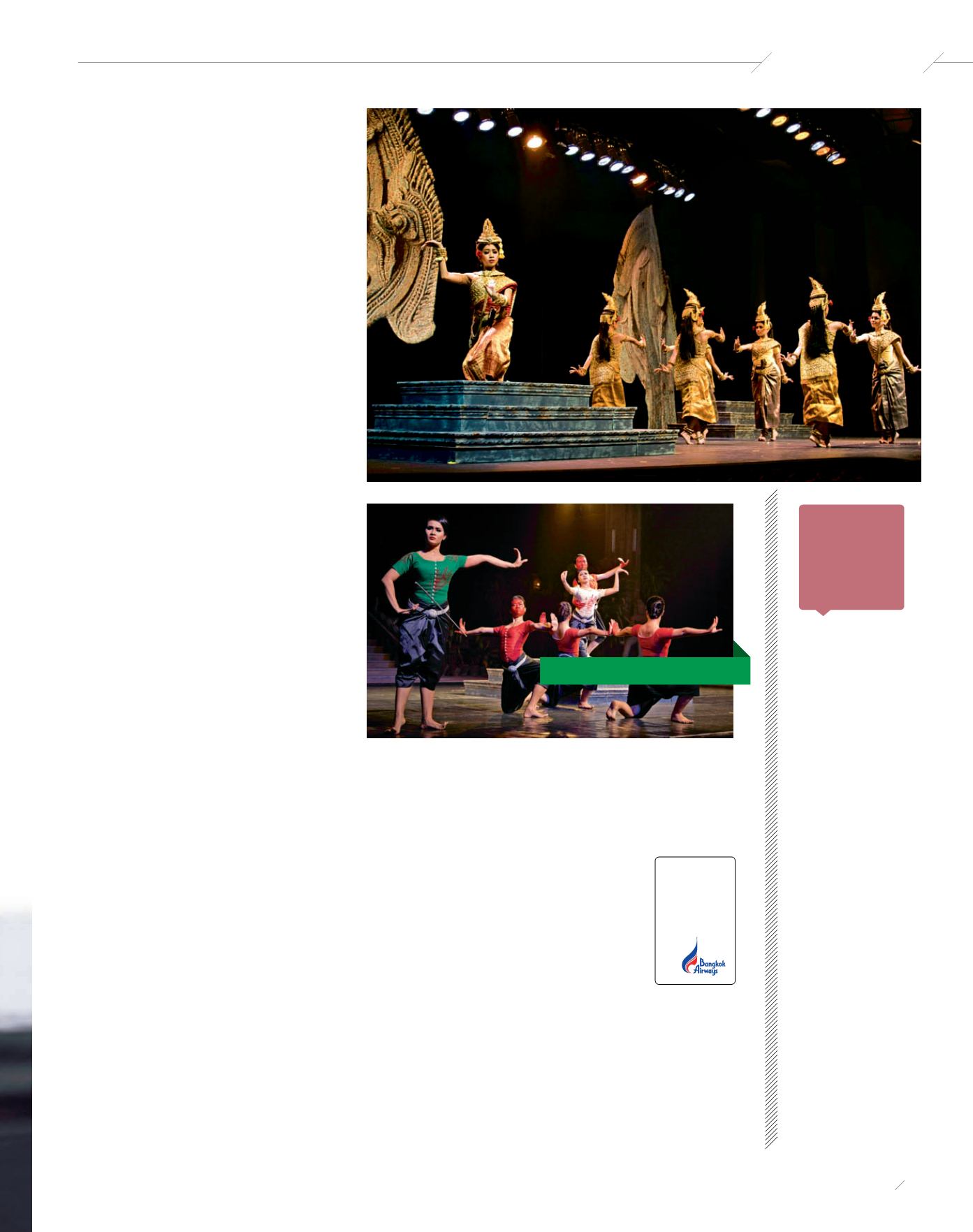
We train professional dancers in classical
and experimental dance, and produce and
choreograph performances that have travelled
the world.
What is classical Cambodian dance?
Apsara dancing is beautifully graceful.
Technically and aesthetically, it has very
slow and stylised movements. It has a secret
history relating to rituals and each dance tells
a story through subtle hand gestures and body
movements.
How important is dance to you?
Dance helps me strengthen my sense of
Cambodia and my identity. Dance is the source
of my cultural pride because Cambodian
classical dance dates back thousands of years
to the Angkor period. Dance is also a friend to
me because it always stays with me.
Why did you start dancing?
Sometimes I think to escape reality. I was
eight when the Khmer Rouge took over
and afterwards the country was absolutely
devastated and everyone was just trying to
survive. Everyone was physically nervous and
emotionally wounded and the country was a
mess. When I danced, I forgot everything. My
teachers taught me how important it is that we
revive and rebuild Cambodian culture, which
was destroyed by the Khmer Rouge. At that
time, dance gave me a sense of refinement and
that was the opposite of my reality.
How successful has the revival been?
There’s a lot of incredible talent out there and
they’re doing an incredible job of passing on
our culture to future generations. We train
many talented women and men who have
embraced both classical and contemporary
dance. They’re tuning into their creativity and
that’s amazing. I think dance in any form and
situation is important and necessary in life.
What is your inspiration?
I like to do fresh interpretations of classical
Cambodian dance movements and music by
incorporating new and innovative ideas. The
preservation of traditions is important but
so are the modern issues around us. I try to
bring new elements to the music, costumes and
dance while ensuring that everything looks
Cambodian. I want to create a contemporary
Cambodian dance culture.
What do you think about when you are dancing?
It’s like meditation for me. It’s easy to forget
about everything around me and I feel
detached and very calm.
P E R S O N A L I T Y
TEXT: MARISSA CARRUTHERS; IMAGES: ZEESHAN HAIDER


