


Page 55 - TransportationPlanUsetsGuide
P. 55
Washington County Resolution and Order 86-95
            In 1986, Washington County adopted Resolution and Order 86-95, “Determining Traffic Safety Improvements under the
            Traffic Impact Fee,” which established the process for reviewing land development applications in the County. The need
            for a distinction between safety improvements and capacity improvements initiated the drafting of R&O 86-95. The Traf-
            fic Impact Fee (TIF) adopted by the County, which has since been updated and replaced by the Transportation Develop-
            ment Tax (TDT), significantly changed the method the County uses to calculate fees to assure that developments provide
            the improvements necessary to maintain adequate levels of service for roadways. The adoption of the TIF shifted the
            basis for determining conditions of development approval from an assessment of capacity deficiencies to a determina-
            tion of when and where traffic safety improvements would be required. The basic assumption in determining necessary
            traffic safety improvements is that:


            Locations currently exist that present an unacceptable risk to the traveling public’s safety, and increasing accident expo-
            sure by significantly increasing traffic resulting from development is unacceptable without mitigation measures; and
            Significant increases in traffic resulting from development can create hazard locations that currently do not exist, and
            mitigating measures are necessary to protect the traveling public.

            For the first situation, a comprehensive analysis of accident data for county intersections was used to determine exist-
            ing hazardous locations. The top 50 percent of all SPIS scores, as established by policy of the Board of County Com-
            missioners, are defined as existing hazard locations on the premise that this would reflect a manageable number of
            locations where safety issues might be addressed.

            Metro State of Safety Report – April 2012
            The 2014 RTP includes specific performance measures/targets to track the region’s progress in achieving the regional
            goals and objectives included in the plan. The purpose of Metro’s State of Safety Report was to document roadway
            crash data, patterns, and trends in the Portland metropolitan area and beyond. It presents data on the safety of the
            transportation system within the Portland metropolitan area, and includes a number of findings and potential strate-
            gies that local jurisdictions may incorporate into their transportation system plans. According to this report, Washington
            County has the lowest rate of serious crashes (combined motor vehicle, bicycle, and pedestrian crashes) per capita
            and per vehicle mile traveled of any county in the Portland metropolitan area. Furthermore, Washington County has the
            lowest rate in the region for all injuries per million residents; and the density of crashes in Washington County is much
            lower than in other locations in the Portland metropolitan area. Additional information from this report is included in the
            Existing Conditions Report.

            Facility Conditions
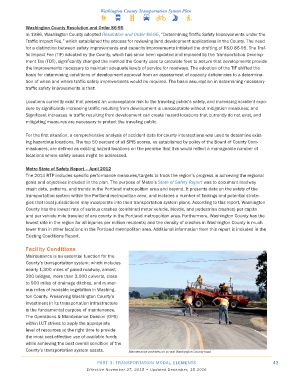
            Maintenance is an essential function for the
            County’s transportation system; which includes
            nearly 1,300 miles of paved roadway, almost
            200 bridges, more than 3,000 culverts, close
            to 900 miles of drainage ditches, and numer-
            ous miles of roadside vegetation in Washing-
            ton County. Preserving Washington County’s
            investment in its transportation infrastructure
            is the fundamental purpose of maintenance.
            The Operations & Maintenance Division (OPS)
            within LUT strives to apply the appropriate
            level of resources at the right time to provide
            the most cost-effective use of available funds
            while achieving the best overall condition of the
            County’s transportation system assets.     Maintenance activities on a rural Washington County road


                                          PART 3: TRANSPORTATION MODAL ELEMENTS                                    43
                                     Effective November 27, 2015 • Updated December, 15 2016

