


Page 12 - TransportationPlanUsetsGuide
P. 12
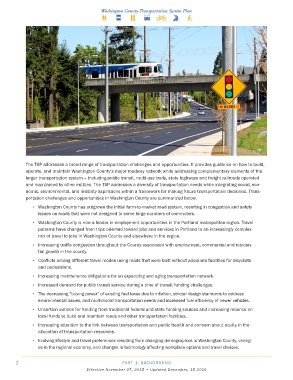
The TSP addresses a broad range of transportation challenges and opportunities. It provides guidance on how to build,
            operate, and maintain Washington County’s major roadway network while addressing complementary elements of the
            larger transportation system – including public transit, multi-use trails, state highways and freight railroads operated
            and maintained by other entities. The TSP addresses a diversity of transportation needs while integrating social, eco-
            nomic, environmental, and livability aspirations within a framework for making future transportation decisions. Trans-
            portation challenges and opportunities in Washington County are summarized below.
              •  Washington County has outgrown the initial farm-to-market road system, resulting in congestion and safety
                 issues on roads that were not designed to serve large numbers of commuters.
              •  Washington County is now a leader in employment opportunities in the Portland metropolitan region. Travel
                 patterns have changed from trips oriented toward jobs and services in Portland to an increasingly complex
                 mix of travel to jobs in Washington County and elsewhere in the region.
              •  Increasing traffic congestion throughout the County associated with employment, commercial and residen-
                 tial growth in the county.
              •  Conflicts among different travel modes using roads that were built without adequate facilities for bicyclists
                 and pedestrians.
              •  Increasing maintenance obligations for an expanding and aging transportation network.
              •  Increased demand for public transit service during a time of transit funding challenges.

              •  The decreasing “buying power” of existing fuel taxes due to inflation, stricter design standards to address
                 environmental issues, and multimodal transportation needs and increased fuel efficiency of newer vehicles.
              •  Uncertain outlook for funding from traditional federal and state funding sources and increasing reliance on
                 local funds to build and maintain roads and other transportation facilities.
              •  Increasing attention to the link between transportation and public health and concern about equity in the
                 allocation of transportation resources.
              •  Evolving lifestyle and travel preferences resulting from changing demographics in Washington County, chang-
                 es in the regional economy, and changes in technology affecting workplace options and travel choices.


        2                                           PART 1: BACKGROUND
                                     Effective November 27, 2015 • Updated December, 15 2016

