


Page 11 - TransportationPlanUsetsGuide
P. 11
Part 1 – Background


                                                             Part 1 provides information about why Washington County
                                                             has a TSP, how it is used, and the regulations and require-
                                                             ments that govern the plan’s contents. This section also
                                                             includes brief summaries of framework documents that
                                                             provide context or other information useful for the County’s
                                                             TSP; a summary of the existing transportation system and its
                                                             utilization, demographic trends, and forecasts for the year
                                                             2035; and a summary of the community input received dur-
                                                             ing the update of the TSP.


                                                             PAST, PRESENT AND FUTURE
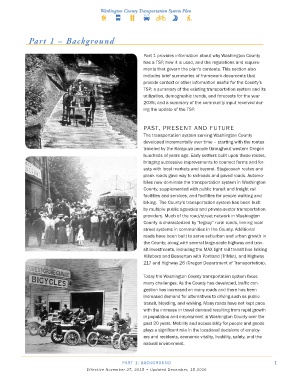
                                                             The transportation system serving Washington County
                                                             developed incrementally over time – starting with the routes
                                                             traveled by the Kalapuya people throughout western Oregon
                                                             hundreds of years ago. Early settlers built upon these routes,
                                                             bringing successive improvements to connect farms and for-
                                                             ests with local markets and beyond. Stagecoach routes and
                                                             plank roads gave way to railroads and paved roads. Automo-
                                                             biles now dominate the transportation system in Washington
                                                             County, supplemented with public transit and freight rail
                                                             facilities and services, and facilities for people walking and
                                                             biking.  The County’s transportation system has been built
                                                             by multiple public agencies and private-sector transportation
                                                             providers. Much of the road/street network in Washington
                                                             County is characterized by “legacy” rural roads, linking local
                                                             street systems in communities in the County. Additional
                                                             roads have been built to serve suburban and urban growth in
                                                             the County; along with several large-scale highway and tran-
                                                             sit investments, including the MAX light rail transit line linking
                                                             Hillsboro and Beaverton with Portland (TriMet), and Highway
                                                             217 and Highway 26 (Oregon Department of Transportation).

                                                             Today the Washington County transportation system faces
                                                             many challenges. As the County has developed, traffic con-
                                                             gestion has increased on many roads and there has been
                                                             increased demand for alternatives to driving such as public
                                                             transit, bicycling, and walking. Many roads have not kept pace
                                                             with the increase in travel demand resulting from rapid growth
                                                             in population and employment in Washington County over the
                                                             past 20 years. Mobility and accessibility for people and goods
                                                             plays a significant role in the locational decisions of employ-
                                                             ers and residents, economic vitality, livability, safety, and the
                                                             natural environment.


                                                    PART 1: BACKGROUND                                              1
                                     Effective November 27, 2015 • Updated December, 15 2016

