


Page 64 - Rural Tourism Report Washington County
P. 64
CHAPTER 3: THE WASHINGTON COUNTY RURAL TOURISM SECTOR


            4. Culinary Tourism
            Culinary tourism attracts visitors to rural areas. At the   Rural farms, businesses, and communities can benefit
            most basic level, food is a quintessential component   from the growing culinary tourism trend, and rural

            of local culture just like art, music, architecture,   tourism geared toward local food and drink can play
            film, literature, humor, and so on. What we eat,   a major role in driving economic development. As
            how we prepare it, the dishes and utensils we use,   noted within the earlier section on the County’s site
            and even the recipes passed down by our elders     research, 50 of 127 sites surveyed in rural Washington
            are all part of our area's food and drink culture. The   County were noted to host some form of culinary
            strength of the food culture in countries like France   experience. There is opportunity for growth in culinary
            and Italy is readily apparent. For example, foods   tourism in Washington County, including, but not
            such as Parmigiano-Reggiano Cheese, originating in   limited to, expanding opportunities for farm-to-table
            the northern Italian provinces of Parma and Reggio   dinners; winemaker dinners and wine tasting; cooking

            Emilia have achieved iconic importance and serve as   schools; food harvest, preparation, processing, and
            culinary ambassadors for their regions.            preservation experiences; on-site chef preparation of
                                                               self-harvested foods; and farm tours.
            According to Erik Wolf of the Portland-based World
            Food Travel Association , our region has a food-ob-
                                 54
            sessed culture. A group of 200 international food tour-
            ism industry leaders met in Portland in spring of 2015
            and confirmed the opinion that food and drink tour-

            ism is here to stay. Major local food and drink-related
            events such as the Pinot Noir, Beer, Blues, and Portland
            Taste festivals provide a major draw to visitors.

            According to the American Independent Business
            Alliance, chain restaurants recirculate only 34.5
            percent of revenue in the U.S. while locally owned
            ones recirculate 65.4 percent. In other words,

            money spent at independently owned local food
            establishments is nearly twice as valuable to
            the community because more of it stays in the
            community. According to Mr. Wolf, visitors spend
            about 25 percent of their travel budget on food and
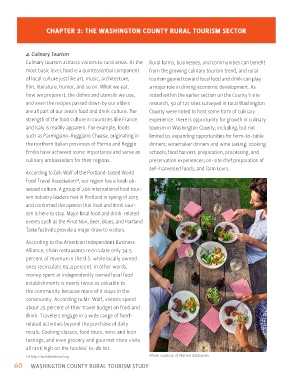
            drink. Travelers engage in a wide range of food-
            related activities beyond the purchase of daily

            meals. Cooking classes, food tours, wine and beer
            tastings, and even grocery and gourmet store visits
            all rank high on the foodies' to-do list.
            54 http://worldfoodtravel.org                      Photo courtesy of Warren Goldswain
       60     WASHINGTON COUNTY RURAL TOURISM STUDY

