



 8-9 / 72

8
9
J
agdish Swaminathan was a versatile artist, writer, and activist, and is considered one of
the stalwarts of Indian art. During his career, he explored colour, geometry, repetition and
symbolism, and his firm belief in the relevance and even superiority of folk and tribal art
was demonstrated not only in his practice – which was often inspired by such motifs – but
also in his tireless efforts to promote these art forms as a museum director. It was his ideas
that set Swaminathan apart from his contemporaries, who often borrowed inspiration from
the West.
Swaminathan was born in Simla on 21 June 1928, the sixth child in a large Tamil family. He
was a curious, even “impossible” child, and his tryst with art began early. “I was six years
old when I first smelled oil paint. My aunt, Parvati, had returned to India after completing
her studies at Leeds in 1934 and it was she who gifted me with a box of Reeves oil colours
and the smell of oil has stayed with me all through these years. Decades later when I
had a one-man show in the town of my birth my aunt went about telling everybody that
I painted much better when I was a child.” (J Swaminathan, “The Cygan: An Auto-bio note,”
J Swaminathan, Geeta Kapur, Gieve Patel et al,
Lalit Kala Contemporary 40
, New Delhi: Lalit
Kala Akademi, 1995, p. 7)
At school, Swaminathan showed an aptitude for drawing and languages – his flair for the
written word would prove to be significant in earning a livelihood – and he later joined the
pre-medical programme at Hindu College in Delhi. Being inclined towards the arts, however,
Swaminathan dropped out of college to explore other options. He became involved in
politics, initially joining the Congress Socialist Party, where he also edited the weekly Hindi
journal. After experiencing the violence of Partition, he became a part of the Communist
Party of India (CPI), and met his future wife Bhawani Pande at one of their gatherings. The
couple was married in 1955 despite the disapproval of their families. The following year,
Swaminathan resigned from the CPI and began to seek a more stable life for himself and his
growing family.
“The truth is Swami loves words as much as he loves
paint. And he likes to paint a little with words, from time
to time.”
– RICHARD BARTHOLOMEW
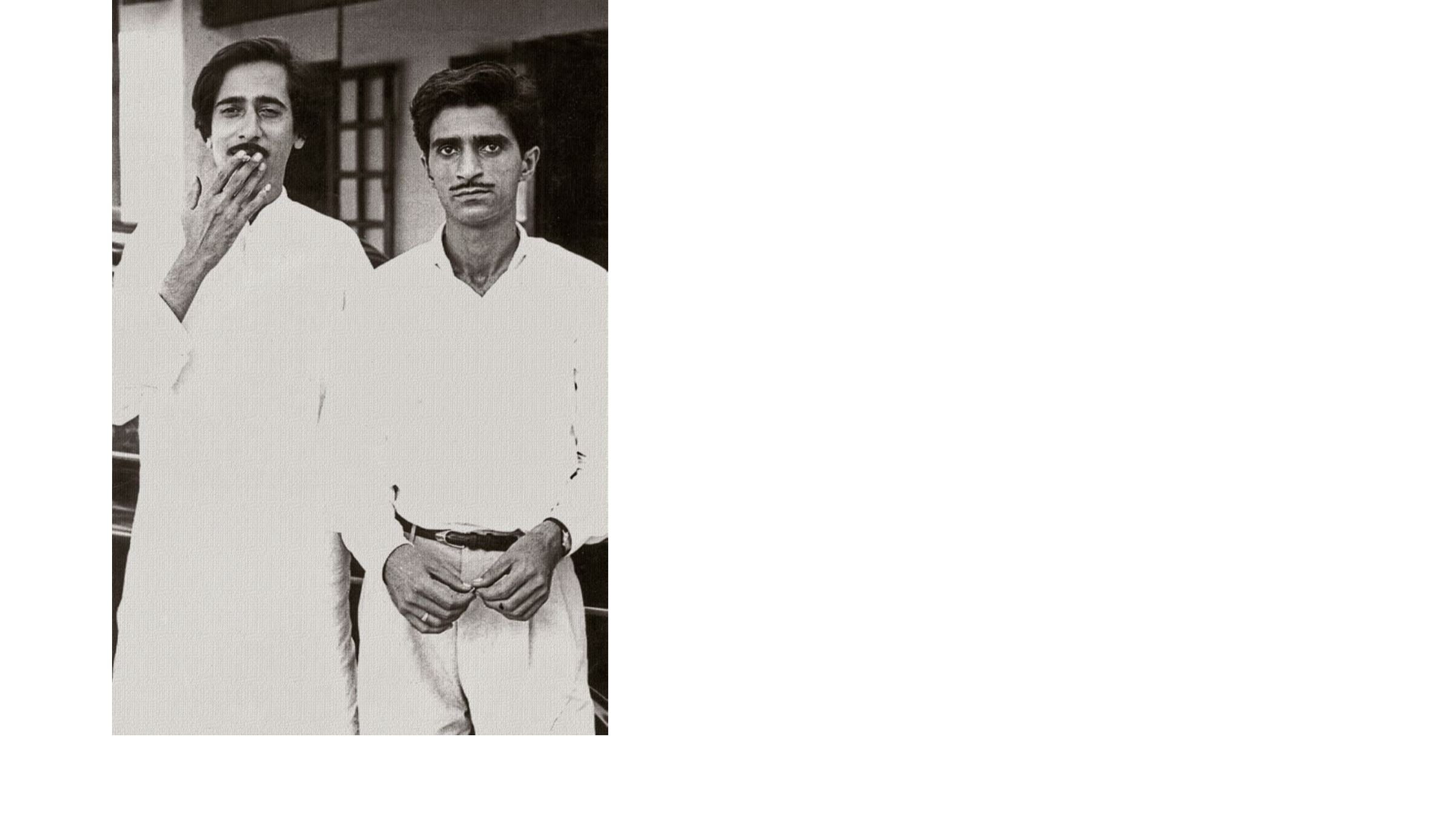
The artist with Narendra Dixit
© S Kalidas
Image courtesy of Gallery Espace