



 10-11 / 72

10
11
After their wedding, Swaminathan and Bhawani briefly visited Betul in Madhya Pradesh, and the artist considered
this a turning point in his life. He described coming across a scene in the tribal village of Korku, where a boy bitten
by a snake was being revived by a witch doctor. “This early encounter with tribal life was to have a deep impact on
my later life as an artist.” (Artist quoted in S Kalidas ed.,
Transits of a Wholetimer: J Swaminathan Years 1950-69
, New
Delhi: Gallery Espace, p. 22) It was also on this trip that Swaminathan started to “draw tentatively again,” and upon
his return to Delhi, he briefly enrolled for evening classes in the Art Department of the Delhi Polytechnic where his
teachers included artists B C Sanyal and Sailoz Mookherjea. Though he was unable to balance these classes with his
full-time job as a translator and editor at the People’s Publishing House, he continued to moonlight as a painter.
In 1958, Swaminathan enrolled in the printmaking programme at the Academy of Fine Arts in Warsaw, Poland with a
scholarship; but despite being happy there, he left before graduating because he yearned to be back with his family.
Upon his return to India, Swaminathan “launched” himself as a freelance painter, “prepared to brave all the storms
that life may brew up but determined to stick to the canvas and the brush.” (Swaminathan, Kapur, Patel et al, p. 9)
In 1960, Swaminathan had his first exhibition of prints and oils, alongside artists P K Razdan and N Dixit, which was
inaugurated by M F Husain. The positive attention he received led to a number of solo shows in the next couple of
years, and his work was collected by the likes of George Butcher, art critic of
The Guardian
. “This painting is seminal
because it precedes all neo-tantric trends in modern art,” said the artist of his own work. (Swaminathan, Kapur,
Patel et al, p. 10) In 1962, he was instrumental in calling for the need to rethink the art scene, in order to counter the
influence of Western movements such as abstract expressionism and the Paris School. According to Krishen Khanna,
“He thought that all modern painting in India since 1947 was far too concerned with the mundane physical world.
Nor did he favour any kind of revivalism. He talked and wrote about the numenous [sic] image at a time when most
artists were dealing with phenomena… He found in Paul Klee a kindred spirit as he did in the folk and tribal artists
[yet] his own work bears no formal relationship to theirs.” (Krishen Khanna,
J Swaminathan: Contemporary Indian
Art Series
, New Delhi: Lalit Kala Akademi)
Indeed, Swaminathan felt that the perspective and realism that the British tried to teach Indian artists was
misguided, and Indian artists were far more progressive. Eventually “the modern movement in the West gave up
linear perspective for two-dimensional space, a principle practised by our miniature painters and folk artists long
before Picasso was born… The use of flat areas of colour as against tonalities, the simplification and distortion of
forms to depict “meaning” instead of mere fact… the anthropomorphytic imagination functioning in our miniature
painting, the psychedelic use of colour in Tantric painting and the geometric use of space in all of our traditional
painting have one end in view: not to represent reality or even analyse it, but to create that para-natural image
which inspires man to contend with reality.” (J Swaminathan, “The New Promise,” Swaminathan, Kapur, Patel et al,
pp. 19-20)
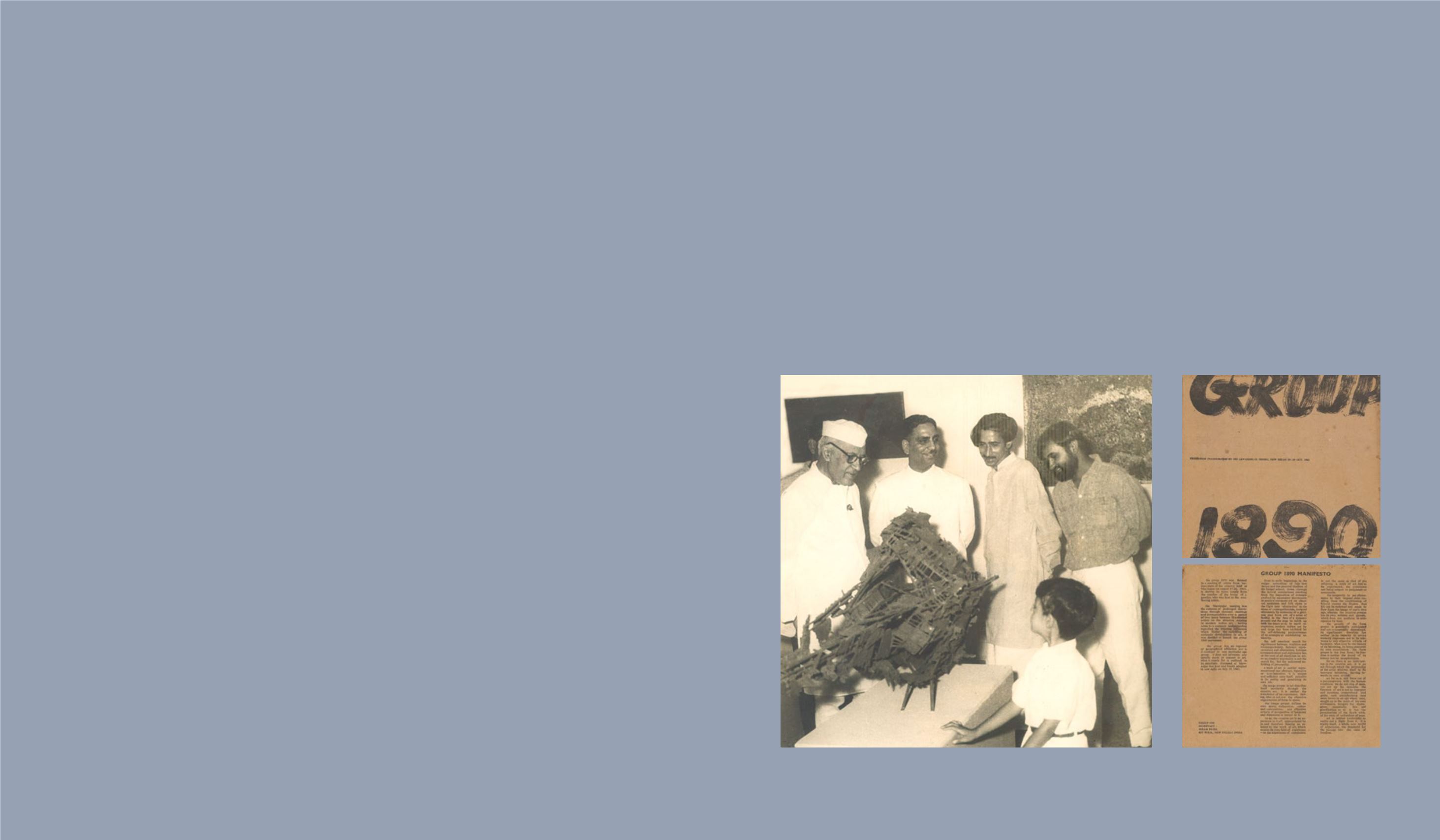
Such discussions with fellow artists led to the founding of Group 1890 on 25-26 August in Bhavnagar, Gujarat, which
included artists such as Jeram Patel, Gulam Mohammed Sheikh and Jyoti Bhatt. “The Bhavnagar meeting was the
outcome of prolonged discussions through personal meetings and correspondence over a period of two years
between like-minded artists on the situation existing in modern Indian art. Having come to a common understanding
regarding the vitiating influences which hinder the unfolding of authentic development in art, it was decided to
launch the
Group 1890
movement… To us creative expression is not the search for, but the unfettered unfolding
of personality.” (“Group 1890 Manifesto,” S Kalidas ed., pp. 70-71) The group’s only show was held in October 1963,
inaugurated by Jawaharlal Nehru and introduced by Octavio Paz – a Mexican poet and diplomat – who later helped
and encouraged Swaminathan to start a journal of art criticism titled
Contra
‘
66
.
A TURNING POINT
Raghav Kaneria, J Swaminathan and S Harsha with Prime Minister Jawaharlal Nehru
at the inaugural Group 1890 exhibition, 1963
Group 1890 exhibition catalogue, 20-29 October 1963
©
S Kalidas
Images courtesy of Gallery Espace