79
BEGINNERS’ BOTANY
NAME THAT BLOOM
Scientific names tend to sound intimidating to us non-botanists, but it helps to think of them this way: the genus name is the plant’s
last name and the species name is its first. It also helps to know a bit of Latin and Greek as these are typically used in descriptions of
an organism’s most prominent or distinctive qualities. For example,
multiflora
means “many flowers” and
fungosa
means “fungus-like”.
Sometimes the place of origin figures in a plant’s name, as in
sibuyanensis
(Sibuyan) and
philippinensis
(Philippines). The name of
a person associated with the plant may also come into play, for instance,
elmeri
(a famous plant collector), and
sanderiana
(a noted
orchid enthusiast). In all instances, the genus name must always be capitalized while the species name must be in lower-case letters.
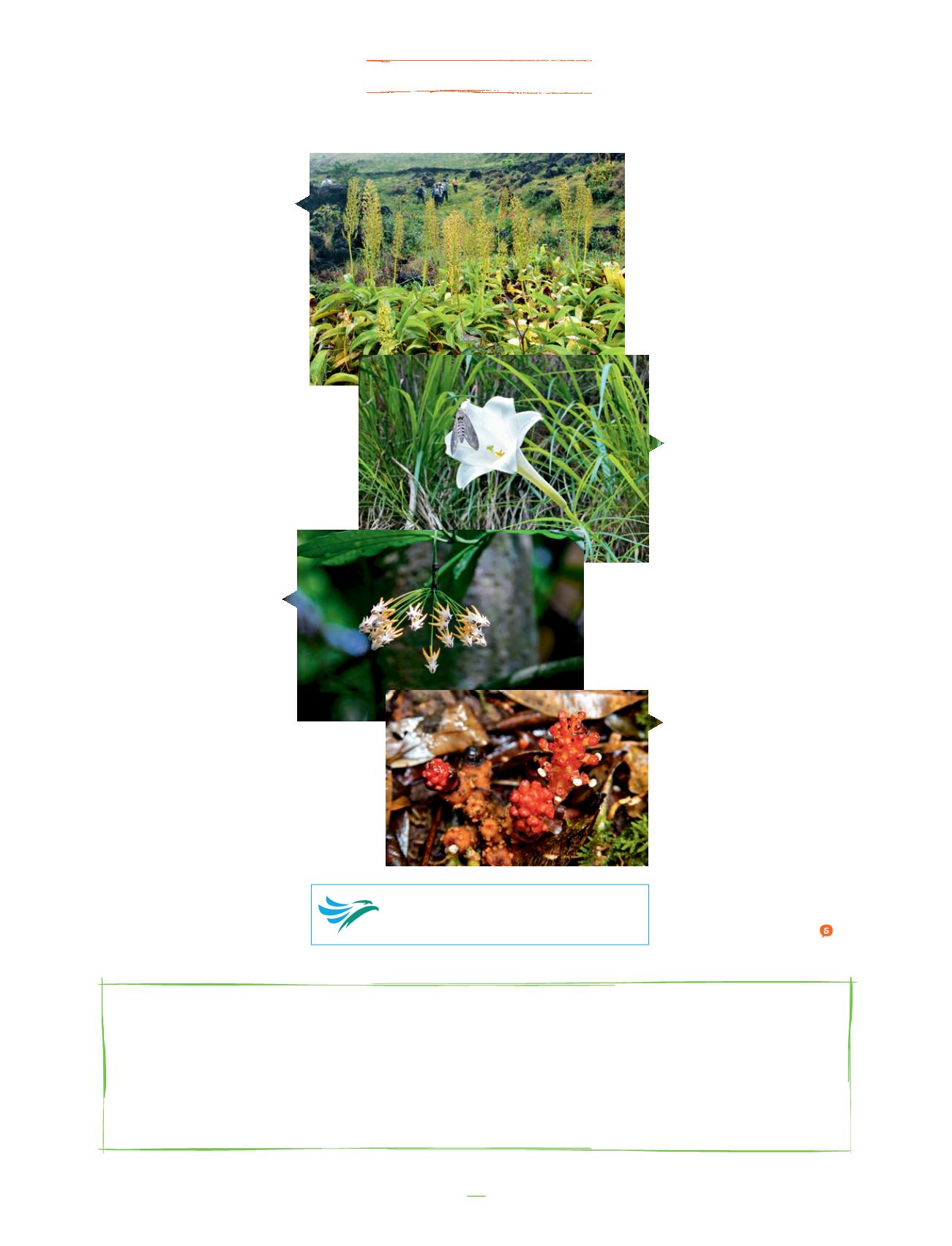
PITCHER PLANTS
Nepenthes sp.
Tropical pitcher plants are
carnivorous. They feed
by trapping insects and
invertebrates with their pitcher-
like leaves, which are laden
with digestive enzymes. These
complex evolutionary marvels,
which grow on barren terrain, are
prime evidence of the fact that
life does find a way to thrive.
The Philippines is home to a
diverse array of tropical pitcher
plants; the 40 endemic species
(and counting) account for
roughly a quarter of all known
Nepenthes varieties worldwide.
Those shown here can be
found in the Babuyan Islands.
“SHOOTING STAR”
HOYA
Hoya multiflora
This epiphytic plant (which
means it survives on nutrients
from the air and rain, and its
host plant) is typically found on
tree branches high above the
forest floor, thus its nickname. It
belongs to a genus of tropical
vines known as wax flowers,
though you won’t find it
looking as bushy as its brethren
(which are mostly clingy). The
Philippines is thought to be the
wellspring from which all Hoya
species flowed — a big deal,
considering there are more
than 120 varieties in all.
BENGUET LILY
Lilium philippinense
The Benguet lily is a true
lily with fragrant, trumpet-
shaped flowers. It thrives in
mountainous pine regions
and is known to grow in the
Cordilleras in northern Luzon
and in Taiwan. Recently,
however, Benguet lilies turned
up in the Zambales mountain
range. Of all lily varieties, it’s
said to be the one from the
southernmost tropical region.
Owing to overcollection and
limited distribution, it’s now
very rare and endangered.
BALANOPHORA
Balanophora fungosa
This bizarre plant is often
mistaken for a mushroom
or a fungus, which is why
it’s also called “fungosa”.
Like the Rafflesia, it’s a
parasitic plant that cannot
photosynthesize due to the
absence of chlorophyll. The
only time it becomes visible
is when it flowers — the rest
of the time it thrives within
its host plant. Though hardly
rare, Balanophora is seldom
seen; it remains hidden on the
forest floor until it’s ready to
reproduce. Practitioners of folk
medicine are said to value this
plant for its effectiveness in
treating various ailments.
Cebu Pacific flies to 34 domestic destinations.


