56
First of the festivals
colourfully costumed revelers
grooving their way into thousands
of postcards. The Ati-atihan has
long been the
de facto
symbol of the
fun-loving Pinoy culture, its practice
dating back at least 800 years. So
renowned is this tradition that it’s
been referred to as the “Mother of
All Philippine Fiestas”, a tribute to
its pedigree and the fact that it has
inspired countless similarly styled
occasions elsewhere.
Despite its popularity, the roots
of this fiesta are somewhat unclear,
though there are a number of origin
stories that hint at its multi-faceted
history. One version states that the
Ati-atihan was first held in 1212,
when the region’s early Malay settlers
formed a peace pact with the dark-
skinned Ati natives. Another account
goes back further, claiming that this
tradition commemorates “The Barter
of Panay”, a pseudo-historic trade
between the Ati and a group of Malays
led by 10 Bornean
datu
for the right
to live on the island. As a show of
solidarity with their new neighbors,
the newcomers were said to have
danced and smeared themselves with
soot, thus originating the festival’s
trademark. This age-old act of
mimicry is reflected in the Ati-atihan
name, which translates as “become
like an Ati”.
There’s also the Catholic angle to
the story, which holds that one fine
January morning centuries ago, the
Spaniards converted one thousand
(“
isa ka libo
” in the dialect) natives
in the name of the Santo Niño, an
event that gave the locale its modern
name of Kalibo as well as the festival’s
Christian color.
Whatever its true beginnings, this
celebration upholds a host of age-
old traditions: crowds of Aklanons
take to the streets carrying drums,
booze and images of the Santo Niño.
Occasionally they raise their voices in
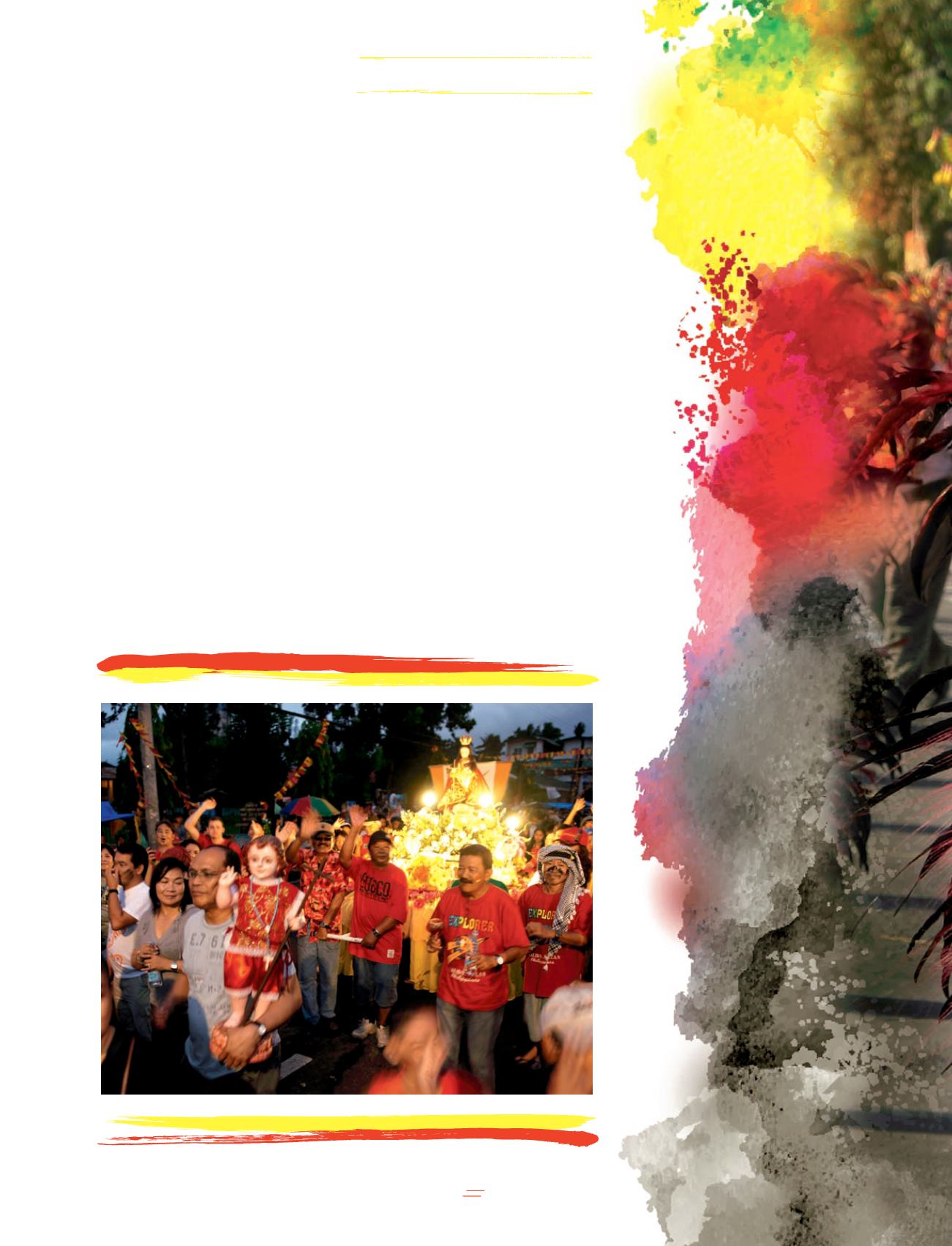
The solemn side of the
Ati-atihan can be seen
early on Saturday morning,
during the dawn procession
honoring the Santo Niño


