B E ST HOS P I TAL S
A H E M I S P H E R E S P R O M O T I O N
HEALTHCARE REFORM
“The biggest challenge for the health
industry today is responding to what’s
happening inWashington,” says Peterson.
“There’s a lot of uncertainty about who’s
going to reimburse us for our service, and
so we need to plan ahead.”
For Johns Hopkins, this entails a
two-pronged approach. On one hand, it has
to meet the expectations of the government,
employers and consumers to become more
efficient and slow the rate of cost increases,
while on the other, it must lean on its
formidable research team to help deliver
improvements in performance. “Innovation
and new discoveries informwhat we do in
care,” says Peterson.
As the industry adapts to the new
legislation, there has been a clear shi from
the old fee-for-service model of care, which
was a significant contributory factor in the
nation’s excessive healthcare spending.
Instead, a more value-based model has
been established in which a hospital is
accountable for its patients, and federal
payments reflect the balance between
treatment outcomes and cost.
“Quality and safety will continue to be
the most important factors in healthcare
delivery as hospitals are held accountable
for hospital-acquired conditions and
complications that result from unsafe
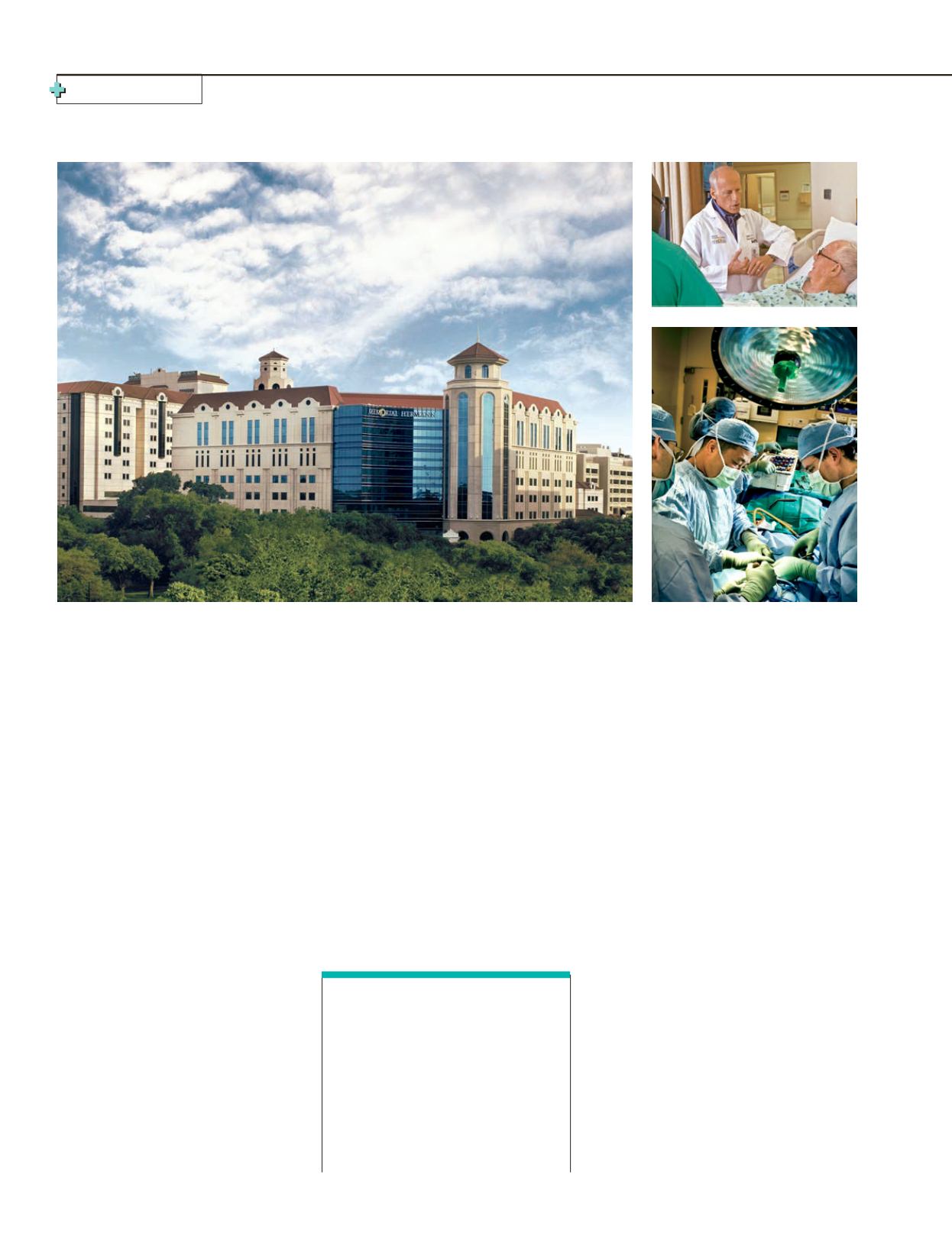
care,” says Dr. Dong Kim, director of
Memorial Hermann’s Mischer
Neuroscience Institute in Houston—the
city’s market share leader for treatment of
brain-related conditions.
The hospital has taken great strides
towards this newmodel of healthcare,
reducing observed-to-expected mortality
by 50 percent since 2007 and overseeing
three consecutive years of declining
surgical site infections, despite higher
patient acuity and increased volumes.
“We’re proud of the advances we’ve made
and will continue to provide the highest
level of care to our patients,” says Kim.
Down the road, HoustonMethodist has
made a similar pledge. “Our commitment to
lead medicine is what allows us to provide
patients with the best possible experience
regardless of the changing medical
landscape,” says Boom. He explains that the
mission is to provide quality care framed by
integrity, compassion, accountability, respect
and excellence. “The I CARE values are
modeled by every employee and physician,
who try to live them every day.”
At Cincinnati Children’s Hospital, a great
deal of consideration is given to how a
patient navigates their treatment. “We use
an integrated team approach to make
science count for our patients,” says Dr.
John Perentesis, co-director of the Cancer
and Blood Diseases Institute. “This includes
perfecting our safety programs to, for
example, lower the risk of chemotherapy.
We have collaborated with consultants in
the airline and nuclear power industries to
reduce errors in human factors. In many
ways, the hospital is similar to a United
Airlines cockpit.” This approach has not
gone unrewarded, with the
U.S. News &
World Report
ranking Cincinnati Children’s
as the best children’s hospital in the country
TRANSPARENCY
AND EASE OF TRAVEL
HAVE CREATED A
COMPETITIVE MARKET
IN WHICH HOSPITALS
HAVE TO INNOVATE
TO SURVIVE


