Paris’s Royal Monceau
Raffles, proudly
publicise they serve
only “Pierre Hermé
desserts”.Having
observed the level of
care that goes into
every creation, during
an earlier masterclass
in Hermé’s test kitchen, I don’t blame them.
“He spends a long time sourcing the very best ingredients
from around the world,” one of Hermé’s chefs tells me as he
adds what will be the fifth layer – candied Sicilian lemon –
to a
choux infiniment citron
(choux buns with four kinds of
lemon), “and he’ll never add something just to make it look
pretty. Only if it adds to the flavour.”
The arrival of a plate of macarons from Hermé’s new Jardin
range interrupts my thoughts. It’s the moment of truth. Just
how good are they? Crunchy on the outside, gooey in the
middle, the apple, mint, cucumber and rocket creation
collapses satisfyingly in my mouth. I’m left astounded by just
how clearly every ingredient comes through. It’s…
“Not perfect,” Hermé gruffly corrects me. “I hate
perfection. Everything can be improved.” I should have
expected nothing less from a man so notoriously pedantic
when it comes to detail. “It’s a good thing,” he eventually adds
with a grin. “It means my work is never done.”
SWEET SPOT
01
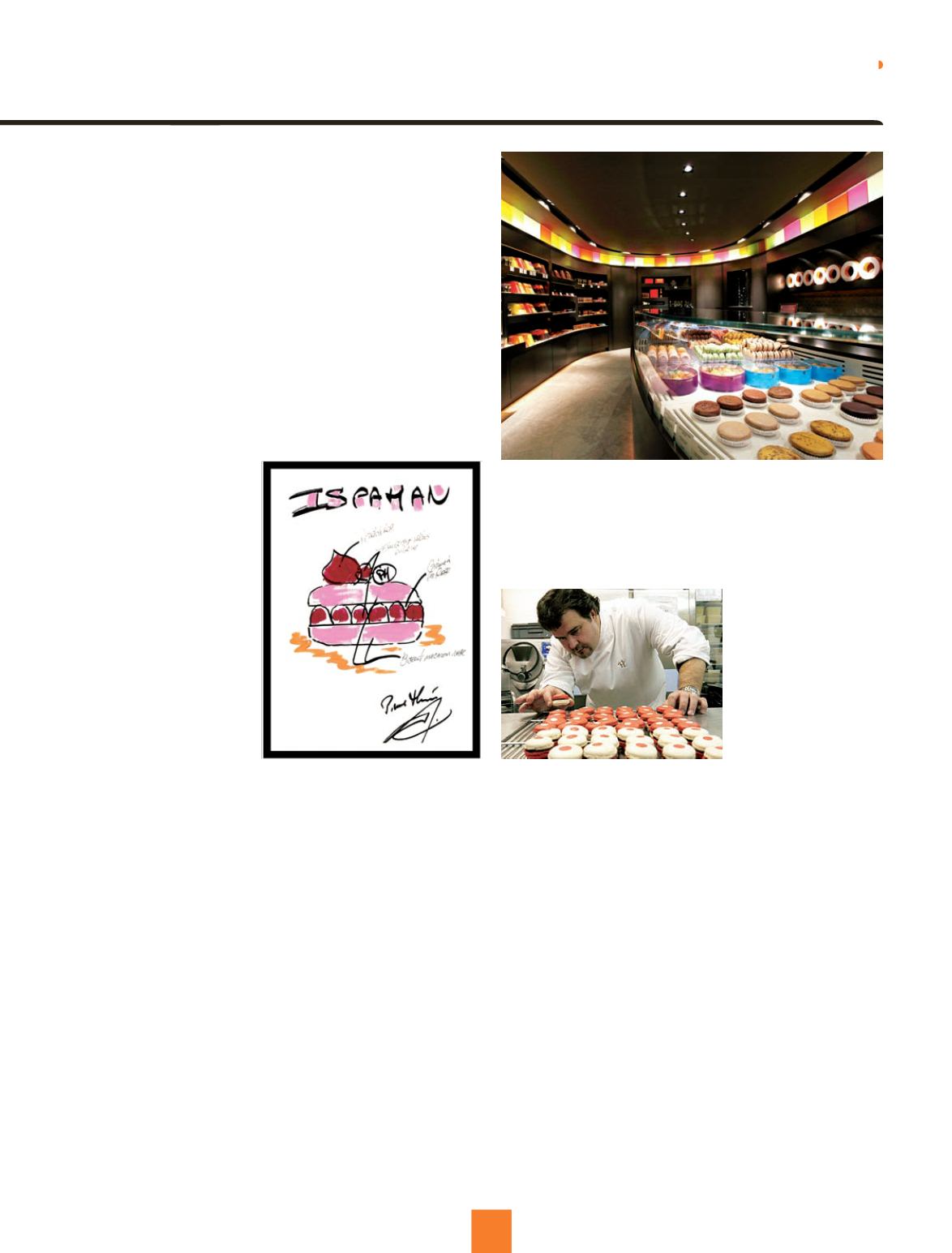
There’s nothing basic
about these macarons
02
An early sketch
03
Pierre Hermé
boutiques ooze luxury
04
Good isn’t good
enough for Hermé
Certainly, there’s much that is exceptional about what he
does. I’m spending a day with the ‘Picasso of Pastry’, as he
was once dubbed by
Vogue
, and we’ve just finished a tour of
one of his flagship stores. More like jewellers’ shops than
bakeries – hence the fact they’re referred to as boutiques –
these house rainbow displays of chocolates, pastries and
cakes, lying seductively under glass. Prices are jewellery-like
too; his macarons command anything up to €72 a kilo.
The almond-sweet aroma is still on my clothes as Hermé
pulls out a notebook, crammed full of annotated sketches. He
explains that when he gets an idea – which can be inspired by
“everything” – he immediately jots it down. “I have the
capacity to imagine the final taste,” he adds.
Growing up above his family’s bakery in France’s Alsace
region, Hermé says he
knew by the age of
nine he wanted to
become a pastry chef.
“It was my life,“ he says
with a shrug. “I often
helped my father in
the kitchen.”
At age 14, he tried
his first macaron as an
apprentice under
acclaimed pâtissier
Gaston Lenôtre, but
found it “too sweet”. It
wasn’t until he joined
French gourmet
food company Fauchon, at 24, that
the experimenting really began.
Starting with flavours such as lemon
and pistachio, Hermé spent hours
playing with combinations, before
creating what was to be his
signature: a mix of rose, raspberry
and lychee. It bombed.
“We sold very few,” the chef admits, “but I always thought
it was an interesting combination, so kept developing it.”
Ten years later, “everyone” was flavouring their products
with rose. “Yes, I think I had a lot to do with that,” he nods.
It’s the kind of attitude that helped the Frenchman launch as
a luxury brand, rather than “just another pastry shop”. Since
opening his flagship Tokyo store in 1998, 32 boutiques have
popped up across the world and the brand has expanded
beyond chocolate and pastries. It now includes products such
as jam, tea and bespoke cooking utensils. Some hotels, such as
02
03
“Their creation has become an
art-form, with ingredients such as
white truffle, caviar and cigar”
04
PHOTO
GETTY
0 3 7
R E G U L A R S


