Basic HTML Version



“Paris is one of the
most dynamic
culinary cities”
48
|
TRAVELLER
cooked in butter and lemon juice, and a shellfish sauce.
It’s a dish of many components, and for a restaurant
obsessive like me, it’s fascinating to see just how much
preparation goes into each separate element.
“It’s important that every part is carefully cooked
and has a good flavour,” says Morat, who has showed
us how to ‘turn’ (prepare) artichokes we then braise
with onion, carrot, stock, white wine, olive oil and
herbs. “Even the garnish should be superb and take
a lot of work.” The artichokes form the base to our
starter, which uses the ingredient three ways: cooked
as above; raw and in a vinaigrette; and sliced very
thinly and deep fried to form artichoke crisps.
This dedication to quality and perfection at every
stage is something that defines the Ducasse brand –
from the haute cuisine of his fine-dining restaurants
to the more rustic fare of his Aux Lyonnais bistro and
his seafood restaurant, Rech, both in Paris.
The previous night we had enjoyed a meal (in the
interests of research, of course) at his three-Michelin-
starred restaurant in the Plaza Athénée hotel – one
of the most exclusive dining experiences in the
French capital – but Paris is also a city where you can
feast on a budget, thanks to its confluence of delis,
cafés and buzzy, down-to-earth bistros. Ducasse
is as enthusiastic about the latter as he is of the
fêted temples of haute cuisine, citing the affordable,
legendary Montmartre favourite Chartier (
bouillon-
chartier.com
), a vast brasserie where orders are written
in biro on the paper tablecloths and plates of bubbling,
greasy, garlic escargots are gobbled with gusto and
washed down with carafes of table wine.
Or there’s Bistrot Paul Bert (
18 Rue Paul Bert; tel:
+33 (0)1 4372 2401
), where the seasonally inspired
menu and pre-war décor are classically Parisian.
The city’s newest dining trend, which Ducasse
places alongside haute cuisine and the traditional
eateries, is the emergence of talented young chefs who
have bewitched diners with their funky restaurants
and creative cooking. The ‘bistronomy’ movement,
as it’s been branded, is a new breed of restaurants
that aren’t grounded in classic French cuisine, but are
producing exciting, affordable food in an environment
that’s more relaxed than at most high-end eateries.
Restaurants like Chicagoan chef Daniel Rose’s
market-driven Spring (which, due to its popularity,
FEATURES
|
PARIS
was forced to move to a bigger site on Rue Bailleul,
springparis.fr
), where the menu changes constantly
and features such creations as veal ‘candy’ cooked
sous-vide (
in a water bath
)
with butter-poached
heirloom beets. Or there’s the effortlessly cool Le
Chateaubriand (
lechateaubriand.fr
), which currently
holds the title of ninth Best Restaurant in the World,
according to
Restaurant
magazine. According to
Ducasse, these places have brought a “new energy”
to the Paris scene. “They have a personal and very
creative cuisine interpreted by talented young chefs,”
he says. “It’s a really interesting movement. There
are about 25 places to try, to feel the pulse of how
Parisian cuisine is evolving.” Le Chateaubriand is run
by Basque chef Inaki Aizpitarte, who last year opened
its little sister tapas bar, Le Dauphin, next door, where
Ducasse suggests enjoying a “nice aperitif ” before a
fixed-price supper at Chateaubriand, which costs €45.
It’s not all about French food. Ducasse is inspired by
international influences, and his book features the tiny,
Franco-Japanese Yam’tcha (
4 Rue Sauval;
tel: +33
(0)1 4026 0807
) in the Les Halles area. Ducasse has
three restaurants in Japan, one of which – Beige, in
Tokyo – Morat worked at for a year. “You only get one
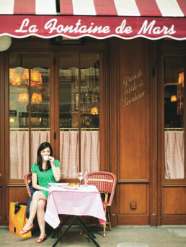
Right,
for a taste of
traditional Parisian
fare, try La Fontaine
deMars;
far right
,
Paris’s Pont
d’Arcole, connecting
Place de l’Hôtel de
Ville and the Île de la
Cité;
bottom right
, a
heavily laden table
at LeChateaubriand,
currently the ninth
best restaurant in
the world