JANUARY 15 2009
AMERICANWAY 63
ALLENST. JOHN’S
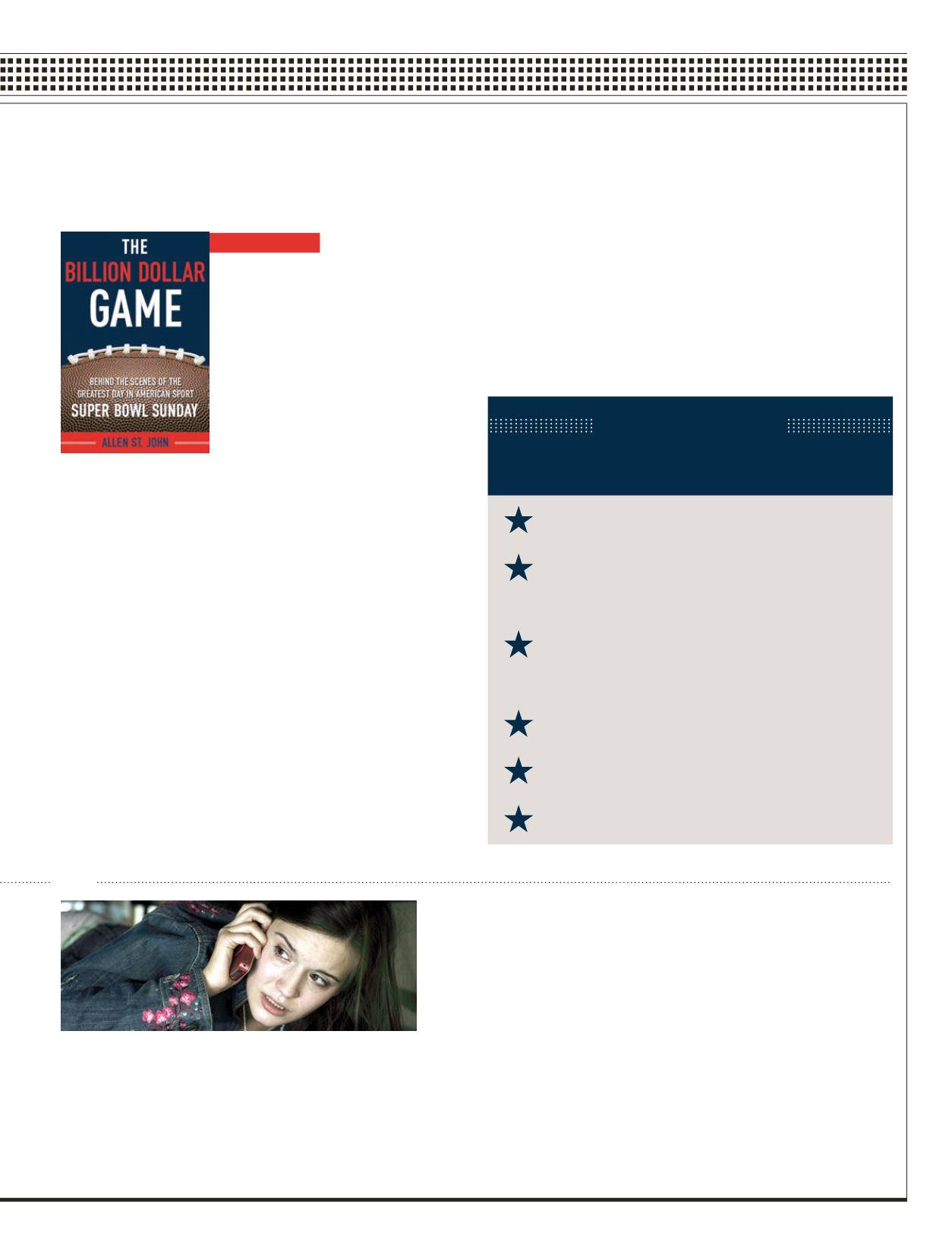
biographyof theSuperBowl,
titled
TheBillionDollarGame: Behind-the-Scenes
of the Greatest Day inAmerican Sport—Super
Bowl Sunday
(Doubleday, $25), is like the event
itself in that it’s aboutmuchmore than just foot-
ball. In 21 addictive chapters, St. John, a former
sports columnist for the
Wall Street Journal
,
offers information and behind-the-scenes an-
ecdotes about the history of what has become
the largest (andmost profitable) annual sporting
event in theworld.
“It’s America’smostwidelywatched live tele-
vision broadcast,” hewrites. “It’s theworld’s biggest party.”
But, as he points out in the book, it hasn’t always been this way. The game
started simply as a championship game in 1967 between the Kansas City Chiefs,
then amember of the now-defunct American Football League, and the National
Football League’s GreenBay Packers, who came out victorious. NFL Films’ Steve
Sabol remembers that it took years for the game to get its footing. As an exam-
ple, he tellsof the timehearrived inNewOrleanswithhiscrew forSuperBowl IV
in 1970. There, he learned that half their hotel rooms hadbeengiven toattendees
of a visiting dry cleaners’ convention. “In the public’s mind, the NFLwasn’t that
big of a deal,” he’s quoted in the book as saying.
Such dismissal is laughable in retrospect, given today’s intense competition
to host the Super Bowl and the estimated $2.5 billion bottom line of last year’s
game in Arizona. That figure includes host city Glendale’s preparation expenses,
television-broadcast rights, advertising and sponsorships, legal betting inLasVe-
gas, and consumer spending. Super Bowl Sunday is the second-largest food con-
sumption day in the United States, coming in after Thanksgiving; approximately
49.5millionpoundsof avocadosareconsumedonSuperBowl Sundayeveryyear,
enough to fill a football stadium 19 feet deep. As St. Johnwrites, “If the Super
Bowl were a nation, it would have a gross domestic product about the size of
NorthKorea, and its economywouldbe larger than that of 49 nations.”
St. Johnbelieves it’s theevent’s sheer size— the result of years of preparation
so a lotwould change aswewent along,” she says.
Those last-minutechangesoften included the fate
of the characters, andGrace’sShannonwas killedoff
the show in 2005. Though her days of shooting in a
tropical paradisewereover (save foraguest appear-
ance on
Lost
in 2007), she had little time to lament,
as before long, she was off to Paris to film
Taken
,
a Luc Besson–helmed thriller that
hits theaters this month. Grace
had no qualms about some of the
darker themes the film deals with
— her character is kidnapped and
sold into a slave trade — but she
was nervous about working along-
sideHollywood heavyweights like LiamNeeson, who
plays her father. Thankfully, Neeson proved a kind
and considerate costar.
“My fears were quelled right away,” Grace says.
“He’s sowonderful.”
Once shootingwrapped, Gracewent toLondon to
work on
Malice inWonderland
, a dark take on the
Lewis Carroll classic
Alice in Wonderland
. “I was
the onlyAmerican in the cast,” says Grace, who had
trouble shakingher slightBritishaccentafterfilming
was completed. As thenameof theproject suggests,
viewers shouldn’t expect any Disney fairy tales. “It’s
amodern-day twist on the tale, with adult themes,”
she explains. “It’s definitely not for kids.”
For now, Grace is catching her breath between
projects — she’ll be in NewMexico later this year
to film her next movie, a heist film called
Catch .44
.
With this little bit of downtime, she can finally take
amoment to reflect onher success from thecomfort
of her house in Los Angeles. It’s a long way from
suburbanOhio, but it’s starting to feel like home.
Taken
WithSuperBowlXLIII rightaround thecorner, authorAllenSt. John
uncovers the history of the biggest game in sports in his revealing
newbook. ByNatalieDanford
GameTime
Football is agame of numbers, andAllenSt. Johnhelps
readers add themup in
TheBillionDollarGame
. Here’s a sampling
of some of themore surprisingfigures he uncovered. —N.D.
SUPER STATS
by eachhost city— thatmakes theSuperBowl anAmerican icon. Butwith such
a spectacle comes the potential for spectacular failure as well. “The more you
hear about all the near misses and all the things that could have gone wrong,”
St. John said in a recent phone interview, “the more amazing it is that it works
theway it does.”
Sowith his tireless research, does St. John have a prediction for nextmonth’s
SuperBowl XLIII andhow itwill stackupagainst previous years’ contests? “Just
one,” he says. “Itwill be bigger.”
2.7MILLION:
72,000:
10,000:
25:
20:
0:
Cost indollars of airinga commercial dur-
ing the2008Super Bowl.
Number of Macintosh computers sold in the first
100 days after Apple’s George Orwell–inspired commercial aired
in 1984, a50percent increase over projected sales. The ad is con-
sidered thefirst Super Bowl advertising event.
Number of cans of food used to build replicas of the
University of Phoenix Stadium, where 2008’s Super Bowl XLII
was played, and replicas of the helmets of the two participating
teams. (The canswere later donated to charity.)
The percentage of Super Bowl tickets that the NFL retains
for distribution to sponsors and other VIPs.
The percentage increase in antacid sales on the day after
theSuper Bowl.
Extant copies of the television broadcast of Super Bowl I.


