71
OCTOBER 1 2007
AMERICANWAY
a biodegradable wool blend. Previously,
trimmings frommaking fabric chairs were
treated as hazardous waste. Now they’re
used asmulch.
The Chinese government has hiredMc-
Donough to help design seven new cities.
He’s identifying new, nontoxic building
materials and creating efficient heatingand
cooling systems. He’s suggested putting
displaced farmland on roofs and using so-
lar panels on land that is otherwise useless
in order to greatly increase the amount of
clean energy.
For the HermanMiller company, he de-
signeda factory that isheatedandcooledby
solar power, thereby cutting its energy costs
by 30 percent. For Palm, in Silicon Valley,
his campus design features large windows
fordaylight and freshair, aswell as outdoor
terraces for working. “If I get 10minutes a
day of better performance from people in
the newworkspace, I’ve paid for the entire
building in 10years,”he says.
In
Cradle to Cradle: Remaking theWay
We Make Things
, the groundbreaking
2002bookhewrotewithGermanenviron-
mentalist and chemistMichael Braungart,
McDonough argues that growth is good,
evennecessary: Just look at nature’s abun-
dance.McDonough’s viewpoint isonemost
environmentalistswould abhor. But he be-
lieves growth can be sustainably designed
using newmaterials that can be upcycled,
meaning recycled into better products
rather than into products that add more
toxicmaterials.
“Most environmentalists feel guiltyabout
how society behaves, so they saywe should
make longer-lasting products— for exam-
ple, a car that lasts 25 years. That car will
still use compound epoxies and toxic adhe-
sives, but theecological footprint is reduced
because you’ve amortized it over a longer
time,”McDonough told
Newsweek
in2005.
“Butwhat’s the result?You lose jobsbecause
people aren’t buying as much, and you’re
using the wrong technology longer. I want
five-year cars. Then you can always be get-
ting the newest car—more solar-powered,
cleaner, with the newest air bags and safety
features. The old car gets upcycled intonew
cars, so therearestillplentyof jobs.Andyou
don’t feel guilty about throwing the old one
away. Peoplewantnew technology.”
Designing products that way creates a
virtuous circle that appeals to both sides of
the green divide. “Our idea is tomake pro-
duction so clean, there’s nothing bad left to
regulate,”headded. “This isextremely inter-
esting to people of all political persuasions
—thosewho lovetheenvironmentandthose
whowant commerce freeof regulation.”
GRETCHENDAILY
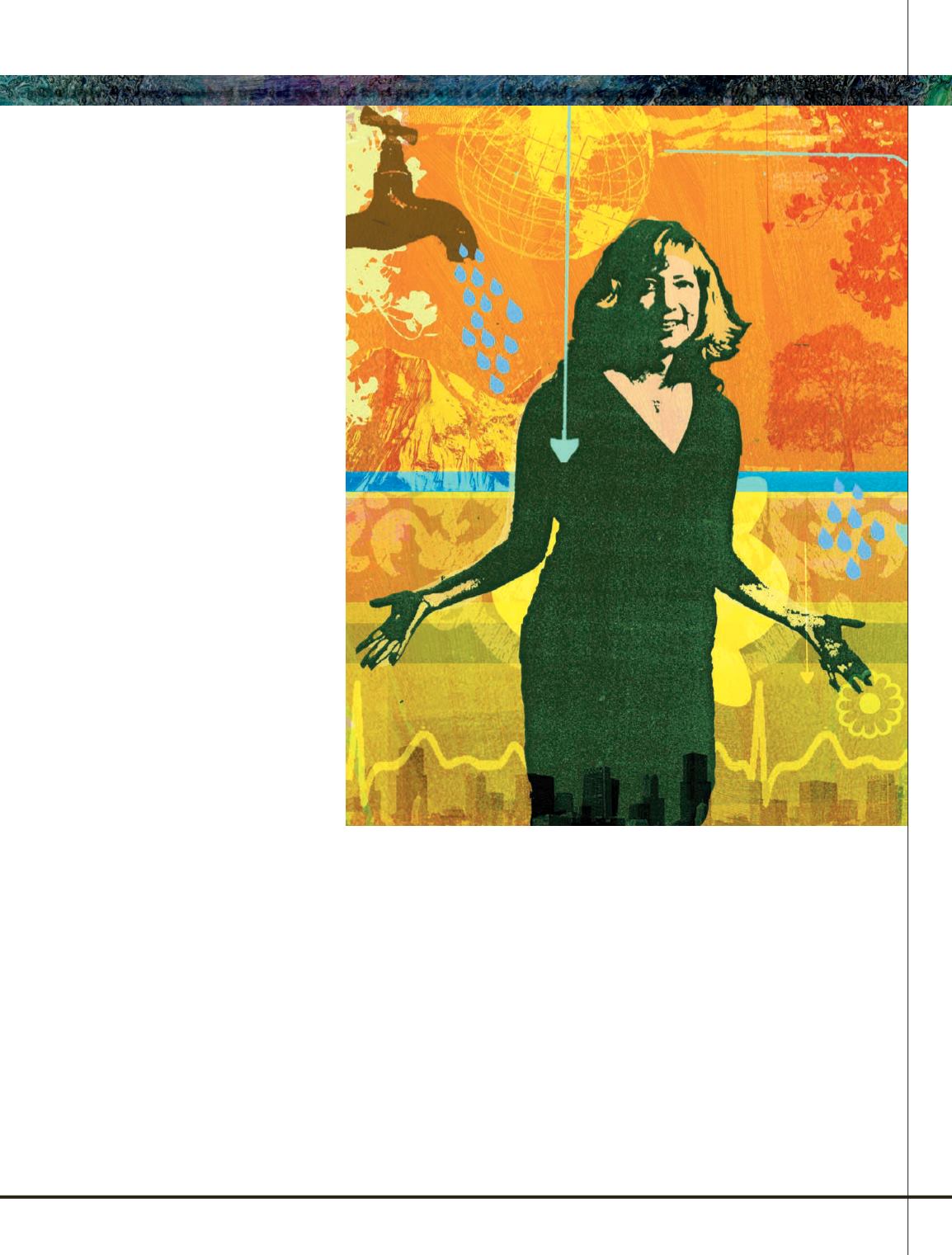
NATURE’SACCOUNTANT
Think about the 1.3 billion gallons of wa-
ter the cityofNewYorkuses everyday, says
GretchenDaily. That water flows from the
Catskill Mountains, down hills, through
forests and pastures, and eventually into
giant aqueducts that serve nine million
people. Beneath those forests, microorgan-
ismsbreakdowncontaminants. In streams,
plants absorb polluting fertilizer and ma-
nure. In themeadows,wetlandsfilternutri-
ents andbreakdownheavymetals.
IfNewYorkhad tobuildafiltrationplant
for that water, it could cost $8 billion to
construct and another $400million annu-
ally to operate. Instead, whendevelopment
in the area threatened the water’s quality,
the city decided to invest in protecting the
land as a cheaper means of securing clean
water.
Daily, a biology professor and researcher
at Stanford University, says that’s one ex-
ampleof themany services thatnaturepro-
vides but is never credited for on a balance
sheet. Now, she says, it’s time to go beyond
million trees.
}
If everyhousehold replaced one roll of toilet paperwith a roll of recycledpostconsumerwaste, 424,000 treeswouldbe saved.
}


