18 AMERICANWAY
OCTOBER 1 2007
really, but it should be. You see, the Panta-
nal is theworld’s largest wetland, a swamp
that is about a fifth the size of France and
more than 20 times the size of our own
FloridaEverglades. It’s an enormous flood-
plain in portions of three countries (Brazil,
Paraguay, and Bolivia) that is inundated
like clockwork six months of every year, a
beautiful quagmire that is home to a third
of Brazil’s abundant bird population and
to enough fascinating animals — jaguars,
caimans, anacondas, giant river otters,
capybaras— todizzy even themost fervent
naturalist. ThePantanal is a captivating al-
luvial plain and hosts one of SouthAmeri-
ca’smost important ecosystems.
Though the Amazon ismore the subject
of legend andHollywood-level attention, it
is actually the Pantanal that shines when
it comes towildlife. The numbers are star-
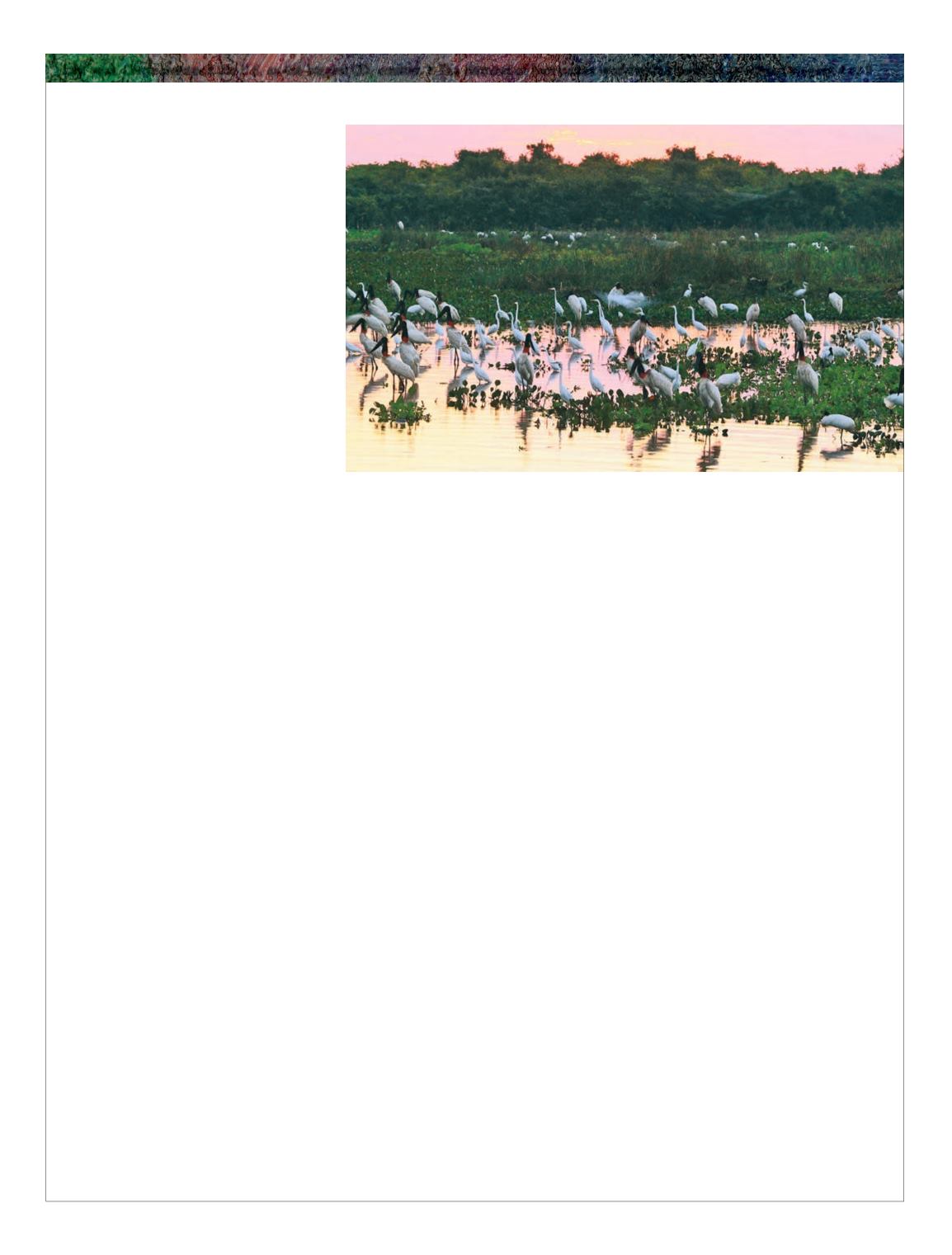
tling: There are 124 species of mammals,
463 species of birds, 50 species of frogs, 177
species of reptiles, 260 species of fish (in-
cluding scores of vicious piranhas and bul-
lyingdorados), and3,500 species of plants.
Due to its topography — wide-open fields
free of large trees and foliage — it easily
trumps the Amazon as the place for spot-
tingmammals andbirds.
But not all in the Pantanal is the stuff of
safari dreams. This ecological hot spot, 80
percent of which sits in Brazil’s expansive
Central West region, is endangered thanks
toanumberofvillains, someofwhich, iron-
ically, were actually designed to help fight
global warming and lessen our environ-
mental impact. “Nowadays, the expansion
of sugarcaneplantations isoccurring exact-
ly on theborders of Pantanal,” saysRicardo
Machado, director of theCerrado-Pantanal
program for Conservation International,
an environmental group that protects the
earth’s most endangered places. “Many ex-
isting pastures are being converted to sug-
arcane plantations. … If the demand for
ethanol increasesand theconservationcon-
cern stays focused only in the Amazon, it’s
very likely that new sugarcane plantations
will takeover the remainingnatural areas.”
The jugular of thePantanal is themighty
RioParaguai,a1,584-milewaterway(on the
continent, it’s secondonly to theAmazon in
navigable length) that servesas the lifeblood
for significant parts of Brazil, Argentina,
Bolivia, Uruguay, and Paraguay. Between
November and March, the river breaches
its banks and floods an area some 89,000
squaremiles insize, greatlyhampering trav-
el andhabitabilitybut feeding the region.
Yet, that very rivercurrently iscentral toa
proposed plan that could prove the tipping
point foranecologicaldisaster in theregion:
theHidrovia project, an estimated$1.3 bil-
lion initiative that would alter the course of
the river (by redigging itsfloor toaccommo-
date large cargo ships) inan effort to reduce
the costs of exporting soybeans and other
crops from thearea. Theproject currently is
designated as a “plan for development,” and
the issue isbeingbattledout.“Iftheriverbot-
tom isdredged toaccommodate largeboats,
theseasonalfloodpulse thatspreadsonboth
sides of the river during thewet season can
beseriouslyaffectedand thenaturalcapacity
of thePantanal to retainwater—essentially
thenatural condition for its existence—will
bediminished,” saysMachado.
And the threats don’t stop there. The
majority of thePantanal is privately owned,
mainly by soybean and cattle farmers who
are constantlybuttingheadswithbothecol-
ogists and jaguars. The Pantanal is the last
great stronghold for the biggest and most
elusiveof theAmericancats,but the jaguar’s
taste for beef puts it in the firing line of
farmers,whodon’t takekindly toattacks on
their inventory (anestimated40 jaguarsare
killedeachyear).There is agovernment ini-
tiative tofinancially compensate farmers for
lost cattle, but the view ofmost of the Pan-
taneiros—who livemore or less in a wild,
wildWest stateofmind— is that themoney
won’t ever showupat theirdoorsteps.
So, what will save the Pantanal? For
starters, since 2005, Conservation Interna-
tional has been settingup anetworkof pri-
vate reserves in thearea,which lure farmers
to participate in conservation in exchange
for technical and financial support. Thus
far, thesePrivateNaturalHeritageReserves
have increasedprotected land in theareaby
30percent.
But it’s the ecotourism and sustainable-
tourismmovements that could prove to be
the turning points for the region. As more
and more farmers realize they can make
their profits soar by embracing low-impact
tourism instead of high-impact farming,
this remarkable wildlife refuge will thrive,
all the while providing tourists with once-
in-a-lifetime opportunities to view the
area’s endearing creatures in their natural
habitat.
“The Pantanal is the last stronghold for
some of the continent’s most endangered
and importantflagship species, suchas jag-
uars, marsh deer, hyacinth macaws, giant
river otters, giant anteaters, tapirs, jabiru
“ThePantanal is the last stronghold for
some of the continent’smost endangered
and important flagship species.”
Last year, Chinaovertook theU.S. as the biggest CO
2
emitter.
}
Thenumber of hurricanesworldwide classified as either Category4or 5


