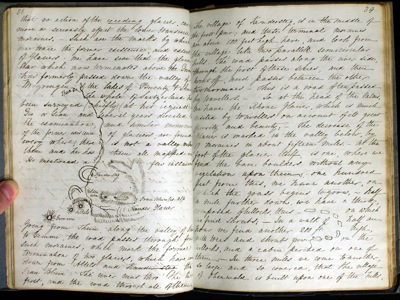
Holographs, continued
Secondly, another special type of manuscript is a holograph. A handwritten work entirely in the hand of a single person (excluding annotations) is a holograph, which may or may not be in the hand of the author. For example, a transcription of the Boston lectures of Louis Agassiz is a holograph, even though it is probably not in Agassiz’s own handwriting (above). A handwritten introduction to astronomy dating from the early 1600’s is a holograph, even though we do not know who transcribed it or who authored it. A student’s transcription of a 16th-century lecture by Erasmus Reinhold is a holograph, even if we don’t know the name of the student who wrote it. Finally, the work by Baldi, referred to above, is both a holograph and an autograph, because it was entirely written by a single person who also happens to be its author. Obviously, the definition of holograph overlaps with autograph.

Handwritten items
Friday, October 20, 2006