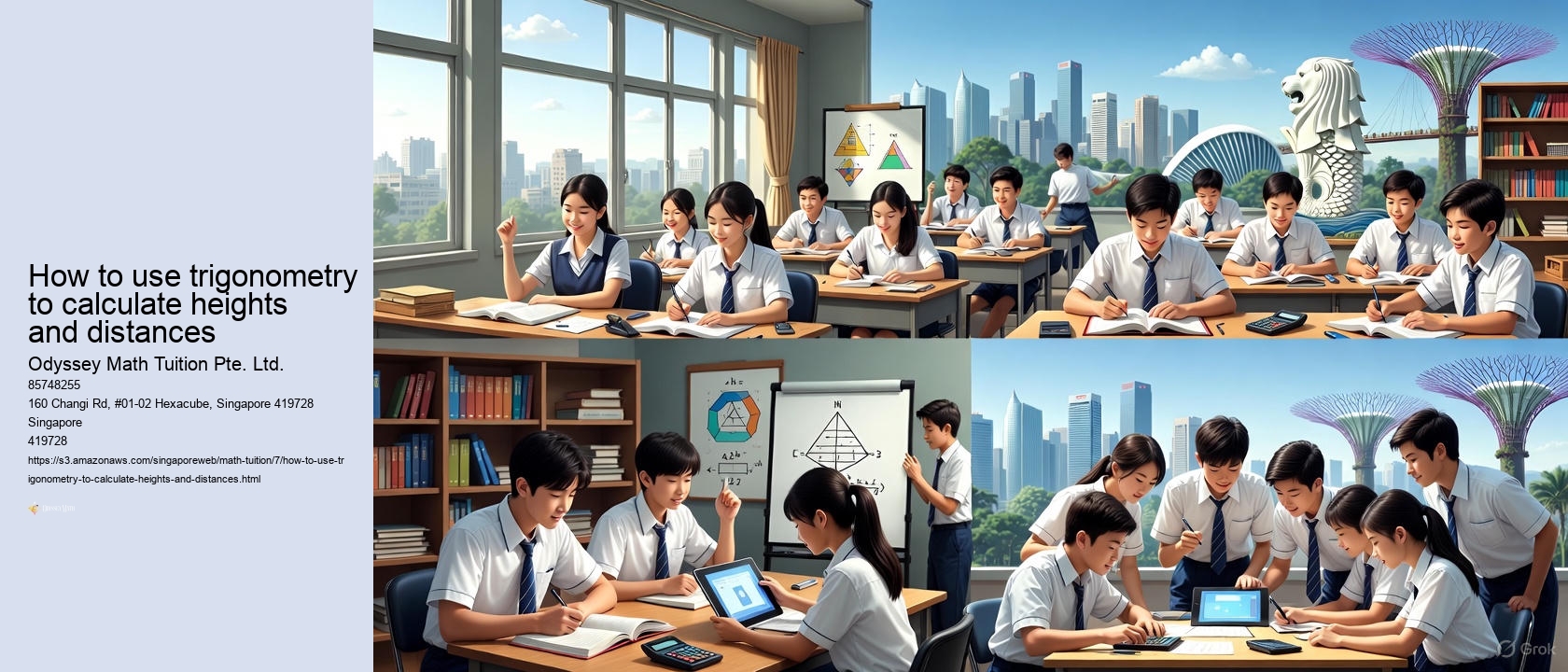
Have you ever wondered how surveyors measure the height of a skyscraper or the distance across a wide river? The answer lies in the magic of trigonometry! This branch of mathematics, often shortened to "trig," might seem intimidating at first, but it's actually a powerful tool that can unlock a whole new way of seeing the world. For Singaporean Secondary 3 students, understanding trigonometry is not just about acing exams; it's about developing problem-solving skills that are applicable in many real-life situations. Plus, it's a key component of the singapore secondary 3 math tuition curriculum.
Singapore Secondary 3 Math Tuition: Your Trigonometry Toolkit
Singapore secondary 3 math tuition often focuses on building a strong foundation in trigonometry. This is because trigonometry forms the backbone for many advanced mathematical concepts you'll encounter later on. Think of it as equipping yourself with the right tools – like sine, cosine, and tangent – to tackle challenging problems. When you get tuition, it's like having a personal guide to help you understand these tools and how to use them effectively. This is especially helpful when dealing with word problems involving heights and distances, which can sometimes seem like a real "blur" initially.
Fun Fact: Did you know that the earliest known use of trigonometry can be traced back to ancient Egypt and Babylon? They used it for surveying land and building pyramids! Talk about practical math!
Before diving into heights and distances, let's quickly recap some fundamental geometry and trigonometry principles. These are the building blocks that make the magic happen:
Now, how do we use these principles to calculate heights and distances? Imagine you're standing a certain distance away from a tall building. You can measure the angle of elevation (the angle between the horizontal and your line of sight to the top of the building). Using trigonometry, you can then calculate the height of the building!
Here's the basic approach:
Let's say you're standing 50 meters away from a tree, and the angle of elevation to the top of the tree is 30 degrees. To find the height of the tree, you'd use the tangent function (TOA):
tan(30°) = Height / 50 meters
Height = 50 meters * tan(30°) ≈ 28.87 meters
Therefore, the height of the tree is approximately 28.87 meters.
Interesting Fact: Surveyors use sophisticated instruments like theodolites and total stations to measure angles and distances with incredible accuracy. These instruments rely heavily on trigonometry!
Trigonometry isn't just confined to textbooks and classrooms. In the challenging world of Singapore's education system, parents are increasingly intent on preparing their children with the competencies needed to excel in challenging math curricula, encompassing PSLE, O-Level, and A-Level exams. Spotting early indicators of difficulty in areas like algebra, geometry, or calculus can make a world of difference in developing strength and mastery over intricate problem-solving. Exploring dependable maths tuition options can provide tailored assistance that corresponds with the national syllabus, making sure students acquire the boost they require for top exam scores. By prioritizing engaging sessions and steady practice, families can assist their kids not only meet but go beyond academic goals, paving the way for prospective opportunities in competitive fields.. It has numerous real-world applications, especially relevant in Singapore:
In Singapore, with its impressive skyline and ongoing construction projects, understanding trigonometry is particularly valuable. Imagine being able to estimate the height of the Marina Bay Sands or the distance between two buildings just by using your knowledge of trigonometry! Knowing your trig can even help you understand how the Gardens by the Bay were designed and built. Not bad, right?
History: The word "trigonometry" comes from the Greek words "trigonon" (triangle) and "metron" (measure). So, literally, it means "triangle measurement."
Okay, so how can you, as a Secondary 3 student in Singapore, truly master trigonometry and use it to your advantage, especially when preparing for exams or seeking singapore secondary 3 math tuition?
So, there you have it! Trigonometry is not just some abstract mathematical concept; it's a powerful tool that can help you understand and solve real-world problems. By mastering the fundamentals and practicing regularly, you can unlock the secrets of heights and distances and impress your friends with your newfound mathematical prowess. Jiayou!

Let's explore how trigonometry, a cornerstone of Geometry and Trigonometry Principles, helps us measure the world around us, even those things that seem impossibly tall or far away! This is super relevant for your Secondary 3 math syllabus, and a key area covered in Singapore secondary 3 math tuition.
Imagine you're standing at the foot of the Supertrees at Gardens by the Bay. How would you figure out their height without climbing all the way up? That's where SOH-CAH-TOA comes in! It's a mnemonic that helps us remember the three fundamental trigonometric ratios:
These ratios relate the angles of a right-angled triangle to the lengths of its sides. "Opposite" refers to the side opposite the angle you're considering, "Adjacent" is the side next to the angle (but not the hypotenuse), and "Hypotenuse" is the longest side, opposite the right angle.
Think of it this way: SOH-CAH-TOA is your secret weapon for solving problems involving triangles, angles, and distances.
Now, let's add another layer: angles of elevation and depression.
These angles are crucial because they help us create right-angled triangles in real-world scenarios, allowing us to use SOH-CAH-TOA to find unknown heights and distances.
Fun Fact: Did you know that ancient Egyptians used rudimentary forms of trigonometry to build the pyramids? Talk about practical application!
Let's say you're standing 50 meters away from a tall tree. You measure the angle of elevation to the top of the tree to be 30 degrees. How tall is the tree?
Therefore, the tree is approximately 28.87 meters tall. See? In a digital time where continuous skill-building is crucial for career growth and individual growth, prestigious schools worldwide are breaking down barriers by providing a variety of free online courses that encompass wide-ranging subjects from digital technology and business to humanities and health sciences. These programs allow learners of all backgrounds to utilize premium lessons, projects, and tools without the economic cost of traditional admission, frequently through platforms that provide adaptable scheduling and interactive features. Uncovering universities free online courses opens opportunities to prestigious institutions' knowledge, empowering proactive people to improve at no charge and secure qualifications that boost resumes. By making premium instruction freely accessible online, such initiatives promote worldwide equality, strengthen underserved populations, and foster innovation, demonstrating that high-standard information is progressively merely a tap away for anyone with online access.. Not so cheem (difficult) after all!
Interesting Fact: Surveyors and engineers use trigonometry extensively to map land, design bridges, and construct buildings. It's not just textbook stuff; it's used every day!
In Singapore secondary 3 math tuition, these concepts are often taught using practical examples and real-world scenarios. Tutors will often use visual aids, like diagrams and interactive software, to help students grasp the relationships between angles and sides. You'll likely encounter word problems that require you to apply SOH-CAH-TOA to solve for unknown heights, distances, and angles. The goal is to move beyond rote memorization and develop a deeper understanding of how trigonometry works. Good tutors can help make the concepts stick, lah!
History Snippet: The word "trigonometry" comes from the Greek words "trigonon" (triangle) and "metron" (measure). The study of trigonometry dates back to ancient Greece and India, where it was used for astronomy and navigation.
Trigonometry isn't just about passing exams; it has numerous real-world applications:
So, next time you're struggling with a trigonometry problem, remember that you're learning a skill that can be used in countless ways to understand and shape the world around you!
This knowledge empowers you to tackle problems with confidence and see the math in everyday life, not just in singapore secondary 3 math tuition.
Trigonometry provides tools for calculating heights using angles of elevation. By measuring the angle from a point on the ground to the top of an object and knowing the distance to the base, one can use tangent to find the height. This method is useful in scenarios where direct measurement is impossible.
Many height and distance problems involve multiple triangles, requiring a systematic approach. Breaking down complex shapes into simpler triangles allows for application of trigonometric ratios. Solving each triangle individually and combining the results leads to the final solution.
Trigonometry finds applications in various real-world scenarios, such as surveying, navigation, and architecture. Surveyors use trigonometric principles to measure land areas and create maps. Architects rely on it for designing structures and ensuring stability.
Trigonometry enables the calculation of distances using angles and known lengths. The sine and cosine ratios are particularly useful when dealing with triangles that aren't right-angled. Knowing one side and two angles, or two sides and an angle, allows for distance determination.
Geometry provides the foundational understanding for trigonometry. Concepts like angles, parallel lines, and similar triangles are crucial. Understanding these geometrical relationships allows us to set up trigonometric equations correctly when solving problems involving heights and distances. Without a solid grasp of geometry, applying trigonometric ratios can be challenging, especially in complex scenarios often encountered in Singapore secondary 3 math tuition. In Singapore's rigorous education system, where English functions as the key medium of education and plays a crucial part in national exams, parents are eager to help their youngsters tackle common challenges like grammar affected by Singlish, word deficiencies, and difficulties in comprehension or essay crafting. Building robust foundational competencies from elementary levels can substantially boost assurance in tackling PSLE parts such as contextual writing and oral interaction, while secondary learners gain from targeted exercises in textual review and argumentative essays for O-Levels. In this bustling city-state's bustling education environment, where students deal with considerable stress to succeed in numerical studies from primary to tertiary stages, locating a educational centre that combines proficiency with authentic enthusiasm can create all the difference in cultivating a appreciation for the field. Enthusiastic educators who go outside mechanical learning to motivate strategic problem-solving and tackling abilities are rare, but they are vital for helping students tackle difficulties in areas like algebra, calculus, and statistics. For guardians hunting for this kind of dedicated guidance, Secondary 3 math tuition stand out as a example of dedication, motivated by educators who are deeply engaged in each learner's progress. This unwavering dedication turns into customized teaching approaches that adapt to personal needs, culminating in enhanced scores and a lasting respect for numeracy that reaches into future educational and professional pursuits.. For those hunting for efficient methods, investigating English tuition Singapore offers useful insights into programs that sync with the MOE syllabus and stress engaging instruction. This additional assistance not only refines assessment techniques through mock exams and reviews but also supports home habits like everyday reading along with discussions to nurture long-term language mastery and educational achievement.. It's like trying to build a house without a proper foundation – the structure won't be stable.
Trigonometry builds upon geometric principles by introducing ratios that relate angles and sides of right-angled triangles. The three primary trigonometric ratios are sine (sin), cosine (cos), and tangent (tan). These ratios allow us to calculate unknown lengths or angles when some information is already known. Mastering these ratios is essential for tackling problems involving angles of elevation and depression. Think of trigonometry as the toolbox that allows us to measure the world around us using angles and distances.
The angle of elevation is the angle formed between the horizontal line of sight and an upward line of sight to an object. Imagine you are standing on the ground looking up at the top of a building; the angle between your eye level and the top of the building is the angle of elevation. Identifying this angle correctly is crucial in setting up trigonometric equations. Problems involving angle of elevation are common in Singapore secondary 3 math tuition, especially when dealing with real-world applications like finding the height of a tree or a building.
Conversely, the angle of depression is the angle formed between the horizontal line of sight and a downward line of sight to an object. Picture yourself standing on top of a cliff looking down at a boat in the sea; the angle between your eye level and the boat is the angle of depression. Just like the angle of elevation, correctly identifying the angle of depression is key to solving problems. Remember, angles of elevation and depression are always measured from the horizontal, hor.
Applying trigonometry to calculate heights and distances requires a systematic approach. First, draw a clear diagram of the problem, labeling all known angles and lengths. Next, identify the right-angled triangle and choose the appropriate trigonometric ratio (sin, cos, or tan) that relates the known and unknown quantities. Finally, solve the equation to find the unknown height or distance. Consistent practice with various problem types, like those covered in Singapore secondary 3 math tuition, will build confidence and proficiency. Don't be afraid to ask "why like that?" – understanding the logic is more important than memorizing formulas, lah!
Ever wondered how surveyors measure the height of a building or the distance across a river without actually climbing the building or swimming across? The answer lies in the fascinating world of trigonometry! For Singapore Secondary 3 students, mastering trigonometry is not just about acing your math exams; it's about unlocking a powerful tool for solving real-world problems. And for parents, understanding these concepts can help you better support your child's learning journey, especially if they're attending Singapore Secondary 3 math tuition.
Before we dive into solving height and distance problems, let's refresh some fundamental concepts. Trigonometry, at its heart, deals with the relationships between the angles and sides of triangles. The three primary trigonometric ratios – sine (sin), cosine (cos), and tangent (tan) – are the keys to unlocking these relationships, especially in right-angled triangles.
Remember SOH CAH TOA? This handy mnemonic helps you recall these ratios. Knowing these ratios is crucial for tackling problems involving heights and distances.
These angles are essential when dealing with height and distance problems. The angle of elevation is the angle formed between the horizontal line and the line of sight when looking upwards at an object. Imagine you're standing on the ground looking up at the top of a building – the angle between your eye-level and the top of the building is the angle of elevation. Conversely, the angle of depression is the angle formed between the horizontal line and the line of sight when looking downwards at an object. Picture yourself standing on top of a cliff looking down at a boat – the angle between your eye-level and the boat is the angle of depression.
Fun fact: The word "trigonometry" comes from the Greek words "trigonon" (triangle) and "metron" (measure). So, literally, it means "triangle measurement!"
Let's look at some examples where we can use trigonometry to find heights and distances using just one right-angled triangle. These are common in Singapore Secondary 3 math problems. This is where singapore secondary 3 math tuition can be super helpful!
Example 1: Finding the Height of a Tree
Imagine you're standing a certain distance away from a tree. You measure the angle of elevation to the top of the tree. Let's say you're standing 20 meters away from the base of the tree, and the angle of elevation to the top of the tree is 30 degrees. How tall is the tree?
Therefore, the height of the tree is approximately 11.55 meters.
Example 2: Finding the Distance to a Building
Suppose you're standing on top of a cliff, and you measure the angle of depression to a building below. The cliff is 50 meters high, and the angle of depression to the base of the building is 45 degrees. What is the horizontal distance from the base of the cliff to the building?
Therefore, the horizontal distance from the base of the cliff to the building is 50 meters.
These examples demonstrate how trigonometric ratios can be applied to solve practical problems involving heights and distances. Wah, so useful right?
While these concepts might seem straightforward, mastering them requires practice and a solid understanding of the underlying principles. This is where Singapore Secondary 3 math tuition can make a significant difference. A good tutor can provide:
Think of it this way: your child might understand the theory in class, but the tuition provides the "hands-on" experience, like learning to ride a bicycle. You can read all about it, but you need to actually *do* it to get good!
Interesting fact: Ancient Egyptians used trigonometry-like principles for building the pyramids! They needed precise measurements to ensure the pyramids were perfectly aligned.
By mastering trigonometry, your child is not just learning math; they're developing critical thinking and problem-solving skills that will benefit them in all aspects of life. So, encourage them to embrace the challenge, seek help when needed (like with singapore secondary 3 math tuition), and remember - practice makes perfect! Jiayou!
Ever looked up at the Merlion and wondered just how tall it is? Or maybe you're planning a hiking trip at Bukit Timah Hill and want to estimate the distance to the summit? Well, trigonometry is your secret weapon! This isn't just some abstract math concept; it's a practical tool that can help you solve real-world distance problems. And for students preparing for their exams through singapore secondary 3 math tuition, mastering trigonometry is essential.
Geometry and Trigonometry Principles
Before we dive into calculations, let's quickly recap some fundamental principles. Geometry provides the foundation, dealing with shapes, sizes, and relative positions of figures. Trigonometry, a branch of geometry, focuses on the relationships between angles and sides of triangles. Specifically, we'll be using trigonometric ratios for right-angled triangles – triangles with one angle measuring 90 degrees. These ratios are sine (sin), cosine (cos), and tangent (tan). Remember SOH CAH TOA? (Sine = Opposite/Hypotenuse, Cosine = Adjacent/Hypotenuse, Tangent = Opposite/Adjacent). Knowing these ratios is key to unlocking the secrets of height and distance calculations. This is where a good singapore secondary 3 math tuition program can really make a difference, ensuring students grasp these concepts thoroughly.
Fun Fact: Did you know that trigonometry has its roots in ancient Egypt and Greece? Early astronomers used it to measure the positions of stars and planets!
Applying Trigonometric Ratios
Let's say you're standing a certain distance away from a building and you want to find its height. You can measure the angle of elevation (the angle between the horizontal line of sight and the top of the building). Using the tangent ratio (tan = Opposite/Adjacent), where the opposite side is the height of the building and the adjacent side is your distance from it, you can calculate the height. For example:
Imagine you're 50 meters away from a building, and the angle of elevation to the top is 60 degrees. In this island nation's demanding educational environment, parents dedicated to their children's excellence in mathematics frequently emphasize comprehending the organized advancement from PSLE's foundational problem-solving to O Levels' intricate subjects like algebra and geometry, and moreover to A Levels' higher-level concepts in calculus and statistics. Remaining informed about curriculum revisions and assessment requirements is crucial to providing the suitable support at all stage, ensuring students cultivate self-assurance and secure excellent outcomes. For formal perspectives and resources, checking out the Ministry Of Education page can deliver useful updates on guidelines, programs, and educational approaches customized to countrywide standards. Engaging with these reliable materials enables families to match domestic learning with classroom requirements, nurturing enduring achievement in numerical fields and beyond, while remaining informed of the newest MOE initiatives for holistic student growth.. Therefore:
tan(60°) = Height / 50m
Height = tan(60°) * 50m
Height ≈ 1.732 * 50m
Height ≈ 86.6 meters
So, the building is approximately 86.6 meters tall. See? Not so cheem (difficult), right?
Interesting Fact: Surveyors use trigonometry extensively to map land and determine boundaries. They use instruments like theodolites to measure angles with great precision.
Singapore Context Examples
Let's bring this closer to home. Imagine you're at Gardens by the Bay, looking at one of the Supertrees. You know the distance from where you're standing to the base of the Supertree. You measure the angle of elevation to the top of the Supertree. With these two pieces of information, you can calculate the Supertree’s height using the tangent ratio. Or perhaps you're trying to estimate the distance across Marina Bay. By measuring angles from two different points and knowing the distance between those points, you can use trigonometric principles to find the distance across the bay. These are practical applications that make learning trigonometry relevant and engaging for students. A good singapore secondary 3 math tuition centre will often incorporate such real-world examples to enhance understanding.
Importance for Singapore Secondary 3 Math Tuition
Trigonometry is a fundamental topic in the Singapore Secondary 3 math syllabus. Mastering it is not only crucial for scoring well in exams but also for building a strong foundation for higher-level mathematics. Many topics in physics and engineering rely heavily on trigonometric principles. Therefore, investing in quality singapore secondary 3 math tuition can provide students with the necessary support and guidance to excel in this area. Tutors can break down complex concepts into simpler, more digestible chunks, provide ample practice opportunities, and offer personalized feedback to help students overcome their challenges. Beyond exam preparation, trigonometry fosters critical thinking and problem-solving skills that are valuable in all aspects of life. Think of it as leveling up your brainpower!
History: The word "trigonometry" comes from the Greek words "trigonon" (triangle) and "metron" (measure".


So, your Secondary 3 kiddo is tackling trigonometry, eh? And now they're facing problems with not just one, but *multiple* right-angled triangles! Don't worry, it's not as cheem (complex) as it looks. This guide will help you, and them, break down these problems like a pro, especially useful for those Singapore Secondary 3 math tuition sessions. Think of it as giving them the 'kiasu' (fear of missing out) edge they need!
Before we dive into the deep end, let's quickly recap the basics. Remember SOH CAH TOA? It's your best friend in trigonometry!
Also, don't forget Pythagoras Theorem: a2 + b2 = c2. These are the building blocks. Make sure your child is super solid on these before moving on. These principles are crucial for success in Singapore Secondary 3 math exams.
The key to tackling multiple triangle problems is to break them down into smaller, manageable steps. Here's how:
Fun fact: Did you know that trigonometry has been used for centuries in navigation and surveying? Ancient Egyptians used it to build the pyramids!
Here are some strategies to help your child ace those Secondary 3 math exams:
Interesting fact: The word "trigonometry" comes from the Greek words "trigonon" (triangle) and "metron" (measure)!
Trigonometry isn't just some abstract math concept. It has many real-world applications, such as:
History: The earliest known use of trigonometry can be traced back to ancient Greece and Egypt, where it was used for astronomical calculations and land surveying.
So there you have it! With a bit of practice and these strategies, your child will be able to conquer those multiple triangle problems like a true math whiz. Remember, "can or not?" (can or cannot?) – definitely CAN! And if they need extra help, don't hesitate to look into Singapore secondary 3 math tuition. Jiayou (add oil/good luck)!
Ever looked up at the towering Singapore Flyer and wondered, "How high is that thing, really?" Or perhaps you're planning a rooftop garden and need to figure out the distance to the opposite building? Well, Secondary 3 math – specifically trigonometry – is your secret weapon! Forget just memorizing formulas; let's see how these concepts come alive, especially for students prepping with singapore secondary 3 math tuition.
Before we conquer skyscrapers, let's solidify our foundation. Geometry provides the shapes, and trigonometry gives us the tools to measure them. Think of it as building blocks and a super-powered ruler!
These ratios are the heart of trigonometry. They define the relationship between angles and sides in right triangles. Understanding them is key to solving real-world problems. Remember, a calculator in degree mode is your best friend here!
Now, the fun part! Let's use these principles to tackle some practical scenarios. The key is to visualize the problem, draw a diagram, and identify the right trigonometric ratio to use.
Fun Fact: Did you know that ancient Egyptians used rudimentary trigonometry to build the pyramids? They needed precise angles to align the massive stones!
Okay, enough theory. Time for some action! Here are a few examples ranging from "easy peasy" to "challenging sia," perfect for students getting extra help from singapore secondary 3 math tuition.
Easy: A ladder leans against a wall, forming a 60-degree angle with the ground. The ladder is 5 meters long. How high up the wall does the ladder reach?
(Hint: Use sine!)
Medium: You're standing 20 meters away from a tree. The angle of elevation to the top of the tree is 30 degrees. How tall is the tree?
(Hint: Use tangent!)
Challenging: Two buildings are 50 meters apart. From the top of the shorter building, the angle of elevation to the top of the taller building is 20 degrees, and the angle of depression to the base of the taller building is 40 degrees. Find the height difference between the two buildings and the height of the taller building.
(Hint: This one requires breaking down the problem into multiple right triangles and using both tangent and some clever addition!)
Here are some tips and tricks to boost your trigonometry problem-solving skills, especially helpful for students enrolled in singapore secondary 3 math tuition:
Interesting Fact: The word "trigonometry" comes from the Greek words "trigonon" (triangle) and "metron" (measure). So, it's literally "triangle measurement!"
While these concepts are powerful, they can also be tricky. That's where singapore secondary 3 math tuition comes in! In this Southeast Asian hub's competitive education framework, where scholastic achievement is crucial, tuition usually refers to supplementary additional classes that deliver specific support in addition to classroom curricula, helping students master topics and gear up for major assessments like PSLE, O-Levels, and A-Levels during fierce rivalry. This independent education sector has expanded into a thriving market, fueled by guardians' investments in personalized support to bridge skill shortfalls and boost grades, although it frequently imposes pressure on young kids. As artificial intelligence surfaces as a disruptor, delving into innovative Singapore tuition approaches uncovers how AI-powered tools are customizing instructional journeys globally, providing adaptive mentoring that surpasses standard methods in efficiency and engagement while tackling global learning gaps. In this nation particularly, AI is revolutionizing the conventional supplementary education approach by enabling budget-friendly , on-demand tools that match with national programs, likely lowering expenses for households and enhancing results through insightful insights, even as principled issues like over-reliance on tech are examined.. Tutors can provide:
So, don't be scared when you see trigonometry problems. With a bit of practice and maybe some help from singapore secondary 3 math tuition, you'll be calculating heights and distances like a pro. Jiayou!