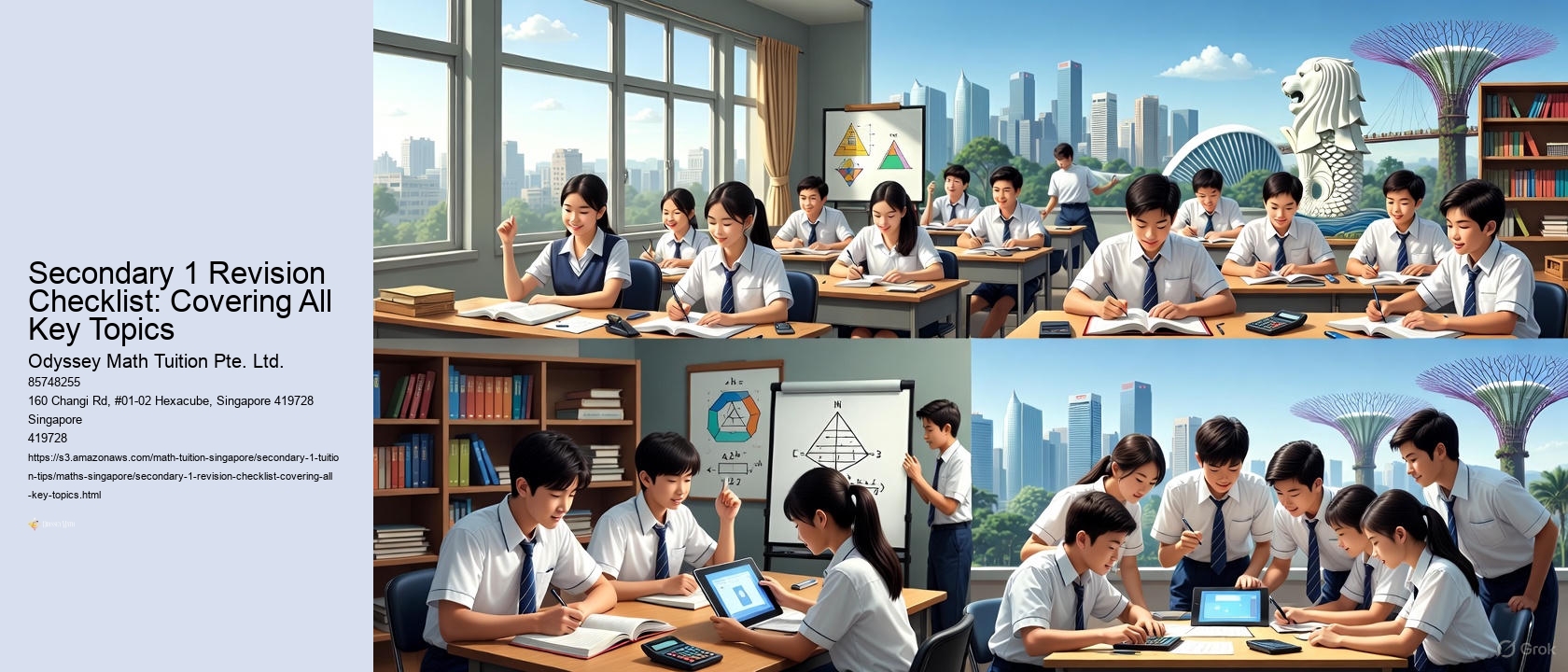
Secondary 1 Revision Checklist: Covering All Key Topics

Secondary 1 Revision Checklist: Covering All Key Topics

Introduction: Setting the Stage for Secondary 1 Success

Welcome to Secondary 1, parents! Your little kakis are now embarking on a whole new adventure in the Singapore education system. Gone are the days of primary school – Secondary 1 is a whole different ball game! This is where the foundation for their future academic success is truly laid. Think of it as building a strong HDB flat – you need a solid base to go high, right?

And speaking of solid bases, let's talk about mathematics. In Singapore, math isn't just a subject; it's a skill for life. With AI and technology becoming increasingly prevalent, a strong grasp of mathematical concepts is more crucial than ever. It's the language of the future, lah! From coding to finance, data analysis to engineering, mathematics is the bedrock of countless career paths. So, investing in your child's math education now is like investing in their future kiasu (but in a good way!).

This checklist is designed to help your child navigate the exciting (and sometimes daunting) world of Secondary 1 Mathematics. We'll cover all the key topics, offer some shiok Singapore secondary 1 tuition tips, and arm them with effective study habits. Let's get started!

Secondary 1 Revision Checklist: Covering All Key Topics

This comprehensive checklist will ensure your child is well-prepared for Secondary 1 Mathematics.

1. Numbers and Operations:

  • Integers: Understanding positive and negative numbers, operations with integers (addition, subtraction, multiplication, division).
  • Fractions, Decimals, and Percentages: Conversion between these forms, operations involving fractions, decimals, and percentages. This is super important for everyday life, from calculating discounts at the pasar malam to understanding interest rates!
  • Ratio and Proportion: Solving problems involving ratios and proportions. Think of it as mastering the art of scaling recipes – essential for becoming a MasterChef!
  • Prime Factorisation, HCF and LCM: Finding the highest common factor (HCF) and lowest common multiple (LCM) of numbers.

2. Algebra:

  • Basic Algebraic Expressions: Simplifying algebraic expressions, collecting like terms. This is like learning the alphabet of mathematics – you need it to form sentences (equations)!
  • Solving Simple Equations: Solving linear equations with one variable.
  • Forming Equations: Translating word problems into algebraic equations. This is where the real challenge begins – but with practice, it becomes second nature.

3. In the city-state's demanding education framework, parents fulfill a crucial function in leading their children through key tests that influence educational trajectories, from the Primary School Leaving Examination (PSLE) which assesses basic skills in areas like math and scientific studies, to the GCE O-Level assessments concentrating on intermediate mastery in varied fields. As learners advance, the GCE A-Level assessments require deeper critical skills and subject proficiency, commonly deciding higher education admissions and occupational directions. To stay well-informed on all aspects of these countrywide assessments, parents should investigate formal materials on Singapore exam papers provided by the Singapore Examinations and Assessment Board (SEAB). This secures entry to the newest syllabi, examination timetables, registration details, and standards that match with Ministry of Education requirements. Frequently referring to SEAB can aid households get ready effectively, lessen ambiguities, and back their children in attaining peak results amid the demanding scene.. Geometry:

  • Angles: Understanding different types of angles (acute, obtuse, right, reflex), angle properties.
  • Triangles: Properties of different types of triangles (equilateral, isosceles, scalene, right-angled).
  • Quadrilaterals: Properties of different types of quadrilaterals (square, rectangle, parallelogram, rhombus, trapezium).
  • Perimeter and Area: Calculating the perimeter and area of basic shapes.

4. Statistics:

  • Data Representation: Interpreting and constructing bar graphs, pie charts, and line graphs. In today's data-driven world, understanding how to read and interpret data is a crucial skill.

Fun Fact: Did you know that the concept of zero, which is fundamental to our number system, was not always widely accepted? It took centuries for mathematicians to fully embrace its power and importance!

Effective Study Habits for Secondary 1 Students

Mastering the content is only half the battle. Developing effective study habits is equally crucial for success. Here are some Singapore secondary 1 tuition tips to help your child excel:

  • Create a Study Schedule: Allocate specific times for studying each subject. Consistency is key!
  • Find a Conducive Study Environment: A quiet place free from distractions is essential. Maybe not the kopitiam, lah!
  • Break Down Study Sessions: Instead of cramming for hours, break down study sessions into smaller, more manageable chunks with short breaks in between.
  • Active Recall: Test themselves regularly on the material they are learning. Don't just passively read – actively try to recall the information.
  • Seek Help When Needed: Don't be afraid to ask for help from teachers, tutors, or classmates. There's no shame in admitting you need a little assistance! Singapore secondary 1 tuition can be a great option for personalized support.
  • Practice, Practice, Practice: The more they practice, the better they will understand the concepts. In the rigorous world of Singapore's education system, parents are ever more concentrated on preparing their children with the abilities essential to excel in rigorous math syllabi, covering PSLE, O-Level, and A-Level preparations. Identifying early indicators of challenge in subjects like algebra, geometry, or calculus can make a world of difference in fostering tenacity and proficiency over advanced problem-solving. In today's fast-paced educational scene, many parents in Singapore are seeking effective methods to boost their children's grasp of mathematical ideas, from basic arithmetic to advanced problem-solving. Building a strong foundation early on can greatly elevate confidence and academic achievement, assisting students handle school exams and real-world applications with ease. For those investigating options like secondary 1 tuition it's vital to prioritize on programs that stress personalized learning and experienced guidance. This approach not only tackles individual weaknesses but also nurtures a love for the subject, contributing to long-term success in STEM-related fields and beyond.. Exploring reliable maths tuition options can deliver customized assistance that corresponds with the national syllabus, guaranteeing students obtain the boost they require for top exam results. By focusing on dynamic sessions and regular practice, families can support their kids not only satisfy but surpass academic standards, opening the way for future possibilities in demanding fields.. Math is like riding a bicycle – you need to keep practicing to stay balanced!

Subtopics to Deep Dive Into:

  • Time Management Strategies: Learning to prioritize tasks and manage time effectively is crucial for success in Secondary 1.
    • Description: This involves teaching students how to create a realistic schedule, break down large tasks into smaller steps, and avoid procrastination. Tools like planners, calendars, and time management apps can be helpful.
  • Note-Taking Techniques: Effective note-taking can significantly improve understanding and retention of information.
    • Description: Encourage students to use different note-taking methods, such as the Cornell method, mind mapping, or outlining. The key is to find a system that works best for them and actively engage with the material while taking notes.
  • Exam Preparation Strategies: Learning how to prepare effectively for exams can reduce stress and improve performance.
    • Description: This includes creating a revision timetable, practicing past papers, and understanding the exam format. It's also important to teach students how to manage their time during the exam and answer questions strategically.

Interesting Fact: The word "algebra" comes from the Arabic word "al-jabr," which means "the reunion of broken parts." This reflects the idea of algebra as a way to solve problems by manipulating equations and bringing together different elements.

Remember, parents, Secondary 1 is a marathon, not a sprint. By providing your child with the right tools, resources, and support, you can help them build a strong foundation for their future success. Jia you! (Add oil!)

Mastering Time Management: A Foundation for Academic Excellence

Alright, let's talk about setting your Sec 1 kid up for success, lah! We Singaporean parents, we all want the best for our children, right? In Singapore's bilingual education framework, where proficiency in Chinese is vital for academic success, parents commonly hunt for ways to assist their children master the tongue's subtleties, from vocabulary and understanding to writing crafting and oral proficiencies. With exams like the PSLE and O-Levels establishing high expectations, timely assistance can avert frequent obstacles such as subpar grammar or limited access to heritage contexts that enhance knowledge acquisition. For families aiming to improve outcomes, investigating Chinese tuition resources offers knowledge into structured courses that align with the MOE syllabus and cultivate bilingual assurance. This specialized support not only improves exam preparation but also develops a more profound respect for the tongue, paving doors to traditional heritage and future professional edges in a pluralistic community.. And in this kiasu environment, that means making sure they're not just keeping up, but excelling in their studies. And let's face it, mathematics is the king (or queen!) of all subjects. It's not just about acing those exams; it's about building a foundation for their future, especially with all this AI stuff happening.

Effective Study Habits for Secondary 1 Students

This is where it all begins! Secondary 1 is a whole new ball game compared to primary school. It's not just about memorising; it's about understanding and applying.

  • Active Recall: Forget just passively reading notes. Test your child! Get them to explain concepts in their own words. This is way more effective than just re-reading the textbook until their eyes glaze over.
  • Spaced Repetition: Don't cram! In a digital age where ongoing education is vital for career growth and personal improvement, leading universities internationally are eliminating barriers by offering a variety of free online courses that encompass varied disciplines from informatics studies and commerce to liberal arts and wellness sciences. These initiatives enable learners of all experiences to utilize premium lessons, tasks, and resources without the monetary burden of standard admission, commonly through systems that deliver adaptable pacing and engaging features. Exploring universities online free courses unlocks pathways to renowned institutions' expertise, empowering proactive individuals to improve at no expense and obtain certificates that enhance CVs. By making elite instruction readily accessible online, such offerings promote international equity, empower marginalized communities, and cultivate advancement, showing that high-standard knowledge is more and more just a step away for anyone with web access.. Encourage regular, shorter study sessions instead of marathon study sessions the night before the exam. This helps with long-term retention. Think of it like this: you wouldn't try to eat a whole plate of chicken rice in one go, right? Same concept!
  • Create a Dedicated Study Space: A quiet, well-lit area free from distractions is crucial. No studying on the bed while watching TikTok videos, okay? This is the place where they can really focus and "chiong" for those grades.
  • Prioritise Sleep: This is a big one! A well-rested brain learns better. Make sure your child is getting enough sleep, especially during exam periods. No point burning the midnight oil if they're too tired to think straight the next day.
  • Seek Help Early: If your child is struggling with a particular subject, don't wait until the last minute to seek help. That's where singapore secondary 1 tuition tips come in! Early intervention can make a huge difference.

    • Finding the Right Tutor: Look for tutors who are experienced in teaching the Sec 1 syllabus and who can explain concepts in a clear and engaging way. A good tutor can be a game-changer! This is where singapore secondary 1 tuition tips really help – ask around for recommendations!
    • Utilising School Resources: Don't forget about the resources available at school! Encourage your child to attend extra help sessions or ask their teachers for clarification.

Fun Fact: Did you know that Singapore consistently ranks highly in international mathematics assessments like TIMSS and PISA? It's a testament to our focus on mathematics education!

Secondary 1 Revision Checklist: Covering All Key Topics

Make sure your child is covering all the essential topics. This checklist can help them stay organised and focused.

  • Mathematics: Algebra, Geometry, Statistics, and Probability. This is the foundation for everything. With AI becoming more prevalent, a strong grasp of mathematics is even more crucial.
  • Science: Biology, Chemistry, and Physics. Understanding the world around us.
  • English: Grammar, Comprehension, Writing. Essential for clear communication.
  • Mother Tongue: Mastering their cultural heritage and language skills.
  • Humanities: History and Geography. Understanding the past and the world around us.
  • Character and Citizenship Education (CCE): Developing good character and values.

Interesting Fact: The Singapore education system has evolved significantly since independence. From a focus on basic literacy, it has transformed into a world-class system that emphasizes critical thinking and problem-solving skills.

Balancing Academic and Extracurricular Activities

It's not all about studying, okay? Extracurricular activities are important for developing well-rounded individuals.

  • Time Management is Key: Help your child create a realistic schedule that allows them to balance their studies with their extracurricular activities.
  • Choose Activities Wisely: Encourage your child to choose activities that they are passionate about and that align with their interests.
  • Don't Overcommit: It's better to be involved in a few activities and do them well than to be spread too thin.
  • Remember to Have Fun! School life shouldn't be all work and no play. Make sure your child has time to relax and enjoy themselves.

History: The emphasis on mathematics in Singapore's education system can be traced back to the early days of nation-building, when the government recognized the importance of STEM fields for economic development.

Remember, every child is different. What works for one child may not work for another. The key is to find what works best for your child and to support them along the way. With the right guidance and support, your Sec 1 kid can definitely "score" in their studies and beyond! Don't forget to explore singapore secondary 1 tuition tips to give them that extra edge!

Consistent Study Schedule

Establish a regular study timetable to allocate specific times for each subject. This helps in managing workload and preventing last-minute cramming. Consistency builds discipline and makes learning a habit, improving retention and reducing stress.

Seek Help When Needed

Don't hesitate to ask teachers or peers for assistance when struggling with a concept. Early intervention prevents gaps in understanding from widening. Proactive help-seeking demonstrates a commitment to learning and improves academic performance.

Break Down Complex Topics

Divide challenging topics into smaller, manageable segments for easier comprehension. Address each segment individually before integrating them. This prevents overwhelm and allows for a more thorough understanding of the material.

Effective Note-Taking Strategies: Capturing Key Information in Class

Active Listening

Active listening is paramount in capturing key information during class. This means paying full attention to the teacher, both verbally and non-verbally. Engage with the lesson by maintaining eye contact, nodding to show understanding, and avoiding distractions like daydreaming or doodling. By actively listening, you'll be better equipped to identify the core concepts and filter out extraneous details, setting a strong foundation for effective note-taking, essential for acing those Secondary 1 exams and beyond. This skill is vital, especially in subjects like Mathematics, where grasping the underlying principles is crucial for success, and for future careers in our technologically advanced world.

Summarizing Points

Summarizing key points involves condensing large amounts of information into concise, manageable notes. Instead of writing down every word, focus on capturing the main ideas, supporting arguments, and important examples. Use abbreviations, symbols, and keywords to streamline your note-taking process. Practice identifying the central theme of each segment of the lesson and articulating it in your own words. Mastering this technique will not only make your notes more efficient but also enhance your comprehension and retention, giving you an edge in your Secondary 1 studies and beyond – like scoring well in the 'O' Levels and even Junior College!

Note Organization

Organizing your notes is critical for easy review and retrieval of information. Employ a consistent system, such as the Cornell method or mind mapping, to structure your notes logically. Use headings, subheadings, and bullet points to categorize different topics and subtopics. Leave space for adding additional information or clarifying points later on. A well-organized notebook will transform from a mere collection of scribbles into a valuable study resource, helping you prepare effectively for quizzes, tests, and examinations, and giving you a head start in your academic journey. This is especially important for subjects like Additional Mathematics, where concepts build upon each other.

Visual Cues

Enhance your notes with visual cues to improve memory and understanding. Use diagrams, charts, and graphs to represent complex information in a visually appealing and easily digestible format. Color-code different topics or concepts to create visual associations. Highlight important keywords and definitions to draw attention to essential information. Incorporating visual cues into your notes can make studying more engaging and effective, helping you retain information more easily and perform better in your Secondary 1 assessments. In this bustling city-state's dynamic education scene, where learners face intense pressure to succeed in numerical studies from elementary to higher levels, discovering a tuition centre that merges knowledge with authentic passion can bring all the difference in cultivating a love for the subject. Passionate instructors who go outside mechanical memorization to motivate analytical problem-solving and tackling abilities are scarce, but they are crucial for helping students overcome challenges in topics like algebra, calculus, and statistics. For families looking for similar dedicated assistance, secondary math tuition stand out as a beacon of commitment, motivated by instructors who are strongly invested in each learner's journey. This steadfast passion translates into customized teaching strategies that adapt to personal demands, leading in better performance and a lasting respect for numeracy that extends into prospective academic and career endeavors.. Furthermore, visual skills are increasingly important in fields like data science and AI, where representing data visually is crucial for understanding and communicating insights.

Regular Review

Regular review is essential for reinforcing learning and retaining information over time. Set aside dedicated time each week to review your notes and identify any gaps in your understanding. Rewrite or reorganize your notes to further solidify your knowledge. Test yourself on the material to assess your comprehension and identify areas that require further study. In this island nation's challenging education system, where English serves as the key channel of education and assumes a crucial part in national exams, parents are keen to support their kids surmount typical obstacles like grammar affected by Singlish, vocabulary gaps, and difficulties in understanding or essay writing. Building solid foundational competencies from primary levels can greatly elevate self-assurance in handling PSLE elements such as scenario-based authoring and oral interaction, while upper-level pupils gain from specific practice in literary analysis and persuasive essays for O-Levels. For those seeking efficient approaches, exploring English tuition delivers useful information into programs that align with the MOE syllabus and stress engaging learning. This supplementary guidance not only refines exam methods through mock exams and input but also encourages family routines like regular reading along with talks to foster lifelong linguistic proficiency and educational achievement.. Consistent review will transform your notes from a static record of information into a dynamic learning tool, helping you achieve academic success in Secondary 1 and beyond. Don't forget to incorporate effective study habits for Secondary 1 students, like spaced repetition, to maximize retention and minimize the need for last-minute cramming, which, let's be honest, is a very Singaporean thing to do!

Creating a Conducive Study Environment: Minimizing Distractions for Focused Learning

In Singapore's fiercely competitive scholastic environment, parents are committed to bolstering their kids' achievement in crucial math tests, starting with the foundational challenges of PSLE where analytical thinking and abstract grasp are examined intensely. As pupils move forward to O Levels, they face further intricate subjects like coordinate geometry and trigonometry that necessitate precision and critical skills, while A Levels bring in advanced calculus and statistics demanding thorough insight and usage. For those committed to offering their offspring an scholastic edge, discovering the Singapore tuition adapted to these programs can transform learning processes through concentrated strategies and specialized perspectives. This investment not only boosts test outcomes across all levels but also cultivates enduring quantitative proficiency, opening opportunities to renowned institutions and STEM professions in a knowledge-driven economy..

Secondary 1 Study Checklist: Essential Revision Strategies

Active Recall and Spaced Repetition: Supercharging Your Memory

Right,Secondary 1. The first step into the big leagues of secondary school! Gone are the days of primary school simplicity; now it's time to chiong (charge) ahead with a whole new level of academic rigour. And let's be real, parents, the pressure is on, isn't it? We all want our kids to not just survive but thrive in this crucial year.

This section is all about arming your child with the memory superpowers they need to conquer those challenging subjects. We're talking about active recall and spaced repetition – techniques that aren't just fancy words but proven strategies for boosting information retention. Think of it as giving your child the ultimate study weapon!

Active Recall: Test Yourself to Success

Forget passively rereading notes until your eyes glaze over. Active recall is all about actively retrieving information from your brain. Think of it like this: instead of just looking at the answer, you're finding the answer within yourself.

  • How it works: After learning a concept, try to recall the information without looking at your notes. Quiz yourself, use flashcards, or even just try explaining the concept out loud.
  • Why it's effective: This process strengthens the neural pathways associated with that information, making it easier to remember later. It's like exercising your brain muscles!
  • Singapore Context: In Singapore's competitive education landscape, active recall helps students move beyond rote memorization and truly understand the material. This is especially important for subjects like Math and Science, where application is key.

Fun Fact: Did you know that regularly testing yourself is more effective than simply re-reading material? It's true! Active recall forces your brain to work harder, leading to better retention.

Spaced Repetition: The Secret to Long-Term Memory

Cramming the night before an exam? We've all been there, lah. But let's face it, that information tends to vanish as quickly as the exam ends. Spaced repetition is the antidote to cramming.

  • How it works: Review information at increasing intervals. So, you might review a topic one day after learning it, then three days later, then a week later, and so on.
  • Why it's effective: This technique takes advantage of the "forgetting curve." By reviewing information just before you're about to forget it, you reinforce the memory and push it further into long-term storage.
  • Singapore Context: With the sheer volume of information covered in the Singapore curriculum, spaced repetition is a lifesaver. It helps students avoid feeling overwhelmed and ensures that they retain knowledge throughout the year.

Interesting Fact: The concept of spaced repetition dates back to the late 19th century! It's a tried-and-true method that has stood the test of time.

Effective Study Habits for Secondary 1 Students

Let's face it, Secondary 1 can be a bit of a shock to the system. New subjects, more homework, and a whole lot of pressure. But don't worry, with the right study habits, your child can navigate this transition with confidence.

  • Create a Study Schedule: Plan specific times for studying each subject. Consistency is key!
  • Find a Quiet Study Space: Minimize distractions by finding a quiet place to focus.
  • Take Regular Breaks: Avoid burnout by taking short breaks every hour. Get up, stretch, and grab a snack.
  • Prioritize Sleep: A well-rested brain is a learning brain. Ensure your child gets enough sleep each night.
  • Master the Fundamentals: Ensure that your child has a strong foundation in the fundamental concepts. Reinforce basic Math concepts and English grammar.

Mathematics: The Bedrock of Future Success

Now, let's talk about Math. In Singapore, Math is more than just a subject; it's a gateway to future opportunities. A strong foundation in Math opens doors to a wide range of careers, from engineering and finance to computer science and data analytics. And with the rise of AI, mathematical skills are more important than ever.

  • Why Math Matters: Math develops critical thinking, problem-solving, and analytical skills – all essential for success in the 21st century.
  • AI and Math: AI relies heavily on mathematical concepts like algorithms, statistics, and calculus. A strong Math background will give your child a competitive edge in the age of AI.
  • Singapore Secondary 1 Tuition Tips: Consider seeking professional guidance if your child is struggling with Math. Singapore secondary 1 tuition tips include finding a tutor who can provide personalized instruction and help your child build a solid foundation. Look for tutors experienced with the Singapore MOE syllabus.

    • Finding the Right Tutor: Look for tutors with experience teaching the Singapore syllabus and a proven track record of success.
    • Utilizing Online Resources: Explore online platforms that offer practice questions, video tutorials, and other resources to supplement your child's learning.
    • Group vs. Individual Tuition: Consider the pros and cons of group and individual tuition to determine which option is best suited to your child's learning style and needs.

History: Did you know that Singapore consistently ranks among the top countries in the world for Math education? This is a testament to the country's commitment to academic excellence.

By incorporating these strategies and seeking appropriate support, you can help your child not only excel in Secondary 1 but also develop a lifelong love of learning. In Singapore's competitive educational landscape, parents dedicated to their youngsters' achievement in numerical studies commonly emphasize understanding the organized progression from PSLE's fundamental problem-solving to O Levels' detailed areas like algebra and geometry, and moreover to A Levels' higher-level principles in calculus and statistics. Keeping informed about syllabus updates and assessment standards is essential to providing the appropriate guidance at each phase, ensuring pupils build self-assurance and attain top performances. For formal information and resources, exploring the Ministry Of Education - MOE page can deliver helpful news on policies, syllabi, and instructional strategies adapted to national benchmarks. Connecting with these credible materials strengthens parents to sync family learning with classroom expectations, fostering lasting achievement in math and beyond, while staying updated of the latest MOE programs for comprehensive student advancement.. Remember, jia you (add oil)!

Seeking Help and Collaboration: Embracing Support for Academic Growth

In the last few times, artificial intelligence has transformed the education industry worldwide by enabling personalized instructional experiences through responsive systems that customize material to unique pupil rhythms and methods, while also mechanizing assessment and managerial tasks to liberate educators for more meaningful engagements. Worldwide, AI-driven systems are overcoming learning disparities in remote regions, such as employing chatbots for communication mastery in underdeveloped countries or predictive insights to spot at-risk learners in European countries and North America. As the adoption of AI education gains traction, Singapore stands out with its Smart Nation initiative, where AI technologies enhance curriculum personalization and inclusive instruction for diverse demands, encompassing adaptive education. This method not only enhances exam performances and involvement in regional classrooms but also corresponds with global endeavors to nurture enduring skill-building skills, preparing pupils for a tech-driven society amongst ethical concerns like information safeguarding and equitable availability..

Alright,

Final Thoughts: Cultivating a Growth Mindset for Long-Term Academic Achievement

Alright, lah! Let's talk about setting your child up for long-term success, the Singaporean way! We all know, in this kiasu society, it's not just about acing the next test, but building a foundation for the future. And believe me, mathematics is the cornerstone, especially with all this AI stuff going on.

Cultivating a Growth Mindset: It's Not Just About Grades

Forget the "instant noodle" approach to learning. We need to instill a growth mindset in our kids. This means encouraging them to see challenges as opportunities to learn, not as roadblocks. It's about the journey, not just the destination, you know?

  • Embrace Mistakes: Nobody's perfect, right? Even Einstein probably made mistakes in his homework! Teach your child that mistakes are part of the learning process. Analyze them, understand them, and learn from them. Don't scold them until the sky turns dark, okay?
  • Celebrate Effort, Not Just Results: Did your child put in the hours, even if the score wasn't perfect? Acknowledge their hard work and dedication. "A" for effort is a real thing!
  • Persistence is Key: Tell them, "Don't give up, hor!" Academic success isn't a sprint; it's a marathon. Encourage them to persevere through tough topics and keep pushing forward.

Fun Fact: Did you know that Singapore consistently ranks high in international mathematics assessments like TIMSS and PISA? This shows the strength of our education system, but also highlights the need for our kids to keep up!

Effective Study Habits for Secondary 1 Students

Okay, now let's get down to the nitty-gritty. Good study habits are crucial, especially as they transition to Secondary 1. This is where things get a bit more serious, so let's help them build a solid foundation. And if you need some singapore secondary 1 tuition tips, keep reading!

Time Management: No More Last-Minute Cramming!

  • Create a Study Schedule: Help your child create a realistic study schedule that balances schoolwork, extracurricular activities, and, of course, playtime! Don't overload them, or they'll "siao" (go crazy)!
  • Prioritize Tasks: Teach them to identify the most important tasks and tackle those first. This helps them feel less overwhelmed and more in control.
  • Break Down Large Tasks: Big projects can feel daunting. Encourage them to break them down into smaller, more manageable steps.

Active Learning Techniques: Ditch the Passive Reading!

  • The Feynman Technique: This involves explaining a concept in simple terms, as if you were teaching it to someone else. This helps identify gaps in understanding.
  • Spaced Repetition: Instead of cramming everything at once, spread out study sessions over time. This helps with long-term retention.
  • Practice, Practice, Practice: This is especially important for mathematics! In the Lion City's competitive education framework, where scholastic achievement is essential, tuition generally pertains to independent additional sessions that offer focused assistance beyond institutional syllabi, aiding pupils grasp subjects and get ready for major exams like PSLE, O-Levels, and A-Levels during intense rivalry. This non-public education field has expanded into a lucrative market, powered by families' commitments in personalized support to bridge learning gaps and boost grades, though it often adds burden on young kids. As machine learning appears as a game-changer, investigating cutting-edge sngapore tuition agency options shows how AI-enhanced systems are customizing learning processes worldwide, delivering responsive tutoring that surpasses conventional methods in productivity and engagement while addressing global academic disparities. In this nation in particular, AI is disrupting the traditional tuition approach by facilitating affordable , accessible tools that correspond with countrywide syllabi, potentially reducing fees for parents and boosting results through analytics-based analysis, while principled concerns like excessive dependence on digital tools are discussed.. Work through practice problems and past papers to solidify understanding. This is where singapore secondary 1 tuition tips often come in handy, as tutors can provide targeted practice.

Interesting Fact: Studies have shown that students who use active learning techniques perform significantly better than those who rely on passive reading. So, ditch the textbooks and get interactive!

The Importance of Seeking Help: It's Not a Sign of Weakness!

  • Encourage Asking Questions: Let your child know that it's okay to ask for help when they're struggling. No one expects them to know everything!
  • Utilize School Resources: Schools offer a variety of resources, such as after-school tutoring and teacher consultations. Encourage your child to take advantage of these opportunities.
  • Consider Tuition: If your child is consistently struggling with a particular subject, consider singapore secondary 1 tuition tips and engaging a tutor. A good tutor can provide personalized attention and help them catch up. Look for secondary 1 math tuition specifically if they're struggling with mathematics.

Secondary 1 Revision Checklist: Covering All Key Topics

This is where we make sure they're on track! Here's a general checklist covering key topics across subjects. Remember, secondary school revision is crucial.

  • Mathematics:
    • Number Systems (Integers, Fractions, Decimals)
    • Algebraic Expressions and Equations
    • Geometry (Angles, Lines, Shapes)
    • Ratio and Proportion
    • Data Analysis
  • Science:
    • Scientific Method
    • Cells and Organisms
    • Matter and Its Properties
    • Energy
    • Forces and Motion
  • English:
    • Grammar and Vocabulary
    • Reading Comprehension
    • Writing Skills (Essays, Reports)
    • Literature Analysis
  • Humanities (History, Geography):
    • Key Historical Events and Figures
    • Map Reading and Interpretation
    • Understanding Different Cultures and Societies

History Snippet: The Singapore education system has evolved significantly since independence, adapting to the changing needs of the economy and society. From a focus on basic literacy to an emphasis on critical thinking and innovation, our education system is constantly striving to prepare students for the future.

The Undeniable Importance of Mathematics

Let's be real, mathematics is the king (or queen!) of all subjects. It's not just about numbers and equations; it's about developing critical thinking, problem-solving, and analytical skills. These skills are essential for success in any field, not just STEM (Science, Technology, Engineering, and Mathematics).

  • Future Career Prospects: A strong foundation in mathematics opens doors to a wide range of career paths, from engineering and finance to data science and artificial intelligence. With AI becoming increasingly prevalent, mathematical skills are more important than ever.
  • Everyday Life Applications: Mathematics is everywhere! From managing your finances to calculating discounts at the supermarket, mathematical skills are essential for navigating everyday life.
  • Developing Logical Thinking: Mathematics trains the brain to think logically and systematically. This helps students approach problems in a structured and efficient manner.

So, there you have it! By cultivating a growth mindset, establishing effective study habits, and emphasizing the importance of mathematics, we can set our children up for long-term academic success. Remember, it's not just about the grades; it's about building a strong foundation for their future. "Can or not?" Of course, can! Just need to put in the effort, lah!

Check our other pages :

Frequently Asked Questions


Key subjects typically include English, Mathematics, Science, Mother Tongue (Chinese, Malay, Tamil), History, Geography, and Art/Music.
Involve your child in the process, allocate specific time slots for each subject, prioritize weaker areas, and schedule regular breaks.
Active recall, spaced repetition, summarizing notes, explaining concepts to others, and using visual aids are all beneficial techniques.
Popular bookstores like Popular and Times, as well as online platforms such as Carousell and online assessment book retailers, offer a wide selection.
A strong grasp of fundamental concepts is crucial as they form the foundation for more advanced topics in subsequent years.
If your child is struggling with specific subjects or needs extra support to build a strong foundation, tuition can be a valuable option.