61
ends are not uncommon.Nor, on 80-plus occasions, are
messy, fulfilling ends.
As we descend the steep and narrow steps of Nohoch
Mul—me, bum-sliding; Šprajc, erect and sure—it begins
to rain.Theshower scatters the touristsand remindsŠprajc,
who lendsme a plastic poncho from his backpack, of his
last research camp.
It rained a lot during 2014’s usual dry season. Roads
flooded.Trucks got stuck. Videos on Šprajc’s Samsung
smartphone,whichweshelter from thedownpourunder the
poncho, showworkers wading in a chocolatey, knee-high
river thatwas theirrecentlyclearedroad; ithadbeena three-
week challenge to open roughly 10miles of jungle for the
expedition’s four-wheel-drive trucks, includingonedevoted
entirely to drums filledwithdrinkingwater.At some less-
than-patient point,Šprajcdecided toabandon the roadand
machetehiswaymorethantwomilesasthetoucanflies inthe
directionsuggestedbystereoscopy.Ittooktheteamof11two
days.AMaya researcher inhisownright,sponsorKen Jones
wasamong the first todiscoveran imposing65-footpyramid
sprouting trees,altarscovered inhieroglyphs,standingstellae
carvedwithmessages,andamassivedoorway in theshapeof
anunderworldmonster.ItwasLagunita,aLateClassiccity
recorded in the1970s thathad sincebeen lost again.
Jones describes the discovery tome this way: “Myself
and Enrique, the head
machetero
, find the zoomorphic
strikes from coral snakes, rattlesnakes,moccasins, and the
dreaded fer-de-lance,or
barbaamarilla
—assumingŠprajc’s
machete doesn’t get them first.His long sleeves andpants
wardoff insects (hehashadsomeburrowunderhisskinand
lay eggs,andothers have caused surface-spreadingulcers).
A columnof beige,hedoesn’t somuch standout as recede
in camouflaged calm from the crowds that are nowburst-
ing from tour buses in the parking lot at Coba dressed in
perspiration-plastered shorts,neonT-shirts,and flip-flops.
They rent cruiser bikes or pedicabs called
triciclos
to coast
down the ancient limestone roads theMaya scraped clean
of the jungle, a network linking palaces and temples and
even another ancient city 60miles off, interspersedwith
agricultural plots.We walk so as not tomiss the numer-
ous,suspiciouslyordered rockpiles thatŠprajcexplains are
unexcavated ruins.“They are safelypreserved thisway,”he
says.“If you rebuild them,youhave tomaintain them.”
Nearly amile in,we reachCoba’s heart, the towering
NohochMul,a138-foot-tallpyramid thatby its sheer scale
ismarkedas a feat of theClassicperiod,whenarchitecture
mirrored feudal society,with grand buildings restricted to
elites to symbolize their dominance.At the summit, the
temple,oneof the tallest in theYucatán,breaks thecanopy,
andourpantingpartyof two is surroundedbya seaofgreen
as faras theeyecansee.From thisvantagepoint,the jungle is
suggestive,hintingatundiscoveredcitieswitheverybouclé
blipon thehorizon.“Ionce found two temples that turned
out tobenaturalhills,”Šprajcoffers.“That iswhyyoualways
have toground-proof it.”
Ground-proofing, or mapping, is Šprajc’s rare
specialty.When he’s not in this jungle, when he’s back
in the Baroque heart of Central Europe at the Scientific
ResearchCentre of the SlovenianAcademy of Sciences
andArts inLjubljana,Šprajc plots his quests over a series
of aerial photographspurchased for roughly$25,000 from
aCanadian survey company that uses stereoscopy to look
for suspicious protrusions.The technique, also employed
byNASA in itsMars ExplorationRovers, involves two
slightlydifferentbutoverlapping two-dimensional images
that,whenviewed together througha stereoscope,createa
three-dimensional view.TheygiveŠprajcan ideaofwhere
to search, leads thatmust be investigated inperson.Dead
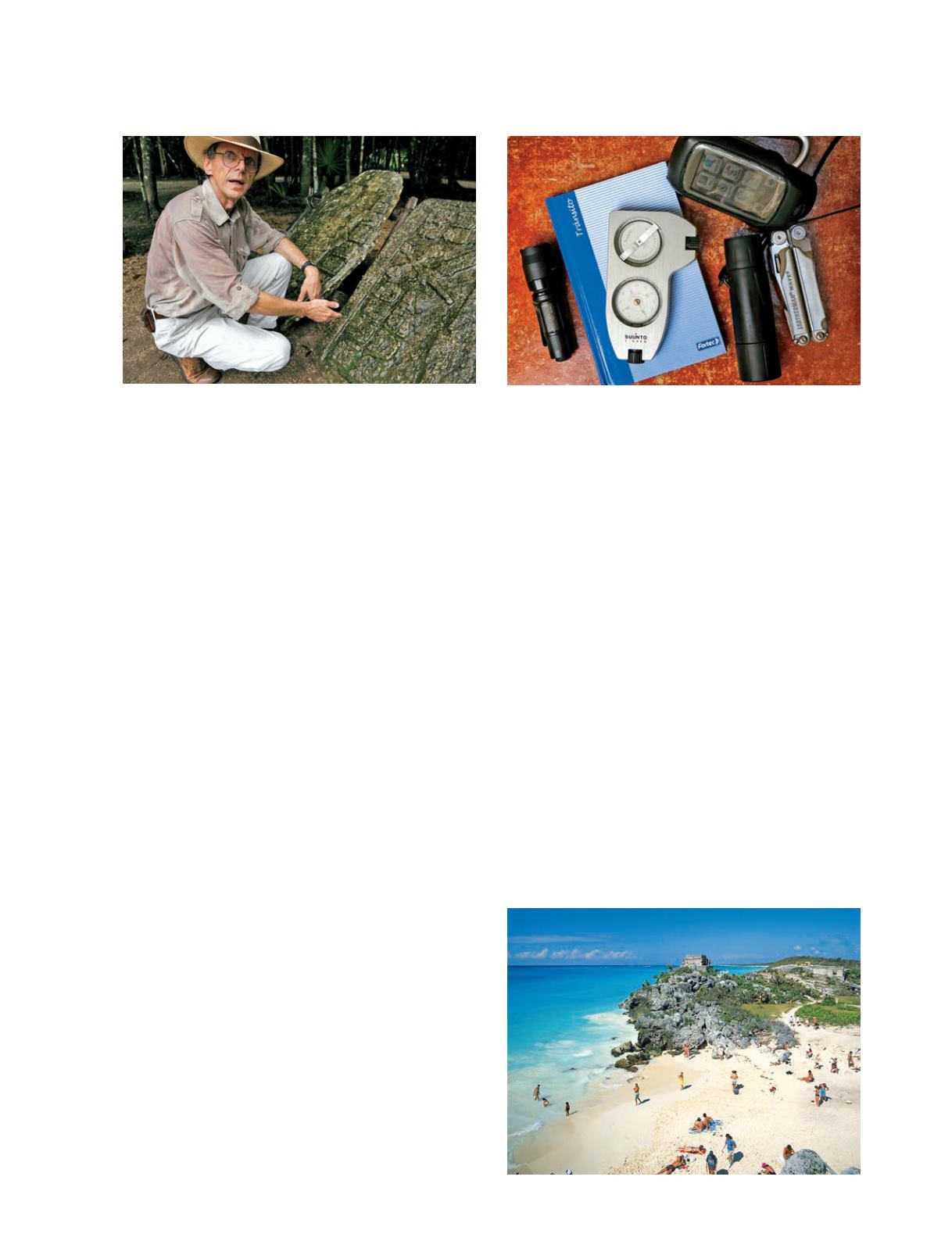
Clockwise from top
left:
Š
prajc with
stellae at Coba; tools
of the trade; Tulum
TERRYWHY/GETTY IMAGES (TULUM)


