CLOSEUP
culinary heritage
FAHTHAI
81
but prepared in a way that’s truer to the cuisine’s origins. It includes the
piquant
saa moo
, which is minced pork tossed with the diced heart of the
banana flower, shallot and mint.
Oua si khai
is a dish taken from Phia Sing’s
notebooks. Here lemongrass stalks – cut with the point of a needle – are
stuffed with ground pork and shallots before being grilled over coals and
then deep fried.
Tamarind’s “Adventures Lao Gourmet” menu showcases a range of
textures, flavours and cooking styles. It’s a tasting menu, so intrepid souls
can try a little of everything. On my visit, I order a selection of these dishes
prepared “Lao style”. The first is a Luang Prabang classic called
or
lam
, a
slow-cooked stew made from stock, chilli, lemongrass, smoked meat and
pounded eggplant, and thickened with a small ball of sticky rice that has
been barbecued to give it a slightly smoky flavour. Or lam’s most crucial
ingredient – the one that roots it in Luang Prabang – is the bark of the sakan
or pepperwood tree. The bark is gathered in the forest and boiled with the
stew to give the dish its lively, peppery tinge.
Or lam’s close cousin,
or paedaek
is even more unusual. A rich, robust
soup of egg, smoked meat and herbs, the dish’s flavour derives from the use
of a generous dollop of paedaek. This fermented fish paste is commonplace in
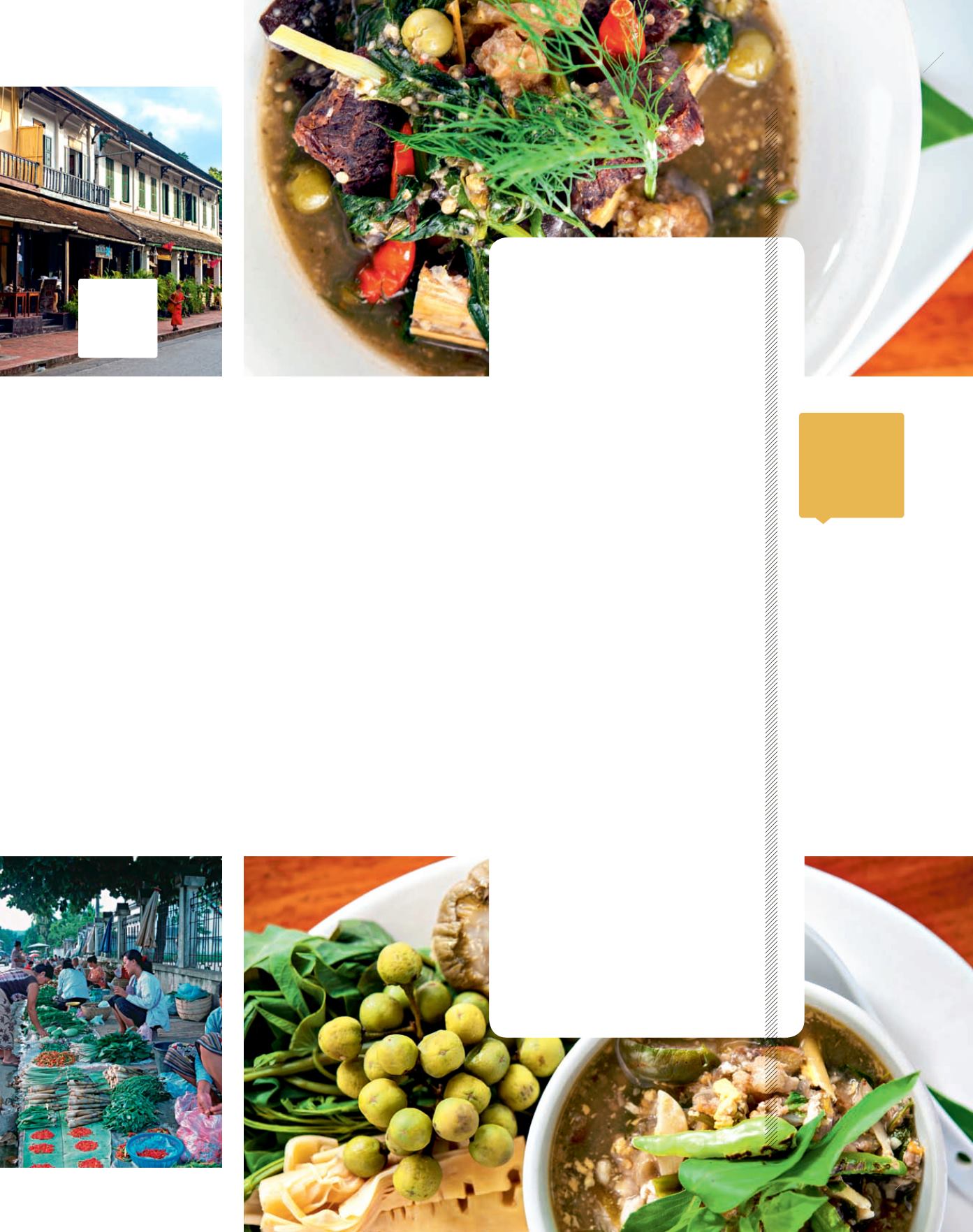
DISH IT OUT
(Clockwise)
Shophouses;
dishes at Tamarind
and street market
Living Land is a villager-
operated community
farm and training
centre located a few
kilometres outside of
Luang Prabang. The farm
produces a bounty of
tropical fruits, vegetables
and grains. Each
morning, guests can learn
how to grow and harvest
rice and even make like a
farmer and use a buffalo
to plough the fields
.
livinglandlao.com
On the
farm
“When I was
a child a dish’s
flavour came
fromboiling
bones for
stock, adding
bark from the
forest and
lots of fresh
herbs. These
days, young
people prefer
to flavour
dishes with
sugar, salt and
MSGbecause
they’remore
convenient”


