CLOSEUP
culinary heritage
FAHTHAI
77
S
ituated on a narrow peninsula cradled by the rust-red Mekong
and Nam Khan rivers, Luang Prabang brims with bejewelled
temples, rambling colonial mansions and quaint shophouses.
However, it’s the former Lao capital’s culinary delights that
really set it apart from other cities in the region. Local dishes are
typically made with herbs and tree bark gathered in the jungle, along with a
handful of foreign ingredients like dill, tomatoes and chilli, which are thought
to have arrived with a Dutch trader in the 16th century.
Luang Prabang has a cuisine that’s as distinct as the city’s quaint streets.
While flavour is at the heart of the local food culture, it was the skills and
shared gift for refinement of its creators – developed over many centuries in
the kitchens of the royal courts in Luang Prabang – that are most responsible
for its flair and uniqueness.
Having fallen into relative obscurity after the communist revolution in
1975, when the courts were dismantled and aristocratic populations were
sent into exile, Luang Prabang’s cuisine received a much-needed boost when
the city was awarded UNESCOWorld Heritage status in 1995 in recognition
of its architecture. The years that followed saw the city’s indigenous food
culture start to re-emerge, fighting for recognition with the Thai, Vietnamese
and French dishes that had surfaced to cater for the tourist crowd. The main
guardians of this revival were chefs whose families had fled overseas at the
onset of the communist revolution and then returned or locals intrigued
by the dishes of Phia Sing, the former cook and master of ceremonies for
the royal court. His celebrated recipes were discovered in notebooks and
published by British diplomat Alan Davidson in the 1980s.
Herbaceous, earthy and spicy, Luang Prabang’s cuisine is bold, full-bodied
and designed to be accompanied by – and toned down with – rice. Here,
the rice is of the low-starch, sticky variety, kneaded into balls and used to
scoop up the accompanying dishes. However, for some this approach to
cuisine is too brazen. Many restaurants serving local cuisine started dumbing
down their dishes, offering weakened, gentler and sweeter versions that their
owners viewed as being more palatable to their overseas guests. “Tourists
would complain about the spice and ingredients like buffalo skin and
fermented fish. So we took them out,” says Chenhpheng Sang Khom, the
chef at The 3 Nagas Restaurant, which in 2005 become the first eatery here
to go back to serving local dishes prepared the local way. “We also used to
keep frog and snake on the menu, hoping that somebody would try them,
but they would end up going to waste.”
CULINARY TAILS
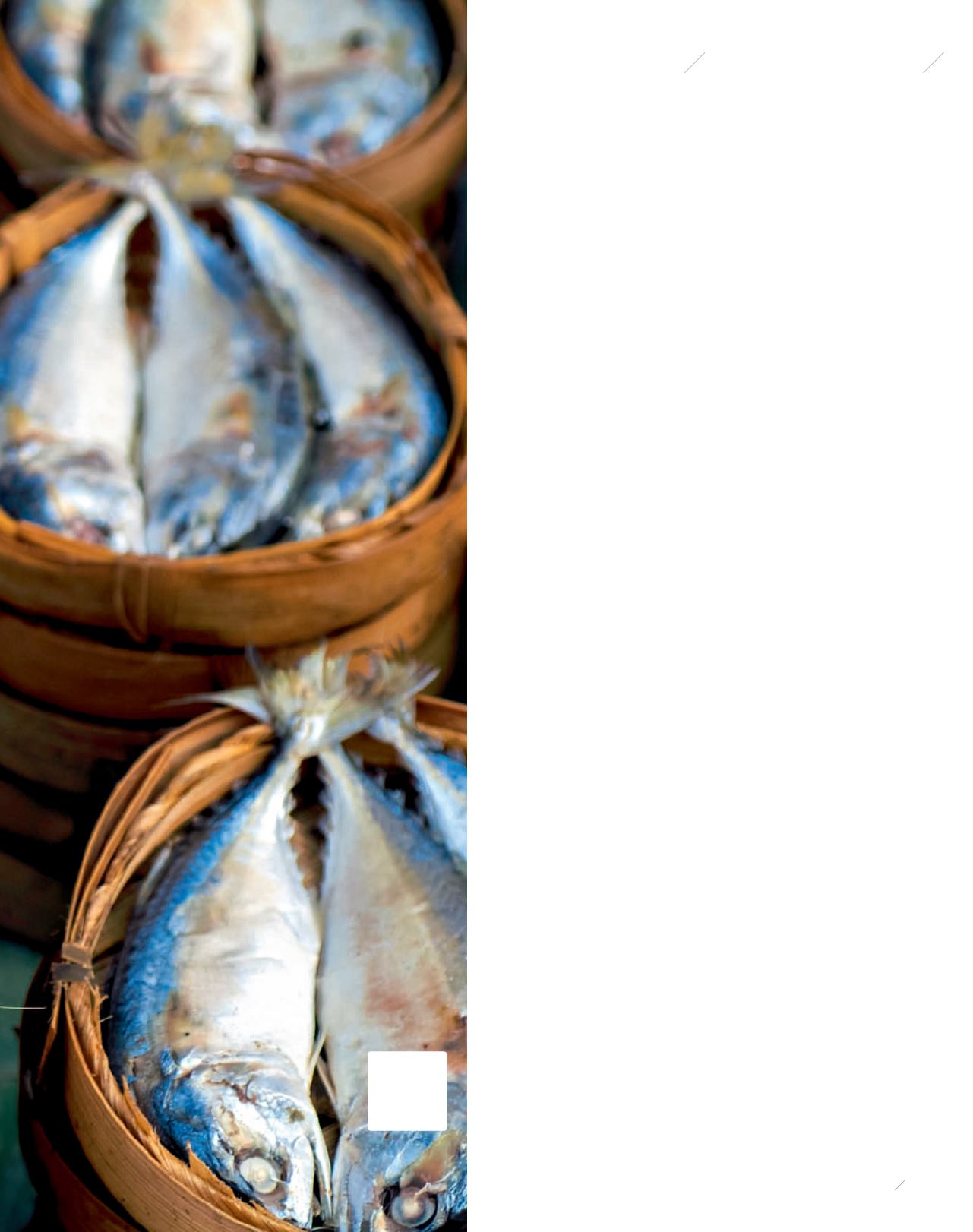
Fish at the market;
(Opening spread):
sai moo
and
oua
si khai
at 3 Nagas


