42
FAHTHAI
CLOSEUP
battambang arts
students getting their money’s worth and workers swinging by
on motorbikes for a quick meal. This is how Cambodians eat,
she says. “We’re always snacking but we save room for the early
evenings.”
When dusk arrives, we collapse in a riverside
sala
(hut) to
sample the local speciality,
sangvak
(fermented fish wrapped in
banana leaves). Cambodia is widely known for its spectacular
sunsets but on this day I’m treated to one of the best I’ve seen
– the sky a kaleidoscopic swirl of tangerine, vivid pink and
washed-out, icy blues.
Phary hails from Siem Reap and her partner had to do some
persuading before she’d agree to pick up sticks and move to
Battambang. But the tales of old ’60s singers and stars like
Cambodia’s answer to Elvis, Sinn Sisamouth, strolling along
the Sangkhae while composing songs had irresistible allure.
“There’s one beautiful song by him about the river called
‘
Dorng Steung Sangkhae
’ that captures my heart,” she says. “I
couldn’t leave now. I get the magic they all talked about.”
I picture what it would have been like for Sisamouth and
his fellow artists on their weekend sojourns to the city, taking
a promenade
sur l’eau
(river excursion) before dolling up
for the dance halls. And I remember something Det told me
about Phare and the artists’ ambitions and what they could
“reclaim.” My reverie is interrupted when an installation by
the artist, Touch, recreated that morning for our photographer,
glides past. The rickety boat is ferrying a handful of monks
draped in tangerine and ochre robes, and the leaves and flowers
that the artist placed there have been burnt a golden brown by
the sun. Phary gives it a curious glance and it’s at that moment
that I feel the Battambang magic, too.
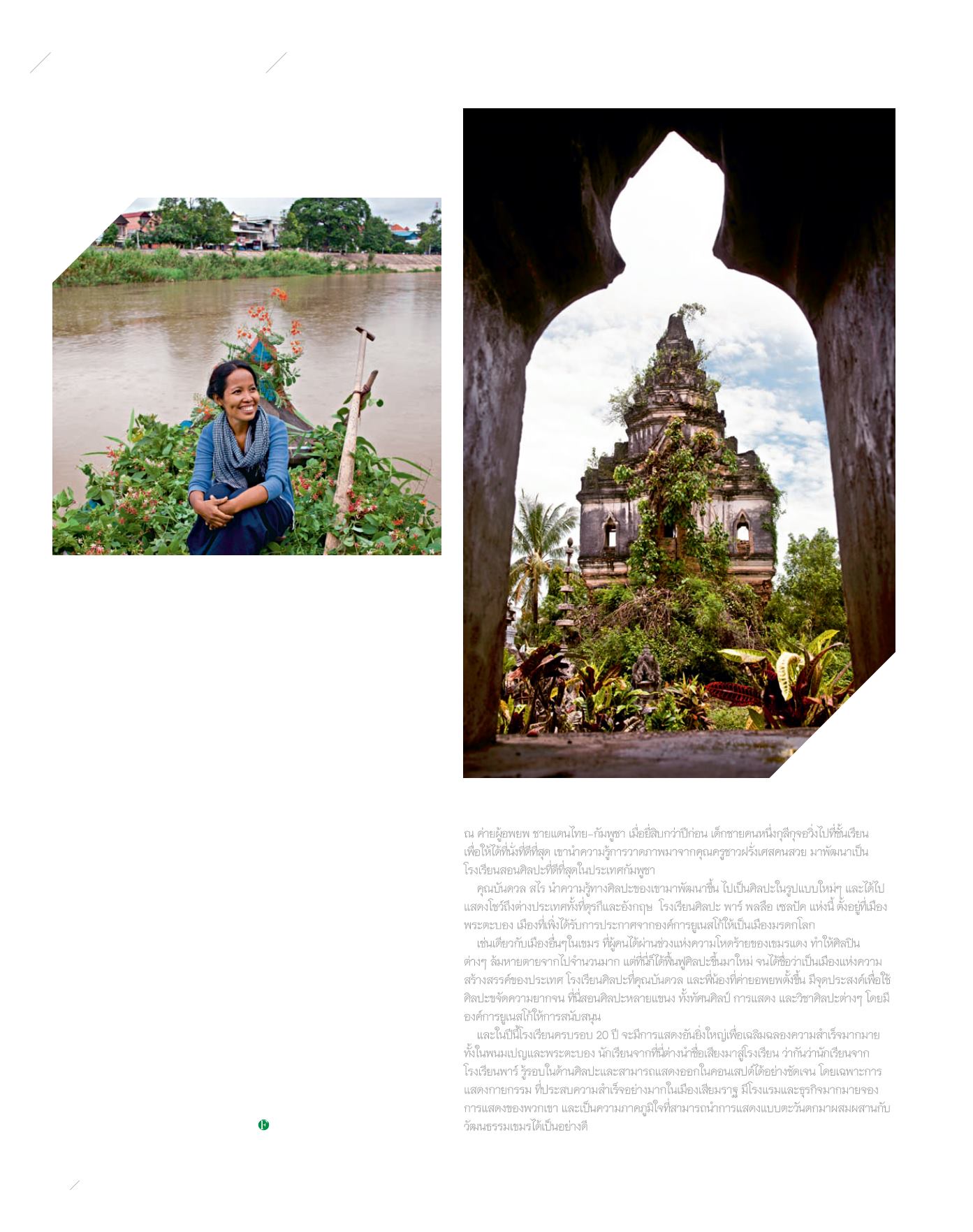
FLOATING ON
Khchao Touch and
her installation,
“Time to Think” on
the Sankhae River


