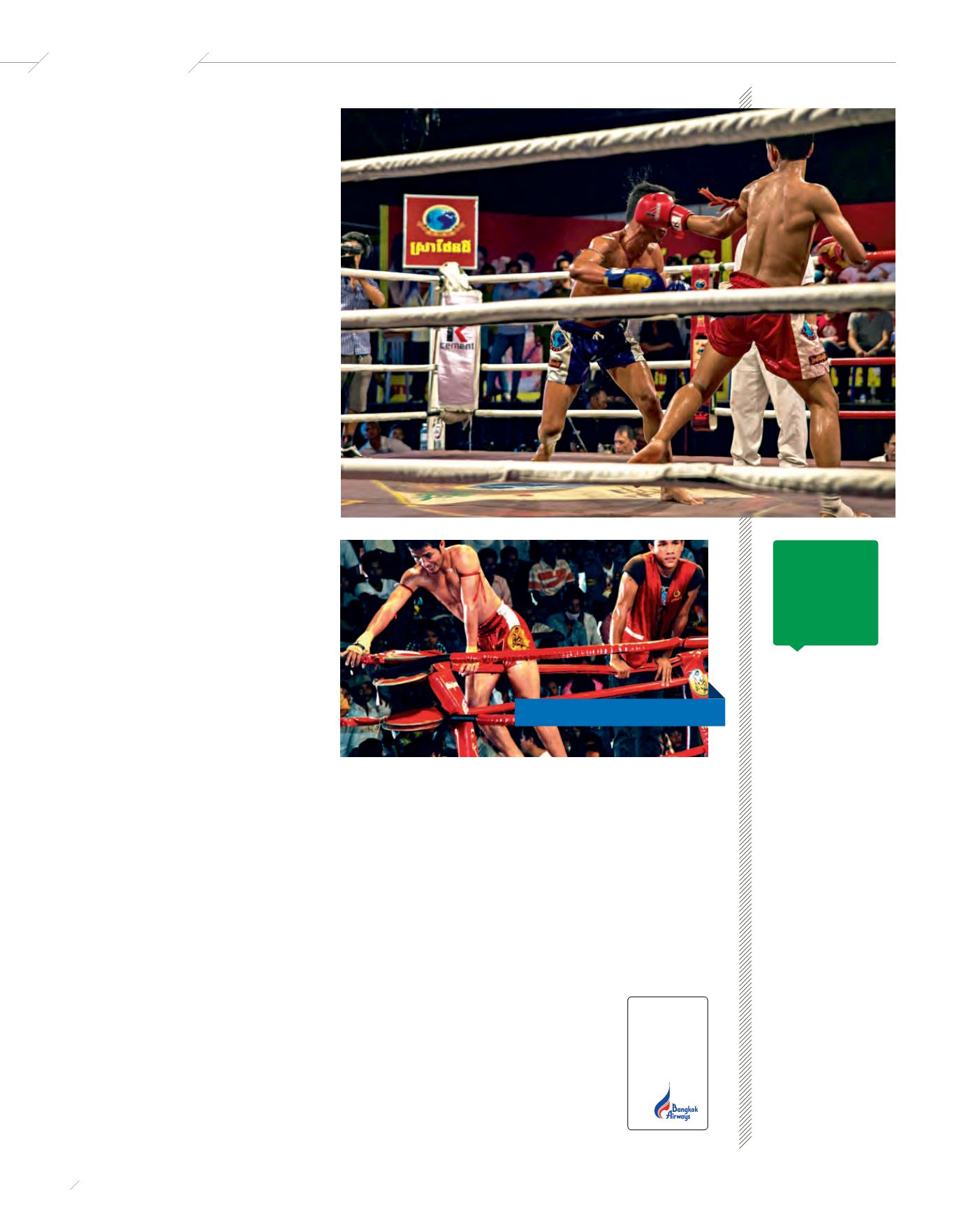
Skilled fighters choose an animal to serve as
a “totem”, which becomes the inspiration for a
fighter’s techniques. Lions and tigers are popular
choices, being seen as invincible creatures, but
Chan opted for the magic eagle Keno. “The eagle
has strength and power,” he says.
But yutakhun khom isn’t solely about
strength. It also takes in discipline, spirit and
an indoctrinated belief, Chan says as he points
to the “protective” tattoos that mark his body.
“These were drawn using incense by a monk and
my father,” he says, adding that tracing invisible
tattoos on the skin before each fight is a ritual.
The son of Lok Kru Chan Bunthoeun, one
of just two surviving Grand Masters, Chan is
fighting to keep the tradition alive. “It’s part of
my culture,” he says. “It has been in my family
for generations and it’s important that we as
Cambodians keep our culture and heritage alive,
because it is part of who we are.”
Born in a refugee camp in the wake of the
civil war, Chan and the surviving members of his
family eventually moved to Ta Khmao in Kandal
province. It was here that he was introduced to
the martial art that has been passed down through
generations of his family. Chan has dedicated the
last decade of his life to studying under his father,
and has so far mastered more than 500 of the
9,958 moves that make up yutakhun khom.
Even at age 72, the elder Chan continues to
teach the martial art he has mastered, specialising
in the pillars of kicks and punches and weapons.
He runs a school in the northern province of
Banteay Meanchey and has even been flown
to the United States to share his skills with
professional MMA fighters.
Thanks in large part to his father’s yutakhun
khom training, Chan has emerged victorious
each of the 80-plus times he has entered the ring.
Last year, he co-founded the Selapak Living
Arts School with
apsara
(Cambodian traditional
dance) teacher Sen Pich. “I want people to know
more about yutakhun khom so it can continue
on for generations to come. This is essential, and
more needs to be done if the tradition is to be kept
alive,” Chan says.
(selapak-cambodia.com)
STOPOVER
sport
26
FAHTHAI
PAST...
The ancient art of
yutakhun khom is
depicted in the bas-
reliefs carved into the
entrance pillars of Bayon,
Jayavarman VII’s state
temple, near Angkor
Wat. Scenes depicting a
series of techniques adorn
the pillars, such as men
grappling and fighters
using their elbows –
standard techniques in the
martial art.
...AND PRESENT
Today, yutakhun khom
is undergoing a rapid
revival, with more young
Cambodians taking an
interest in the sport. Fights
take place regularly across
the country and there are
several training schools.
Check out our
destination guide
on page 127
and book
your flights at
bangkokair.com
“
It is
important
that we as
Cambodians
keep our
culture and
heritage alive,
because it is
part of who
we are”
The
cultural
relevance
T R A D I T I O N
MAIN PHOTO: THOMAS CRISTOFOLETTI


