EDITOR’SNOTE
E
TheChicagoCubs’WrigleyField(page54), the
second-oldestballpark inbaseball (1914), routinely
attracted fewer than 12,000 people for home
games in themid-1950s, mid-’60s, mid-’70s and
early ’80s. Towit, theCubbies rankedeitherworst
or close toworst inNational League attendance
duringbaseball’s“goldenyears.”Thesedays,home
games regularly are soldout, and theCubs aren’t
exactlydoinganybetter than theywereback then.
They finished the2012season61-101, second-worst
inMLB. Yet they’re sellingouthomegames.
“My theory is that baseball, which is different
than anyother American sport because there’s a
game virtually everyday of the season, is always
givingyousomething to talkabout,”Shapirosays.
“What we love about baseball is the conversation.
It’snever a staleconversation. Youcan talkabout
yesterday’sgame;youcan talkaboutyour favorite
player from thenightbefore;youcan talkstatistics
until you’reblue in the face. It offers a chance for
strangers to talk about something that matters
to them.”
Shapiro points out that everything about the
rules of professional baseball, which are virtually
unchanged aftermore than a century, is elegant.
For instance, when a ground ball is hit to an in-
fielder, hehas to field itcleanly, andhe’llgenerally
get the runneroutbyastep. Every time.Onestep.
That’snota lotof time. “It turnsout that90 feet is
theperfectdistance,”hesays. “If itwas91 feetbe-
tween thebases insteadof90, it’sadifferentgame.
Lookatpitching:Acurveballwillbreakat60 feet,6
inches. It’selegantand it’sscientific. Forgetabout
fathers and sons playing catch. That’s abeautiful
thing. Butbaseball isabout theconversation, and
that conversation helps definewhowe are as a
society. It’s theperfectgame.”
Theperfect game. For a spectator, it certainly
is. What’s better than spending a lazy summer
afternoon at the ballpark, wearing the jersey of
your favorite player (for me,
these days, it’s Ian Kinsler of
the Texas Rangers), eating
somegourmet food (page32)
and producing a consistently
highenergy level with42,000
like-minded fans? Or what’s
better than buying a plane
ticket and flying to, say, Los
Angeles to watch Ian Kinsler
playagainst formerteammates
JoshHamiltonandC.J.Wilson,
andALRookieof theYearMike
Troutof theAngels (page30)?
But it’s also the perfect
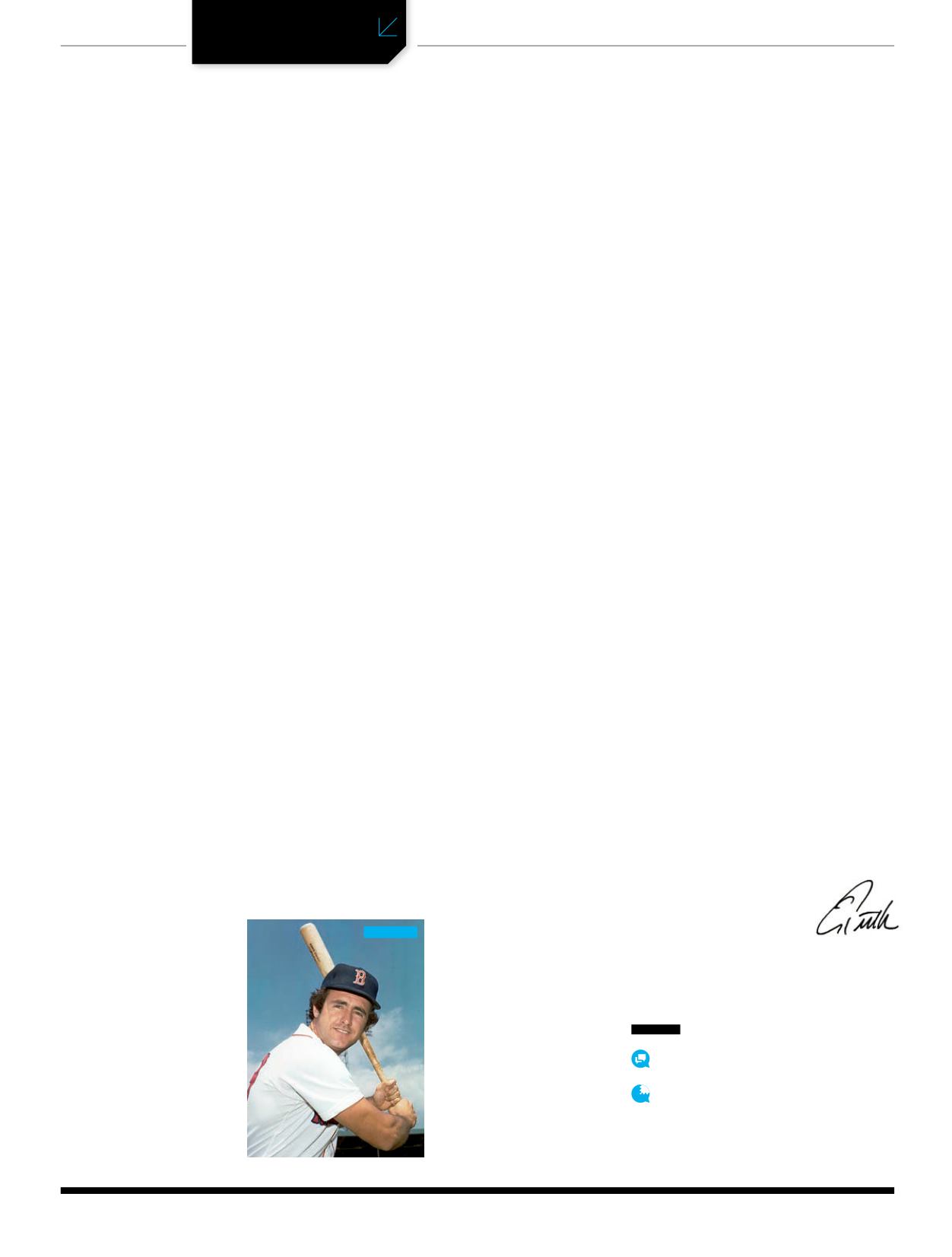
game from the player’s perspective, says nine-
timeAll–Starand four-timeGoldGlovewinnerFred
Lynn,whoplayedcenter field for fivemajor league
teams from 1974 to 1990.
“Baseball ismorepersonal thananyothersport
because you can see the players up close,” says
Lynn, whowas also the first player in history to
winRookieof theYearandMostValuablePlayer in
the sameyear (1975). “In fact, if youwant to, you
canwatch your favorite guy for nine innings and
not miss the rest of the game. You can’t do that
in football or basketball. This creates abondwith
the fans,which iswhyyouhearsome fanssay, ‘My
guyhadagoodgame today.’ There isnoplace to
hideonabaseball field.Weareveryexposed, and
I think that’s just theway the fans like it. I know
that’s theway I liked itwhen Iwasplaying.
“I lovedplaying in front of the hometown fans,
especially when I was with the Red Sox. And I
lovedplayingagainst thehostileNewYork fansat
YankeeStadium. Inbaseball, youcan feel theebb
and flowof thegame. It’snotasudden rush.When
we’redownby three in theeighth inning, and the
firstguygetson, and then thesecondguy, and the
fans get involved, you can feel the emotion start
to factor in. Itmakes you abetter player. That’s a
strong force.
“On theotherside,when I’mplayingcenter field,
I can hear individual fans cheeringme on, or in
NewYork, hecklingme. Do you know howmany
times I haveheard, ‘Comeon! I couldhavecaught
thatball!Whatwereyoudoingout there?’
“Personal.”
Welcome to the firstbaseball issueof
American
Way
in our 47-year history. We take you around
the league like no other magazine, highlighting
thebestplayers, stadiums, food…evenoneof the
best announcers in the game (page 18). Andwe
haveHarrisonFordon thecover,playingoneof the
toughest roles of his storied acting career (page
42).We think it’s theperfect read togetyou ready
for the2013 seasonof theperfectgame.
EVEN TODAY,
in this fast-paced, multitasking,
optimize-production, if-you’re-not-first-you’re-
last day and age, it’s nice to see that at least one
sport continues to be slow and steady. It’s also
nice toknow thateven today, inourmultiplatform,
surf-the-Web-with-your-phone, call-your-mom-
with-your-tablet, take-a-picture-with-just-about-
anythingsociety, asimplegameofcatchwithyour
momordad is still themost satisfyingactivity.
Professional sportsseem tobe inconstant flux.
The rules always seem tobegetting tweaked, the
playersalwaysseemtobechangingshape, the fans
alwaysseem tobepushing theenvelopeofproper
stadium/arenaetiquette.Baseball’snotcompletely
impervioustotheseathleticagitations,buttheyare
decidedly less pronounced inAmerica’s pastime.
Perhaps it’sbecause thegame isplayedataslower
pace. Ormaybe it’s because in baseball, the fans
and the players — especially in the post-steroid
era—are so thoroughly committed topreserving
the sport as a true bastion of American culture
and recreation that trivial problems arenot as am-
plified. Or maybe it’s because, regardless of the
congressional-testimonysteroidsideshow,baseball
was, is, andwill alwaysbe, theperfectgame.
That’s my thesis, and I’m sticking to it. But I
don’t justwanttoprivatelythinkthatbaseball isthe
greatestgameever invented. Iwant toproselytize
it; and Iwant you tobelieveme. Tomakemycase,
Ichecked inwith two individualswhonotonlyhave
definitiveknowledgeof thegame,butwhoalsocan
offertwoperspectivesthatthecasual fancan’t: the
sageprofessor and the formerplayer.
Leading off is Columbia University Graduate
School of Journalism professor Michael Shapiro,
author of
Bottomof theNinth
and
TheLastGood
Season
. Shapiro isabaseball historian,whichalso
makes him a truly dedicated, passionate fan. I
start with a simple question: Is baseball still our
national pastime? In true professorial fashion,
Shapirobeginshis lecturewith
ameasurement:
In 1960, Gallup conducted
a survey to determine the
most popular spectator sports
in the country. Baseball was
No. 1. Ten years later, baseball
was second to the NFL. Back
then, peoplesaid thatbaseball
was finished— that its golden
yearswerebehind it. “Absolute
nonsense,” Shapiro says. “At-
tendance around the league is
higher now than it’s ever been.
LookatWrigley, for example.”
APerfectGame
COURTESYFREDLYNN
ADAM PITLUK
Editor
WanttotalktoAdam?
Reachhimat
Wanttosignupforemail
notificationofAdam’s columnor to
readhispast columns?Visit
aa.com/americanwayand clickon
“Editor’sNote.”
FredLynn
10
APRIL 01, 2013
AA.COM/AMERICANWAY


