Installing a VRA
Zerto recommends installing a VRA on every host in every site so that if protected virtual machines are moved from one host in the cluster to another host in the cluster there is always a VRA to protect the moved virtual machines.
VRA Installation Requirements
To install a VRA you require the following on the host:
|
•
|
At least 1GB of reserved memory. |
|
•
|
(vSphere only) The ESX/ESXi version must be in accordance with supported ESX/ESXi versions in the Interoperability Matrix, and Ports 22 and 443 must be enabled on the host during the installation. |
|
•
|
Port 8100 must be enabled on SCVMM. |
|
•
|
(Hyper-V only) Minimum PowerShell version: 4.0 |
|
•
|
The following PowerShell cmdlet has been run: |
Install-WindowsFeature –Name Hyper-V -IncludeManagementTools -Restart
Before You Begin:
You must know the following information to install a VRA:
|
•
|
(vSphere only) If the ESXi version is 5.5 or higher and the VRA should connect to the host with user credentials, or if the ESXi version is lower than 5.5, the password to access the host root account. |
|
Note:
|
For ESXi versions 5.5 or higher, by default the VRA connects to the host with a vSphere Installation Bundle, VIB. Therefore, it is not necessary to enter the password used to access the host root account. |
|
•
|
The storage the VRA will use, and the local network used by the host. |
|
•
|
The network settings to access the peer site; either the default gateway or the IP address, subnet mask, and gateway. |
|
Note:
|
When the gateway is not required, you can specify 0.0.0.0 as the gateway, for example when performing self replication. |
|
•
|
If a static IP is used, , which is the Zerto recommendation, instead of DHCP you need to know the IP address, subnet mask, and default gateway to be used by the VRA. |
|
Note:
|
Zerto strongly recommends using only Static IPs during production, and to use either static IPs or DHCP during trials. The reason for this is that if the VRA IP is allocated via DHCP and the DHCP server at a later date allocates a different IP (for example on reboot), ZVM does not change the VRA IP in the ZVM records. |
|
•
|
If the peer site VRAs are not on the default gateway, you must set up routing to enable the VRAs on this site to communicate with the peer site VRAs before defining the VRAs. |
|
•
|
Setting up routing after defining VRAs only applies to VRAs installed after the routing is set. |
|
•
|
Any existing VRA is not affected and access to these VRAs continues via the default gateway. |
|
•
|
If the default gateway stops being used, you must reinstall the VRAs that were installed before setting up paired site routing. |
|
•
|
(vSphere only) For the duration of the installation of the VRA, the Zerto Virtual Manager enables SSH in the vCenter Server. |
|
•
|
(vSphere only) You must know the following information to install a VRA: |
|
•
|
The password to access the host root account, for ESXi 5.x. |
|
•
|
The datastore the VRA will use and the local network used by the host. |
|
•
|
The network settings to access the peer site; either the default gateway or the IP address, subnet mask, and gateway. |
|
•
|
If a static IP is used, instead of DHCP, which is the Zerto recommendation, you need to know the IP address, subnet mask, and default gateway to be used by the VRA. |
|
Note:
|
Zerto strongly recommends using only Static IPs during production, and to use either static IPs or DHCP during trials. The reason for this is that if the VRA IP is allocated via DHCP and the DHCP server at a later date allocates a different IP (for example on reboot), ZVM does not change the VRA IP in the ZVM records. |
If the peer site VRAs are not on the default gateway, you must set up routing to enable the VRAs on this site to communicate with the peer site VRAs before defining the VRAs. Setting up routing after defining VRAs only applies to VRAs installed after the routing is set. Any existing VRA is not affected and access to these VRAs continues via the default gateway. If the default gateway stops being used, you must reinstall the VRAs that were installed before setting up paired site routing.
To set up routing:
|
1.
|
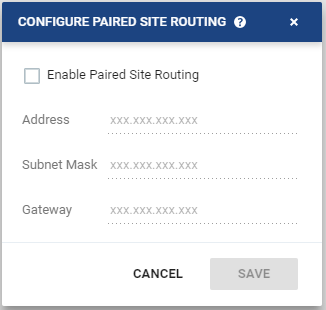
In the SETUP > VRAs tab, select MORE > Paired Site Routing. |
The Configure Paired Site Routing dialog is displayed.
|
2.
|
Click Enable Paired Site Routing. |
|
3.
|
Specify the following, and then click SAVE: |
|
•
|
Address: The IP address of the next hop at the local site, the router or gateway address, that is used to access the peer site network. |
|
•
|
Subnet Mask: The subnet mask for the peer site network. |
|
•
|
Gateway: The gateway for the peer site network. |
These access details are used to access all VRAs installed on the peer site after the information is saved.
To install a Zerto Virtual Replication Appliance (VRA) on ESX/ESXi hosts:
|
1.
|
In the Zerto User Interface, click SETUP > VRAs. |
|
2.
|
Select a host which requires a VRA and click NEW VRA. |
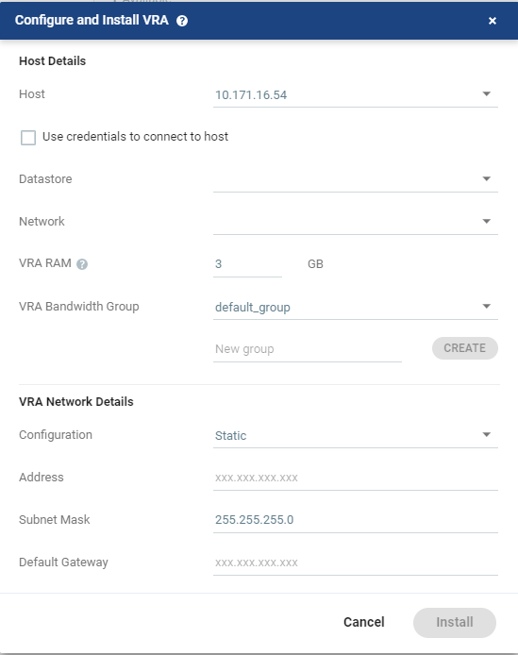
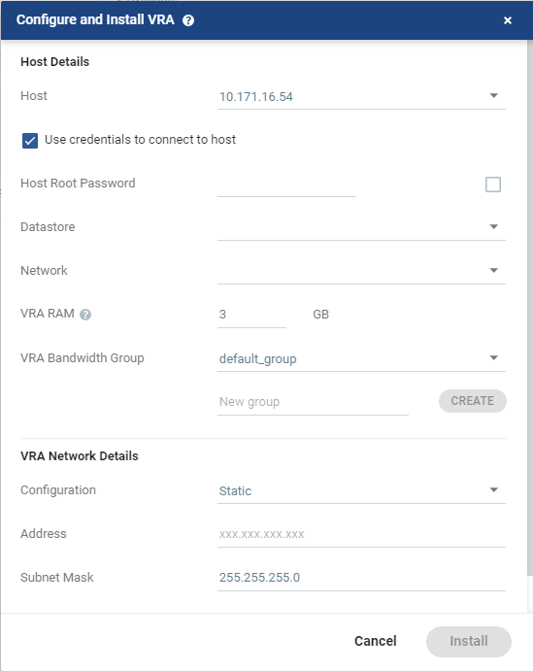
The Configure and Install VRA dialog is displayed. The dialog displayed depends on the ESX/i version:
|
|
| ESXi versions from 5.5 |
ESXi versions before version 5.5 |
To configure and install Zerto Virtual Replication Appliances (VRAs) on ESX/ESXi hosts:
|
3.
|
Specify the following Host Details: |
|
•
|
Host: The host on which the VRA is installed. The drop-down displays the hosts that do not have a VRA installed, with the selected host displayed by default. |
(vSphere only) From ESXi 5.5, by default, Zerto Virtual Manager creates a .VIB (vSphere Installation Bundle) which is used to set up a secure communication channel to the host. The .VIB is installed on the host when the VRA is installed. When using VIB:
|
•
|
The user does not enter a password. |
|
•
|
Once a day, Zerto Virtual Manager checks that the VRA and host can connect. If the connection fails, Zerto Virtual Manager re-initiates the connection automatically and logs it. |
(vSphere only) From ESXi 5.5, by default, Zerto Virtual Manager creates a .VIB (vSphere Installation Bundle) which is used to set up a secure communication channel to the host. The .VIB is installed on the host when the VRA is installed. When using VIB:
|
•
|
The user does not enter a password. |
|
•
|
Once a day, Zerto Virtual Manager checks that the VRA and host can connect. If the connection fails, Zerto Virtual Manager re-initiates the connection automatically and logs it. |
(vSphere only) For ESX/i versions earlier than 5.5, when using a password, Zerto Virtual Manager connects to the host using the root password. Once a day, Zerto Virtual Manager checks that the password is valid. If the password was changed, an alert is issued, requesting the user enter the new password.
|
•
|
Use credentials to connect to host: When unchecked, the Zerto Virtual Manager uses VIB to set up a secure communication channel to the host. This field is only relevant for ESXi 5.5 and later. |
|
•
|
Host Root Password: When the VRA should connect to the host with a password, check Use credential to connect to host and enter the root user password used to access the host. When the box on the right side is checked, the password is displayed in plain text. This field is only relevant for ESXi 5.x hosts. |
|
•
|
Datastore: The datastore that contains the OS disks of the VRA VM. You can install more than one VRA on the same datastore. |
|
•
|
Network: The network used to access the VRA. |
|
•
|
VRA RAM: The amount of memory to allocate to the VRA. The amount determines the maximum buffer size for the VRA for buffering IOs written by the protected virtual machines, before the writes are sent over the network to the recovery VRA. The recovery VRA also buffers the incoming IOs until they are written to the journal. If a buffer becomes full, a Bitmap Sync is performed after space is freed up in the buffer. For details, see Zerto Scale and Benchmarking Guidelines. |
|
•
|
VRA Bandwidth Group: Choose the VRA Bandwidth Group from the dropdown list. To create a new VRA group, type in the name of the new group and click CREATE. You can then choose the new group from the dropdown list. |
You group VRAs together when VRAs use different networks so they can be grouped by network, for example when the protected and recovery sites are managed by the same vCenter Server and you want to replicate from the branch site to the main site. Within a group the priority assigned to a VPG dictates the bandwidth used and is applicable within a group and not between groups. Thus, a VPG with a high priority is allocated bandwidth before VPGs with lower priorities. VPGs that are on VRAs with different VRA groups, for example, VPG1 on VRA1 in group1 and VPG2 on VRA2 in group2, do not affect each other, as the priority is relevant only within each group.
|
4.
|
Specify the following VRA Network Details: |
|
•
|
Configuration: Either have the IP address allocated via a static IP address or a DHCP server. |
Zerto strongly recommends using only Static IPs during production, and to use either static IPs or DHCP during trials. The reason for this is that if the VRA IP is allocated via DHCP and the DHCP server at a later date allocates a different IP, ZVM does not change the VRA IP in the ZVM records.
If you select the Static option, enter the following:
|
•
|
Address: The IP address for the VRA. |
|
•
|
Subnet Mask: The subnet mask for the network. The default value is 255.255.255.0. |
|
•
|
Default Gateway: The default gateway for the network. |
The VRA installation starts and the status is displayed in the TASKS popup dialog in the status bar and under MONITORING > TASKS.
The VRA displayed name, and DNS name, is Z-VRA-hostname. If a virtual machine with this name exists, for example when a previous VRA was not deleted, the VRA name has a number appended to it.
See also: