


Page 186 - TransportationPlanUsetsGuide
P. 186
In addition to the fixed routes described in Table 3.19, TriMet provides LIFT paratransit service - a shared ride advance-
            reservation service for people who cannot use regular buses or trains due to a disability or disabling health condition.
            Users must meet ADA eligibility criteria and be registered with TriMet. The LIFT vehicle fleet includes small buses, vans,
            and taxis, serving the area generally extending 0.75 miles beyond the outer limits of TriMet bus and MAX lines, but
            no further than the TriMet service district boundary. The nonprofit Ride Connection, described later, offers paratransit
            service in a larger area of Washington County.


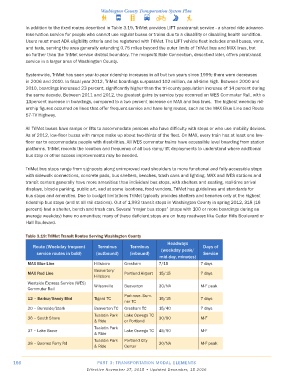
            Systemwide, TriMet has seen year-to-year ridership increases in all but two years since 1999; there were decreases
            in 2006 and 2010. In fiscal year 2012, TriMet boardings surpassed 102 million, an all-time high. Between 2000 and
            2010, boardings increased 23 percent, significantly higher than the tri-county population increase of 14 percent during
            the same decade. Between 2011 and 2012, the greatest gains by service type occurred on WES Commuter Rail, with a
            13percent increase in boardings, compared to a two percent increase on MAX and bus lines.  The highest weekday rid-
            ership figures occurred on lines that offer frequent service and have long routes, such as the MAX Blue Line and Route
            57-TV Highway.


            All TriMet buses have ramps or lifts to accommodate persons who have difficulty with steps or who use mobility devices.
            As of 2012, low-floor buses with ramps make up about two-thirds of the fleet. On MAX, every train has at least one low-
            floor car to accommodate people with disabilities. All WES commuter trains have accessible level boarding from station
            platforms. TriMet records the location and frequency of all bus ramp/lift deployments to understand where additional
            bus stop or other access improvements may be needed.

            TriMet bus stops range from signposts along unimproved road shoulders to more functional and fully-accessible stops
            with sidewalk connections, concrete pads, bus shelters, benches, trash cans and lighting. MAX and WES stations and
            transit centers generally have more amenities than individual bus stops, with shelters and seating, real-time arrival
            displays, bicycle parking, public art, and at some locations, food vendors. TriMet has guidelines and standards for
            bus stops and amenities. Due to budget limitations TriMet typically provides shelters and benches only at the highest
            ridership bus stops (and at all rail stations). Out of 1,993 transit stops in Washington County in spring 2012, 318 (16
            percent) had a shelter, bench and trash can. Several “major bus stops” (stops with 100 or more boardings during an
            average weekday) have no amenities; many of these deficient stops are on busy roadways like Cedar Hills Boulevard or
            Hall Boulevard.


            Table 3�19: TriMet Transit Routes Serving Washington County
                                                                       Headways
               Route (Weekday frequent    Terminus     Terminus     (weekday peak/    Days of
                service routes in bold)  (outbound)    (inbound)                      Service
                                                                    mid-day, minutes)
             MAX Blue Line              Hillsboro    Gresham       7/15              7 days
                                        Beaverton/
             MAX Red Line                            Portland Airport  15/15         7 days
                                        Hillsboro
             Westside Express Service (WES)   Wilsonville  Beaverton  30/NA          M-F peak
             Commuter Rail
                                                     Parkrose- Sum-
             12 – Barbur/Sandy Blvd     Tigard TC                  15/15             7 days
                                                     ner TC
             20 – Burnside/Stark        Beaverton TC  Gresham TC   15/40             7 days
                                        Tualatin Park   Lake Oswego TC
             36 – South Shore                                      30/90             M-F
                                        & Ride       or Portland
                                        Tualatin Park
             37 – Lake Grove                         Lake Oswego TC  45/90           M-F
                                        & Ride
                                        Tualatin Park   Portland City
             38 – Boones Ferry Rd                                  30/NA             M-F peak
                                        & Ride       Center


      166                                 PART 3: TRANSPORTATION MODAL ELEMENTS
                                     Effective November 27, 2015 • Updated December, 15 2016

