


Page 151 - TransportationPlanUsetsGuide
P. 151
Pedestrian
            Crossings
            Street crossings
            form critical con-
            nections in the pe-
            destrian network,
            facilitating the
            simple but some-
            times risky act of
            walking to desti-
            nations across the
            street. Crossings
            are particularly
            important for
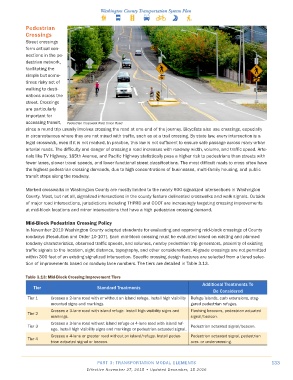
            accessing transit,   Pedestrian Crosswalk West Union Road
            since a round trip usually involves crossing the road at one end of the journey. Bicyclists also use crossings, especially
            in circumstances where they are not mixed with traffic, such as at a trail crossing. By state law, every intersection is a
            legal crosswalk, even if it is not marked. In practice, this law is not sufficient to ensure safe passage across many urban
            arterial roads. The difficulty and danger of crossing a road increases with roadway width, volume, and traffic speed. Arte-
            rials like TV Highway, 185th Avenue, and Pacific Highway statistically pose a higher risk to pedestrians than streets with
            fewer lanes, slower travel speeds, and lower functional street classifications. The most difficult roads to cross often have
            the highest pedestrian crossing demands, due to high concentrations of businesses, multi-family housing, and public
            transit stops along the roadway.


            Marked crosswalks in Washington County are mostly limited to the nearly 600 signalized intersections in Washington
            County. Most, but not all, signalized intersections in the county feature delineated crosswalks and walk signals. Outside
            of major road intersections, jurisdictions including THPRD and ODOT are increasingly targeting crossing improvements
            at mid-block locations and minor intersections that have a high pedestrian crossing demand.

            Mid-Block Pedestrian Crossing Policy
            In November 2010 Washington County adopted standards for evaluating and approving mid-block crossings of County
            roadways (Resolution and Order 10-107). Each mid-block crossing must be evaluated based on existing and planned
            roadway characteristics, observed traffic speeds, and volumes, nearby pedestrian trip generators, proximity of existing
            traffic signals to the location, sight distance, topography, and other considerations. At-grade crossings are not permitted
            within 300 feet of an existing signalized intersection. Specific crossing design features are selected from a tiered selec-
            tion of improvements based on roadway lane numbers. The tiers are detailed in Table 3.13.


            Table 3�13: Mid-Block Crossing Improvement Tiers
                                                                                      Additional Treatments To
               Tier                       Standard Treatments
                                                                                          Be Considered
             Tier 1   Crosses a 2-lane road with or without an island refuge. Install high visibility  Refuge islands, curb extensions, stag-
                      mounted signs and markings.                                gered pedestrian refuges.
                      Crosses a 3-lane road with island refuge. Install high visibility signs and   Flashing beacons, pedestrian actuated
             Tier 2
                      markings.                                                  signal/beacon.
                      Crosses a 3-lane road without island refuge or 4-lane road with island ref-
             Tier 3                                                              Pedestrian actuated signal/beacon.
                      uge. Install high visibility signs and markings or pedestrian actuated signal.
                      Crosses a 4-lane or greater road without an island/refuge. Install pedes-  Pedestrian actuated signal, pedestrian
             Tier 4
                      trian actuated signal or beacon.                           over- or undercrossing.


                                          PART 3: TRANSPORTATION MODAL ELEMENTS                                   133
                                     Effective November 27, 2015 • Updated December, 15 2016

