


Page 127 - TransportationPlanUsetsGuide
P. 127
FREIGHT RAIL
            Rail shipping remains the most fuel-efficient method of moving goods over land. A train can move one ton of goods 400
            miles on one gallon of diesel, compared to three gallons of fuel required for most trucks.


            While the role of railroads in Washington County’s overall freight network is relatively small, a number of local firms
            continue to use them regularly, particularly in the forest products industry. Portland & Western Railroad (PNWR) is the
            primary operator of freight railroads within Washington County, with lines stretching from Banks to Wilsonville, and from
            Lake Oswego to Sherwood.

            Railroad Routes,
            Owners, and Users
            Washington County has
            more than 90 miles of
            active “short line” freight
            railroads; all operated
            PNWR, a Salem-based
            subsidiary of short line
            holding company Genesee
            & Wyoming. Washington
            County does not contain
            any Class I railroads, inter-
            modal facilities, or major
            rail yards. The PNWR
            system interchanges with
            the Albany & Eastern
            Railroad, BNSF Railway,
            Central Oregon & Pacific
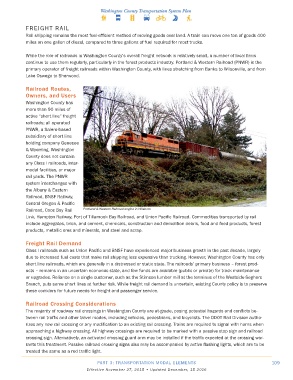
            Railroad, Coos Bay Rail   Portland & Western Railroad engine in Hillsboro
            Link, Hampton Railway, Port of Tillamook Bay Railroad, and Union Pacific Railroad. Commodities transported by rail
            include aggregates, brick, and cement, chemicals, construction and demolition debris, food and feed products, forest
            products, metallic ores and minerals, and steel and scrap.

            Freight Rail Demand
            Class I railroads such as Union Pacific and BNSF have experienced major business growth in the past decade, largely
            due to increased fuel costs that make rail shipping less expensive than trucking. However, Washington County has only
            short line railroads, which are generally in a distressed or static state. The railroads’ primary business – forest prod-
            ucts – remains in an uncertain economic state, and few funds are available (public or private) for track maintenance
            or upgrades. Reliance on a single customer, such as the Stimson lumber mill at the terminus of the Westside-Seghers
            Branch, puts some short lines at further risk. While freight rail demand is uncertain, existing County policy is to preserve
            these corridors for future needs for freight and passenger service.

            Railroad Crossing Considerations
            The majority of roadway rail crossings in Washington County are at-grade, posing potential hazards and conflicts be-
            tween rail traffic and other travel modes, including vehicles, pedestrians, and bicyclists. The ODOT Rail Division autho-
            rizes any new rail crossing or any modification to an existing rail crossing. Trains are required to signal with horns when
            approaching a highway crossing. All highway crossings are required to be marked with a passive stop sign and railroad
            crossing sign. Alternatively, an activated crossing guard arm may be installed if the traffic expected at the crossing war-
            rants this treatment. Passive railroad crossing signs also may be accompanied by active flashing lights, which are to be
            treated the same as a red traffic light.

                                          PART 3: TRANSPORTATION MODAL ELEMENTS                                   109
                                     Effective November 27, 2015 • Updated December, 15 2016

