Basic HTML Version






86
{ }
Processing
There are still a few weeks to go before the barako is ready
to drink. The ripe coffee cherries are laid out to dry in the sun.
Depending on the weather and the humidity, this process
can take anywhere from a few weeks to over a month.
Take a drive down the backroads of Alfonso in Cavite during
February and March, and you’ll notice countless coffee
cherries being dried out by the roadside.
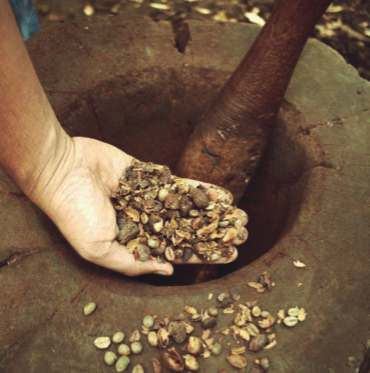
After the sun has done its job, the liberica cherries are then
brought to a hulling machine to remove the dry, leathery
skin. In the village of Calabuso in Cavite, the style of milling
remains classic with the use of a large mortar and pestle.
Whichever method is preferred, though, the final product is
the same — the tiny raw coffee seeds, or “green beans”.
Roasting
It takes a few minutes and a lot of heat
to transform dried plant material into
the source of our morning buzz — so
the green beans are brought to a coffee
roaster for the most important step in
the process. Established Philippine
coffeehouses like Gourmet Café or
Figaro use professional computerized
machines, but elsewhere in the country,
more creative methods are deployed. In
Batangas, the barako beans are placed
inside a metal drum that rotates over
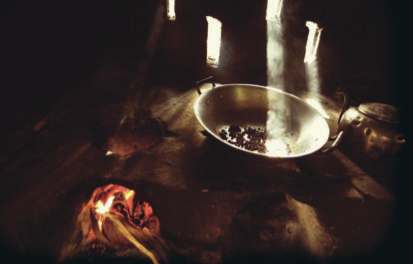
a flame. The folks in Barrio Calabuso,
on the other hand, do their roasting on
an antique wok in the kitchen. Roasted
dark, the barako provides a massive
kick and a full-bodied flavor that has
been compared to caramel, wood or
even licorice.
Clockwise from top left: Sun-
drying coffee seeds is done
by the roadside in Cavite; a
mortar and pestle separate
the seed from the husk; wok-
roasting coffee is a primitive
method, but it wo(r)ks a
treat! Opposite page: Cavite
farmers enjoy fresh, home-
grown and totally organic
barako coffee
A C O F F E E S T O R Y