Basic HTML Version













90
{ }
Bayanihan
is a homegrown Filipino
concept that refers to a spirit of
communal unity or effort to achieve
a particular objective. In Norwegian,
the word for it is
dugnad
. It was in this
spirit that people came to work every
day and pitched in what they could —
fathers were tasked mainly with the
building of the structure, and mothers
were charged with the interior’s design.
“The building itself then became a
means for us to discuss these elements
of their own environment. I think that
the fact that it now looks Filipino is
because it was made to deal with the
climate of the place, with the materials
of the place and by the people of the
place,” says Alexander. “It was an
extremely wonderful experience for us
to see how the creativity in the mothers
and fathers could be channeled into a
structure that now represents them and
their passion for their children.”
Ivar shares a few highlights of more
of the spirit of
bayanihan
in action: “The
idea of using stones came from one
of the fathers, Nestor, when he was
building one-to-one mock-ups of the
walls in different materials. In the end,
the wall stands as a hybrid of all these
experiments. The main concept with
this wall is similar to how the
bahay
na bato
deals with ventilation, and
how the weight of the materials cools
the building down during daytime —
exactly what was needed for the study
center.”
More help arrived in the shape of a
local architect student, Bing Balona,
who brought in stones that were not
damaged by the salty waters and could
be used within the concrete of the wall.
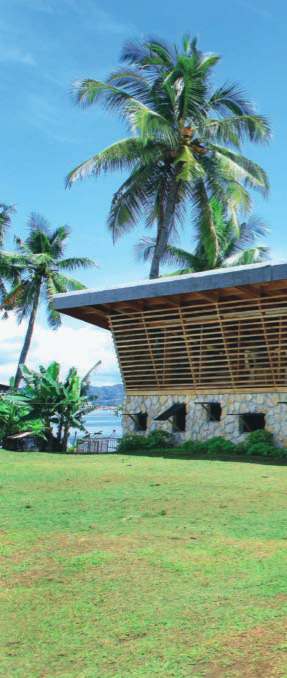
The building, a minimalist and
sleek take on the traditional Filipino
bahay na bato
(stone house), has for
the children become a manifestation
of their parents’ deep-rooted care for
them and their future. Made of locally
sourced materials, its open design
allows natural light in the daytime
and uninterrupted, natural ventilation
throughout the day. It also has a view:
from where children sit, they can turn
their gaze and look beyond the slum
Bayanihan
settlement, and towards a horizon
where anything is possible — most of
all their dreams.
Cebu Pacific flies to Tacloban from Manila
and Cebu.
www.cebupacificair.com
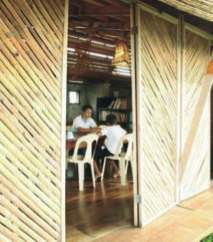
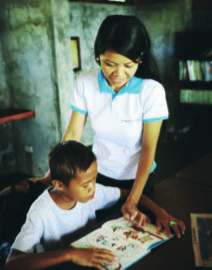
Clockwise from top left: Streetlight’s
Center Nurse Nerren Homeres helps
with the lessons; the study center by
day; diagonal slats of the building walls
have aesthetic and functional values. For
more information on how to help, visit
www.streetlight.org
or
www.wrkshp.org
PHOTOS
NELSON PETILLA