Basic HTML Version


















89
{ }
I N S P I R I N G S T R U C T U R E S
“The natural landscape was incredible,”
says Alexander of Tacloban when he
first arrived. “But the social differences
were obvious, a big contrast between
poor and rich. As for the buildings,
we were surprised by the amount of
enclosed concrete and glass structures
which were not considerate of the
climate, ventilation and how to utilize
natural sunlight.”
Eastern Visayas is an area through
which typhoons from the Pacific barrel
into the country, and thus experiences
heavy rains and episodes of humidity.
“Most of the buildings were heavy,
and damp concrete structures made
air-conditioning a necessity,” explains
Alexander, “when in fact, climate issues
can be properly addressed through
traditional Filipino building techniques.
It was the vernacular buildings as well
as some of the innovative solutions in
the slums that we found very inspiring.”
With these observations as a
springboard, and after a warm welcome
to the village, they all hunkered down
to work. The first, perhaps most crucial
step, was organizing workshops,
designed with the help of Nerren
Homeres, to bring the mothers and
fathers into the design and building
process of the study center.
The idea behind the approach
is nicknamed in some circles as
“grassroots design” or “contextual
architecture”, built on the notion that
the end-users’ involvement in every
stage of the process — from starting
the design to actual building — creates
a deeper sense of ownership that, in
turn, leads to commitment and care.
If people from the community were
personally invested in the building
of the study center — if they sawed
the wood, raised the roof beams,
hammered nails into place, polished
the surfaces to the sheen of their
liking — they are most likely to take
pride in what they had built and make
maximum use of it. More importantly,
adds Ivar, “By engaging the parents,
local engineers and businesses, the
aim was to strengthen relationships
and connections.”
Architecture of the people
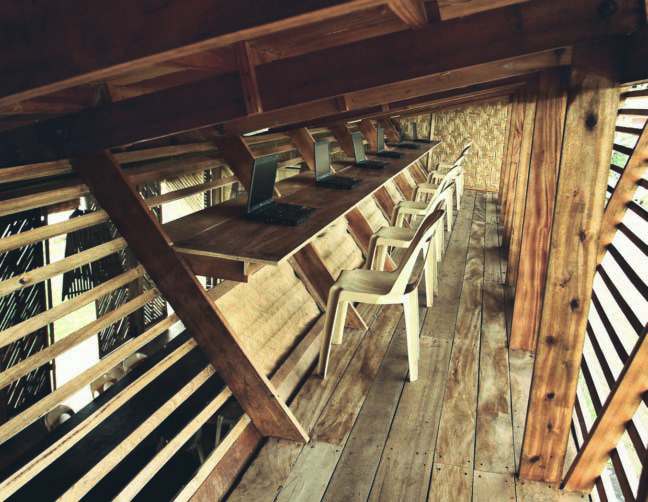
“The building is oriented towards the ocean
with a 13-degree tilted roof that would allow
winds to pass through,” says Alexander.
“This was also inspired by typhoon solutions
used in and around different slum
areas in Tacloban.”
PHOTO
NELSON PETILLA