Basic HTML Version


polnischen und georgischen Kompo-
nisten zu entdecken.
Wenn Sie in die Zukunft schauen:
Was möchten Sie beim MDR als Ver-
mächtnis hinterlassen?
►
Es gibt zwei Berufe, in denen man vier
Jahre lang Zeit bekommt, etwas zu ver-
ändern: als Politiker und als Dirigent.
Aber während die meisten Politiker auf
ihre Wiederwahl hinarbeiten und des-
halb schnelle Lösungen suchen, glaube
ich, dass man langfristig denken muss,
um wirklich etwas zu verändern. Beim
MDR möchten wir etwas Neues schaf-
fen, statt andere zu kopieren. Und wir
möchten die K lassik dem Volk
zurückgeben.
« Es gibt zwei Berufe, in denenman
vier Jahre lang Zeit bekommt, etwas zu
verändern: als Politiker und als Dirigent »
R I G H T N O W
P E O P L E
MUSIC FOR
THE PEOPLE
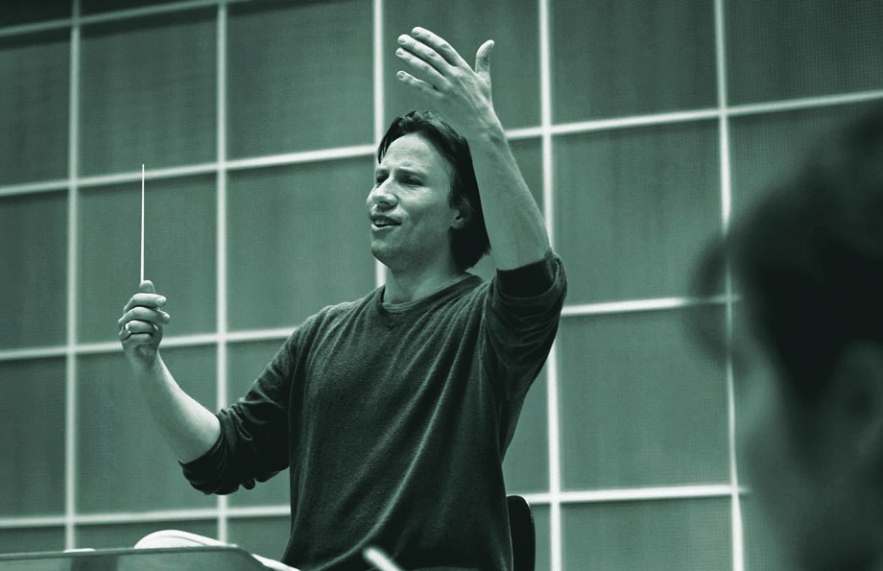
Kristjan Järvi is a visionary.
Not only is the Estonian conductor
founder of the Baltic Youth
Philharmonic, which mentors young
musicians in Baltic countries, he now
has a new role as chief conductor at
the MDR Symphony Orchestra, and
plans to make the Leipzig-based
institution the most innovative
orchestra in the country. Well what
else would you expect from a city
with such a great musical history?
What are your plans for the MDR
Sinfonieorchester?
►
To me Leipzig’s Gewandhaus, the first
symphony orchestra founded by the
upper-middle class, rather than the
aristocratic elite, in 18th-century
Germany, is the role model. We are
working on a 21st-century version.
I want the MDR Orchestra to be a
multimedia, progressive arts centre
because I believe art should not be some
religious experience. Essentially it’s there
for entertainment.
How do you plan to introduce new
elements and reach a wider audience?
►
Well, we are going to do the
soundtrack to Tom
(Run Lola Run)
Tywker’s, new film
Cloud Atlas
, which will
star Tom Hanks, Halle Berry and Susan
Sarandon. I have also asked Gene
Pritsker to arrange this film music in a
symphonic format so that we can
perform it live. In the classical world, new
music is too often seen as something
inaccessible, something people want to
be over so they can hear the songs they
know. But don’t forget, when people first
heard Beethoven they didn’t like it either.
He went on to be the pop star of his time.
Speaking of pop, what’s on your iPod?
►
I really love the Black Eyed Peas’ album,
The E.N.D.
Actually, the music genre
where the most interesting things are
currently happening is pop. It’s tuneful,
soulful and well produced. That’s where
classic has to go back to, to the roots
when it was pop for the people. Why else
did Mozart write 27 piano concertos in a
row? Because he was producing hit tunes,
pop songs for a fan base.
You come from a very musical family;
both your father and brother are also
conductors. What music did you
listen to at home?
►
Well, in Estonia we were part of the
Soviet Union, cut off from Western music,
but luckily we were able to receive
Finnish TV. My father introduced us to
Abba and I still believe Benny Andersson
was the Mozart of his time.
How do you find living in Leipzig?
►
I like how hip and vibrant the city is.
The great thing about Germany is its rich
cultural heritage; in music and literature
it has always been the central European
power house. And Leipzig has played a
vital role. I mean, they have Bach.
Looking into the future what do you
want your legacy at the MDR to be?
►
There are two professions where
people have a four-year period to make
a difference: politicians and conductors.
But while many politicians focus on
being re-elected and therefore go for
quick-fix solutions, as a conductor I
believe you can only really make an
impact if you think long term. At the
MDR we are working on being
progressive and innovative rather than
emulating the Vienna or Berlin
Philharmonic. We want to create
something new rather than just copying
and bring classical back to the people.
Foto: Edith Held MDR
26
—GW