Basic HTML Version


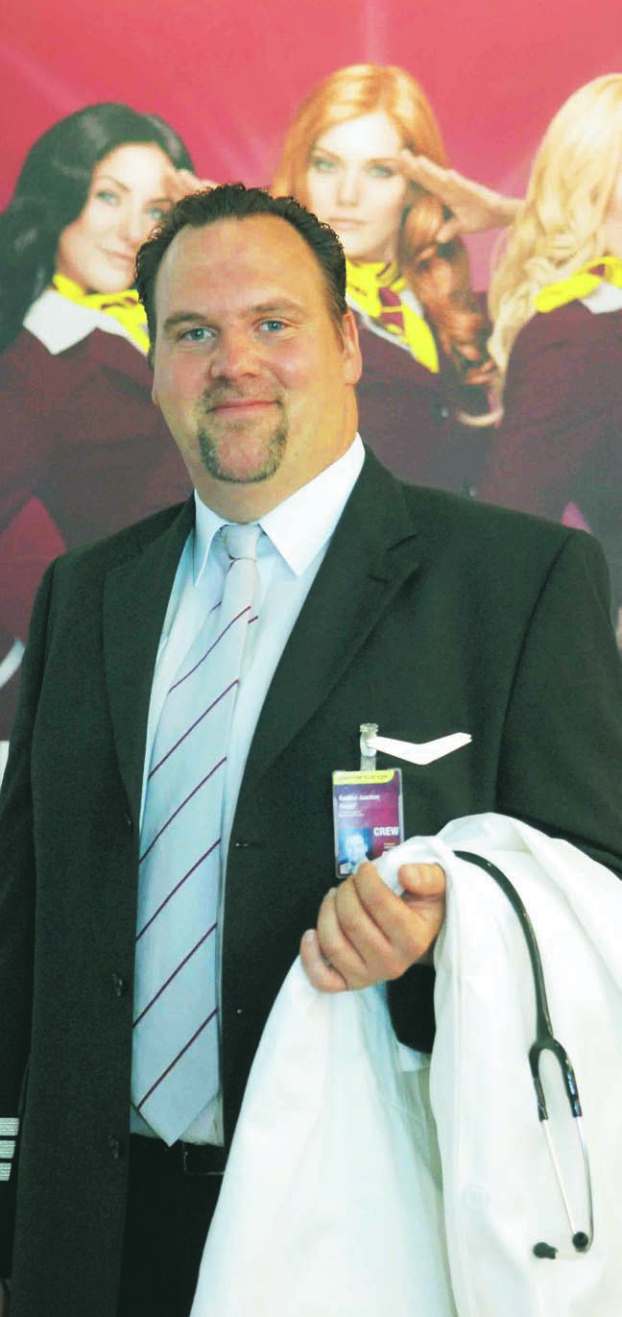
Gibt es einen Arzt an Board?
Ja, Pilot Karsten Kempf
Karsten Kempf is
the flying doctor
since I was at school. When I passed my
Abitur (German equivalent of A-levels)
the war in the Middle East had pushed
up oil prices, which was bad for airlines.
During my civilian service (Germany’s
alternative to military service), I trained
as a paramedic and realised that I was
good at working with people and really
interested in emergency medicine, so I
went on to study medicine. But during
my studies, I’d often drive to the visitor
terrace at Frankfurt Airport and spend
hours there, watching the planes. When
I got my first pay packet as a doctor, I
drove to a small airfield and registered for
a private pilot’s licence.
You trained for your pilot’s licence
while you were doing your PhD. Could
you, or did you not want to, choose
between the two professions?
No. I still have to constantly make decisions
in both jobs. When I undertook pilot’s
training, I had already decided to study flying
professionally. Even before students begin
their training, psychologists assess them on
their ability to make decisions independently
or as part of a team. If you get the chance to
turn one of your major passions into a career,
as I did, the decision is made for you.
What are kind of challenges do you
face in your respective jobs?
I’m always challenging myself to do my
best in both. They both require a huge
amount of background knowledge,
and you can always learn more. But
the biggest challenge in both jobs is
working with others in normal and
occasionally unusual situations.
My aim in both professions is to
develop practical and goal-orientated
communication with others.
Do the jobs share any similarities?
Yes, definitely. For me, a flight is a bit like
an anaesthetic. Before each flight we
have a briefing, and before we administer
an anaesthetic, we look at the patient’s
medical history. Taking off and administering
anaesthetics are both critical situations,
which require a great deal of focus and good
teamwork. A flight, like the time the patient
spends under anaesthetic, is normally quite
relaxed. By contrast, landing and bringing
a patient out of an anaesthetic require
everyone’s full attention.
Have you ever used your skills
from one job in the other one, for exa-
mple, using your medical knowledge
during a flight?
Yes. I’m able to translate a doctor’s medical
speak into pilot speak, which can be very
useful. When we’ve occasionally have
medical incidents on board, I’ve been able to
give our cabin staff a bit of advice, although
they are actually very well trained in first aid.
Doctors andpilotswork irregular hours.
How do you manage to coordinate your
shifts, andwhich job gets priority?
I prioritise my job as a pilot and work as
a doctor in my spare time. Germanwings
pilots can make rota requests (days and
early/late shifts) until the beginning of the
month. Mid-month, I normally know what
my schedule will be, so I can at least plan
some days off. Flight destinations can
change though. In winter, there are fewer
flights, and it’s less intensive than during
the holiday season in summer.
Sounds like you don’t have a lot of
spare time. What do you do when you
get some time off?
It sounds strange, but since I began
flying, I’ve actually had more free time. It
depends how you define time. As a pilot,
I have demanding days, when I have to fly
four relatively long routes. But I don’t take
my work home with me, as I did when I
was working full time as a doctor. At the
end of the day, we close our ‘flight bags’
with all the paperwork in them, lock up
the plane and go home. Flight times don’t
change much, because it normally takes
roughly the same amount of time to fly a
route. The big delays occur on the ground,
and are normally caused by ground
handling and slots issues. I spend my free
time with my family. I’m the proud father
of two boys and happily married (my wife
also flies). There’s never a dull moment!
You’ve been a pilot since 2002, and
this year you and Germanwings both
celebrate your 10th anniversaries. Do
you have any particular memories
that stand out from your time working
for Germanwings?
I’ll always remember my training in
Rostock. That was the first time I flew
a real plane. Prior to that, I’d only flown
simulators. You do your flight circuit 1,500
feet above the airfield, and the first time,
you really feel the power of the plane
during the take-off manoeuvres. But every
day is an experience, to be honest. You
can take off at dawn in miserable, foggy,
rainy weather and three minutes later,
you’re watching the sunrise above the
clouds with your shades on. It’s fantastic.
GW—
139