SEO Version


Auch Köche schätzen ihren neuen
Lieferanten. Gugumucks Schnecken
ernähren sich von Sonnenblumen,
Mangold, Raps, Thymian und Fenchel
– das Ergebnis ist ein geschmacklich
hervorragendes Produkt. „Es gibt der-
zeit viel Kreativität und Neuer fin-
dung“, erklär t Gugumuck. Schne-
ckenbeuschel (Schneckeninnereien)
zum Beispiel, mit Kräutern und Weiß-
wein munden ihm genauso wie
Schneckengulasch. Als traditionelles
Weihnachtsgericht kommen seine
Wiener Schnecken im Markknochen
mit Rotweinsoße und Burgunder Trüf-
feln auf den Tisch. Ein weiteres Lieb-
lingsrezept ist Schneckenfleisch, -le-
ber und -kaviar mit weichgekochtem
Ei und Salat.
Wenn er nicht auf der Farm zu tun
hat, kümmert sich Gugumuck um das
Wiener Schneckenfestival im Herbst,
zu dessen Mitbegründern er zählt. In
diesem Jahr waren immerhin 100 Re-
staurants und auch einige berühmte,
österreichische Köche mit von der Par-
tie. Gugumuck bietet auf seiner Farm
auch Kochkurse und Führungen an. Oft
sind Gäste überrascht, dass er über
100.000 Weinbergschnecken auf der
Farm hat. Selbst Einheimische stau-
nen, dass mitten in Wien solche Land-
wirtschaft betrieben wird. Außerdem
wurde Gugumucks Betrieb 2009 mit
dem Innovationspreis der Jungbauern-
schaft ausgezeichnet.
Über die Zukunft macht er sich da-
her keine Sorgen mehr. So groß sei die
Nachfrage, dass bereits Expansions-
pläne existieren. „Noch nie gab es für
Landwirte einen besseren Zeitpunkt
ein Vertrauensverhältnis aufzubauen.
Die Menschen interessieren sich mehr
denn je für Qualität, und vor allem da-
für, wo ihr Essen herstammt.“
SLOW FOOD
Andreas Gugumuck is bringing
back a forgotten Viennese culinary
delicacy: snails.
Few people embody the slow food
movement better than Vienna’s Andreas
Gugumuck. After working in IT for 10
years he has started breeding the
slowest food of all – snails.
“Farming is in my blood,” he says of
the career change. “I’m from a farming
family; I drove my first tractor at the age
of 10.” Indeed, his late grandfather,
Johann Gugumuck, was a pioneer of
organic farming long before it became
fashionable.
Gugumuck’s interest in molluscs
started four years ago when he read that
the Austrian capital had a historical
tradition of snail breeding and was a
mecca for escargot lovers until the early
20th century. Known locally as the
Viennese Oyster, the dish was rumoured
to have aphrodisiac properties. Market
traders sold snails boiled, candied, deep
fried or wrapped in bacon and served
with
weinkraut
(wine sauerkraut).
Fascinated, Gugumuck set out to
learn more, visiting snail farms in France
to investigate breeding methods and
renovating the family’s 400-year-old
farmhouse to the south of Vienna as a
snailery. This took six months, after
which the molluscs were imported from
France and Germany – snails enjoy
protected status in Austria.
Perhaps needless to say, his family
weren’t entirely convinced the enterprise
would be a success. “The renovation
was a huge undertaking, there was much
to learn and we had no clients,” says
Gugumuck. Nevertheless, his product
has met with huge demand. His first
harvest was in spring 2008 and today
clients include 50 restaurants in Vienna
and 30 more throughout Austria. The
100,000 snails on the farm live on
sunflowers, leaf beet, rapeseed, thyme
and fennel, resulting in a fabulous-
tasting product.
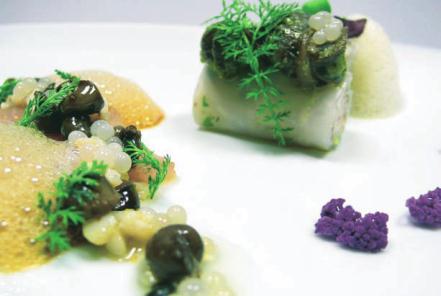
The farm also produces snail caviar
– the only other producer is in France.
Gugumuck loves the caviar’s colour and
herby taste, but he is particularly
passionate about snail liver, of which
he is the world’s sole purveyor.
“It’s beautiful, very soft and we have
experimented a lot. There’s a lot of
VI ENNA SNAI L FARM
www.wienerschnecke.at
creativity and reinvention happening.”
Schneckenbeuschel
(snail innards) with
herbs and white wine is also popular as
is snail goulash. For Christmas,
Gugumuck recommends
Wiener
Schnecke im Markknochen
, an elaborate
offering with snails placed inside marrow
bone cooked in red wine, shallots and
truffles. Another new recipe he loves is
snail meat, liver and caviar with a soft
egg and salad. The farm also offers
cooking courses and guided tours.
Gugumuck co-founded and helps
organise the Vienna Snail Festival each
autumn, which last year attracted over
100 restaurateurs. Having won the
Young Farming Innovator of the Year
award from the agriculture ministry in
2009, he is confident in the industry’s
future; indeed with such huge demand
for his snails, he has plans to expand.
“There has never been a better time
for farmers to build relationships with the
public,” says Gugumuck. “People are
more interested than ever in quality and
where their food comes from.”
P E O P L E
Andreas Gugumuck liefert
Feinschmeckern ausgefallenste
Schneckengerichte
Snail caviar is just one of
Andreas Gugumuck’s novel products
26
—GW
GW07-p025-026-People-LPSF.indd 26
14/1
Powered by FlippingBook Publisher