Basic HTML Version


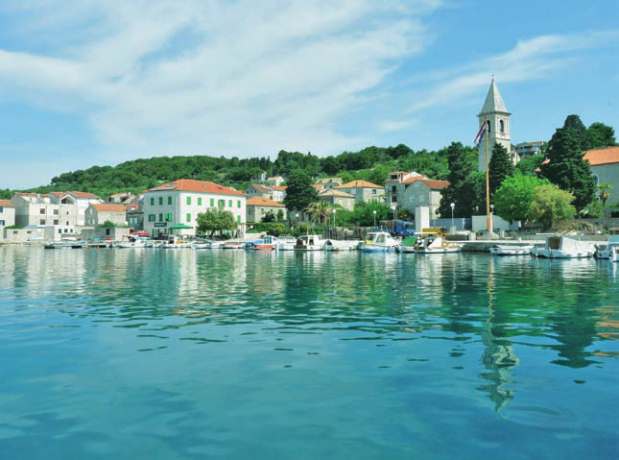

SPLIT
located to the north and west of Split, on Croatia’s coast,
crossings aremuchmore sedate. Those who can afford it
use yachts, mooring up in tranquil harbours along the way
for long, lazy lunches. Chunky white passenger boats also
link some of the bigger islands, transporting deckloads of
tourists across the blue-green waters. Over the summer
months, either method of transport provides a stunning way
to enjoy some quite spectacular scenery.
But, to quote SwimTrek, the tour company that organises
swimming adventures along this part of the Dalmatian
coast, “ferries are for wimps”. Which is how I findmyself in
the water, rather than sunningmyself on the deck of a boat.
I’d donemy best to provemymettle the day before
at our hotel on Prvic´, a car-free island with warm,
rosemary-scented breezes and less than 200 year-round
residents. It was earlymorning and Bruce, our outdoorsy
Australian swimming instructor, wanted to watch us all
having a dip so he could see howwell we swam. At first I
approached the turquoise shoreline confidently, bare feet
sending the sun-bleached pebbles tumbling down towards
the waterline. Then, just as I was about tomakemy first
foray into the water, I spotted a dozen or so spiny sea urchins
pointing up at me frombeneath. I hesitated.
“Go on, just flop onto your chest and start swimming,”
urged Bruce, snappingme into action. A split second later
I was in – arms pullingme forwards, and legs beating up and
down as I mademy way out across the water. Warm sunlight
was dancing across the surface, but after an unusually cold
winter, which had seen snow dusting the palm trees, the sea
was still chilly enough tomake it hard to breathe. I decided
that, for our first proper swimof the week – a 2.2km-long
route along the coastline of a nearby island called Zlarin –
I’d be wearing a wetsuit.
Human history on Zlarin pre-dates
neoprene by a few thousand years,
with evidence of neolithic and Roman
settlements hidden behind the fig trees
that cling to the shoreline. The island’s
brightest age camemuch later, though,
in the 20th century, whenMaglite
inventor AnthonyMaglica and some
of Croatia’s best-known painters, poets
and actors took up residence here. Like
many of the islands in the Šibenik
archipelago, it’s nowmost popular with
day-trippers and swimgroups looking
for a tranquil alternative to island-
hopping inGreece.
Visit a handful of the atolls that are
inhabited and you’ll uncover stone
churches, seafront restaurants that
There’s great satisfaction to be taken fromdropping in on the
different islands, eachwith their own personality
serve platters of lemon-drizzled squid, and crumbling old
villas that are overgrown with fragrant flowers. In between
these populated islands are clumps of deserted rock,
visited only by the occasional crab and criss-crossed by
the walls of old allotments – a legacy from the days when
careful farming, not tourism, helped to put food on the table.
Everywhere the sea remains constant: a wild, sometimes
electric blue, with every rocky crag edged by coral, leathery
purple sea cucumbers and shoals of silvery fish.
You won’t find this close contact with nature in
city-break destinations like Split, which this month hosts
the Split Summer Festival, a riot of music, dance and theatre.
There’s great satisfaction to be taken fromdropping in on
the different islands, each with their own personality, and
get some exercise into the bargain. But as I dripped dry on
the deck of our support boat, warmingmy hands around
a hot cup of coffee, I couldn’t help wondering what made
people want to give up the usual cultural break or beach
holiday for a week in a wetsuit, swimcap and goggles.
“For many of us it’s the contrast,” says Jane, a tribunal
judge fromEngland, now on her second SwimTrek trip.
“There’s a big difference between this and being in an office.
It’s just great to be outside.”
The region offers big rewards for those who like to
explore. Away from the sail-cluttered harbour on Kaprije,
for example, there’s a peaceful walking trail that leads
past tangled grapevines and up to a lonely island summit,
with views stretching far across the archipelago. In the
distance, you can just make out the green undulations of
themainland, where the Krka River curves lazily through
forested terrain on its way through a national park that’s
home to Europe’s most photogenic waterfall.