Basic HTML Version


46
|
TRAVELLER
Senderens’s restaurant [in Paris] and when the bill
came it was equivalent to half of my yearly salary,” he
chuckles. Ducasse now has a total of seven restaurants
here (including one in the Eiffel Tower), and has just
published a book,
J’aime Paris
, in which he shares
insider’s tips on his favourite places to eat in the city.
These are not, as you might expect, just gourmet
restaurants. He is as keen to celebrate the best ice
cream parlour or the perfect place for a café au lait.
“It’s the diversity in Paris and the combination of
haute cuisine, traditional cuisine and creative cuisine
from young chefs here that makes its dining scene so
unique,” he says. “Paris, along with London and New
York, is one of the most dynamic culinary cities in the
world. Parisians are as difficult and demanding to
cook for as a Londoner or New Yorker.”
Before taking the class, I had gingerly asked what
advice he’d give students attending his cookery school.
“Just listen carefully and do not hesitate to ask lots of
questions,” he says in his thick French accent. “Our
goal is that, when a student leaves the school after a
lesson, they can recreate the dishes at home.”
After the cockles, I move on to a pan of winkles,
extracting the diminutive sea snails from their shells
for the seafood sauce that will accompany the poached,
glazed sea bass fillets of our main course. And I’m also
getting the knack of removing razor clams from their
shells. “You just squeeze,” says Morat, holding up one
FEATURES
|
PARIS
“THIS IS LIKE SURGEON’S WORK,”
says my
classmate Kate, as she carefully extracts the tongue
from a blanched cockle, scraping away the tiny grey
detritus from its insides with the needle-point tip of
her knife. I’ll admit that, before today, I didn’t realise
cockles even had tongues – and it’s come as even more
of a surprise to find that they’re actually the best bit.
Or, at least, they are according to Pierre Morat, who
is my teacher for the day. The 31-year-old culinary
instructor is the right-hand man of Alain Ducasse
and we’re here in Paris at the legendary French chef ’s
École de Cuisine for lessons in the art of Michelin-level
cooking. Ducasse, who hails from the south-west of
France, where he grew up among ducks, geese, boletus
mushrooms and lots of foie gras, is something of a
superstar in the food world, having been awarded 20
Michelin stars in all, so he knows a thing or two about
what it takes to achieve culinary excellence. His school
in the French capital’s 16th arrondissement has been
instructing amateur cooks and wannabe gourmets
since it opened in 2009.
Although he became a fixture of the Parisian dining
scene after opening his eponymous restaurant Alain
Ducasse here in 1996, moving it to the opulent Plaza
Athénée hotel in 2000, Ducasse’s relationship with the
city’s food stretches much further back. “It was 1975. I
was a young chef working in New York at the time and
I wasn’t earning much money. I went to eat at Alain
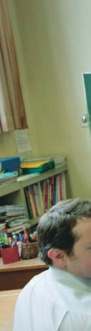
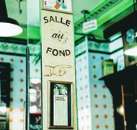
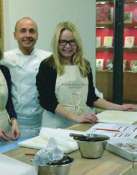
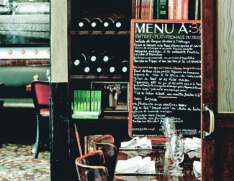
Clockwise from
right,
cookery
instructor Pierre
Morat with our
writer Rosie
Birkett; Alain
Ducasse in his
cookery school; the
classic interior of
Bistrot Paul Bert;
themenu of Bistrot
Paul Bert
PHOTOS © PIERRE MONETTA, PHILIPPE PETIT