70 AMERICANWAY
NOVEMBER 15 2009
By1972Reynoldshad soldhisfirsthouse
— the Thumb House — erected out of
thesebeer-can “bricks.”Then, around 1973,
shortly after the first energy crunch, Reyn-
olds started trying to build thermal mass
intohisexperimentalhouses. “Iwasalready
playingwithgarbageasabuildingmaterial,
and I saw that thereweremountains of au-
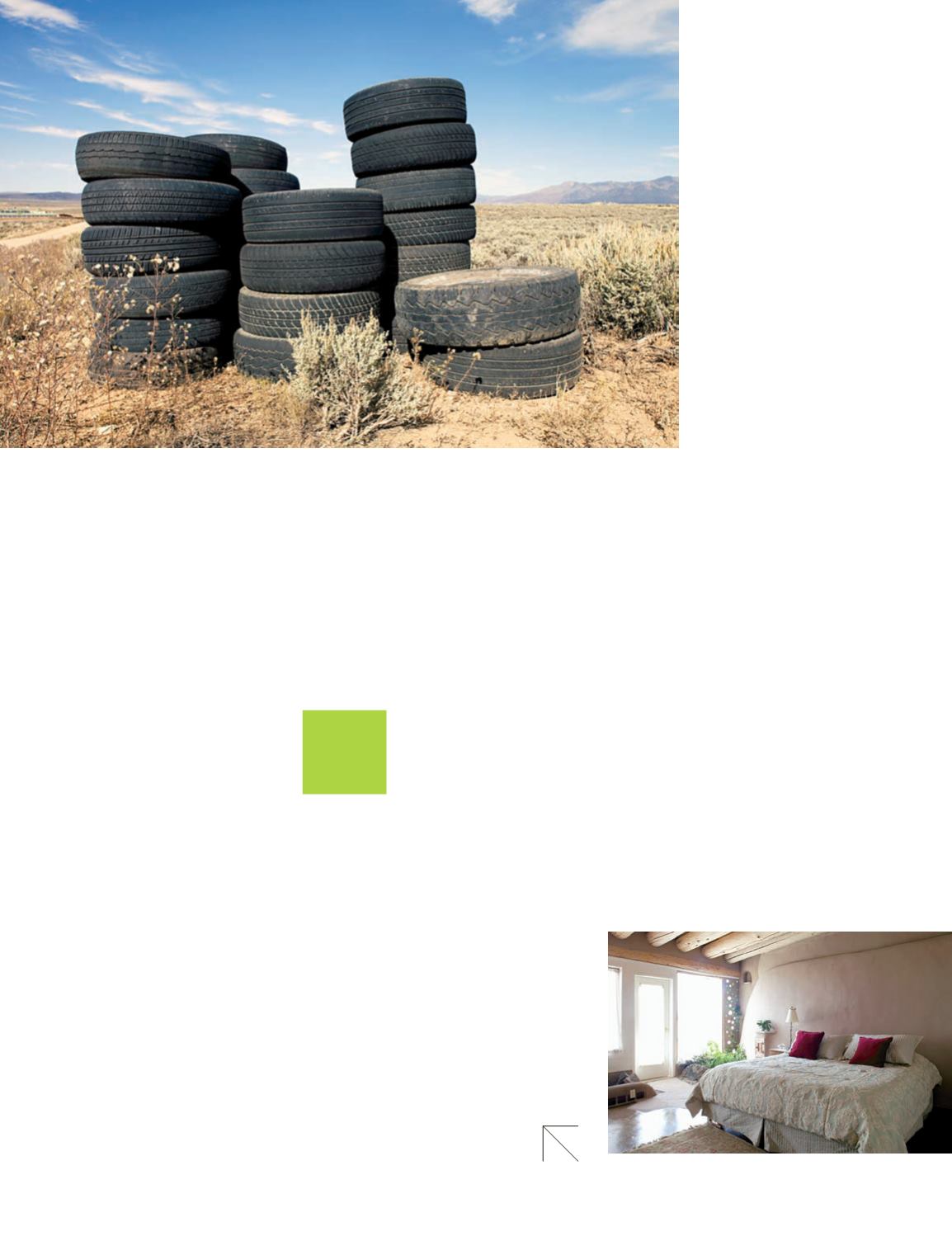
tomobile tires all over the country,” he says.
“I discoveredby trial and error that I could
beat dirt into them and create a massive
wall that stored energy andmade it so that
you had to use less heat in your house be-
cause theheat that youdidput ingot stored
into thewalls.”
Subsequent tweaks to his concept came
about as newer problems were addressed
by the media. Reynolds and his company
also added a photovoltaic-electricity op-
tion following the energy crunch. When
water shortageswere predicted, they began
designing the houses to catch, filter, and
storewaterunderground— forbathingand
washingfirst, watering interior greenhouse
planters second, recycling it for flushing
toilets next, andfinally, forwatering plants
outside thebuilding. Theyaddressed excess
sewageandpollutionbymaking thehouses
contain and treat their own sewage on-site.
And their newer houses also have green-
houses. Reynolds boasts that each home’s
utility costs run less than$100per year.
“You’re totally warm,
[
you
]
have a
flat-screenTVandhigh-speedInternet, and
you can produce food,” Reynolds declares.
“It’s the independent unit of the future.”
Thefirst official Earthship,
Reynolds’s
home, was built in 1988. The first outside–
NewMexicoEarthshipwas thehomeof late
actor Dennis Weaver and was constructed
inRigway, Colorado, in 1990; the first Eu-
ropean ones included a public building in
Brussels, Belgium, built in 2000, and a
residential home in Normandy, France,
finished in2007. There’s evenwhat’s called
the Greater World Community in Taos,
NewMexico, which is made up entirely of
Earthships and became a legal subdivision
in 1998. Reynolds estimates that there are
between 1,500 and 2,000 Earthships
in 15 to 20 countries, and production
has increased rapidly over the last few
years.
The composition of the structures
is simple: They’re made of material
scoured from the localdump, likecard-
board, glass, plasticbottles, aluminum
cans, and tin. “We’ve
[
also
]
startedhar-
vesting the baked-on enamel panels
off of themountains of refrig-
erators, ranges, and washing
machines that every dump
has,” Reynolds adds. The
main building blocks are tires
rammed with dirt, which cre-
ate what he calls “400-pound
bricks.” Reynolds claims they
areearthquake-resistant, store
temperature through their
heating system, and are very
resilient and low-tech.
“We set the buildings up so
the low winter sun comes up
and heats the mass, and the
high summer sun is blocked
out by the way you configure
the roof,” Reynolds explains
further. “You’re getting heat
when you need it and block-
ing itwhen youdon’t. Thenewmodels stay
between 70 and 75 degrees year round,
without a stitch of backup heating or cool-
ing. Andwe get to 20 or 30 degrees below
in thewinter andup to 102 in the summer
[
inNewMexico
]
.”
Whilemany view this as the best form of
green housing available, building authori-
ties have given Reynolds plenty of friction,
especially because of the massive profits at
stake, most notably through public utility
companies that handle and control power,
water, and sewage. Although he voluntarily
turnedoverhisarchitect’s license to thestate
ofNewMexico,Reynolds still holds licenses
inColoradoandArizona.Henowcallshim-
self a “biotect” rather thananarchitect.
Formore information onMichael Reynolds
andEarthships, go to
,
and
.
Soon ReynoldS waS “making a building block out of
beeR canS to uSe feweR tReeS and to eat up gaRbage —
tRying to kill two biRdS with one Stone.”


