42 AMERICANWAY
FEBRUARY 15 2009
G L O B A L N B A
“Iwas two,” saysParkerJr., the starguardof
four-time National Basketball Association
champions theSanAntonioSpurs. “Mydad
played basketball, so I was following him
everywhere, trying to do the same moves
and everything.”
While his playmates were dribbling soc-
cer balls with their feet, Parker dribbled
a basketball with his hands. Also vital to
young Parker’s development as a basket-
ball phenomenon were summers spent in
Chicago at the home of his father’s parents.
There, Parker learned that tobe cool on the
playground, you had to wear a red-and-
blacknumber-23Michael Jordan jersey.
In his grandparents’ living room, the
nine-year-oldwatchedJordan lead theChi-
cago Bulls to the 1991 championship and
declared: “I’m going to play in the NBA
someday.”
Dadmay have been his mentor, but the
French youngsterwanted tobe likeMike.
So, too, did young boys in cities like
Würzburg, Germany; Sant’Angelo, Italy;
BahíaBlanca,Argentina;SãoPaulo,Brazil;
Barcelona, Spain; Belgrade, the former Yu-
goslavia; and Istanbul, Turkey.
Now, Parker, a two-time NBA All-Star
and the most valuable player of the 2007
NBA Finals, is but one of 75 active NBA
players born outside the United States. He
is amember of themost successful profes-
sional sports franchise of thepast decade, a
Spurs team that has built success largelyby
lookingbeyondAmerica’sborders.
WhentheSpursswepttheClevelandCav-
aliers in the 2007 Finals, four of their five
starters were foreigners: Parker (France),
two-time NBA MVP Tim Duncan (St.
Croix), guard Manu Ginobili (Argentina),
and centerFabricioOberto (Argentina).
Last summer, when the gold, silver, and
bronze medals were handed out after the
Olympic basketball tournament inBeijing,
China, to themembers of the teams repre-
sentingtheUnitedStates,Spain,andArgen-
tina,24of the36medals
went to NBA players,
past andpresent.
Standing with hand
over heart as the U.S.
national anthem played
and theflagsof the three
medal-winning nations
were raised in theOlym-
pic basketball arena,
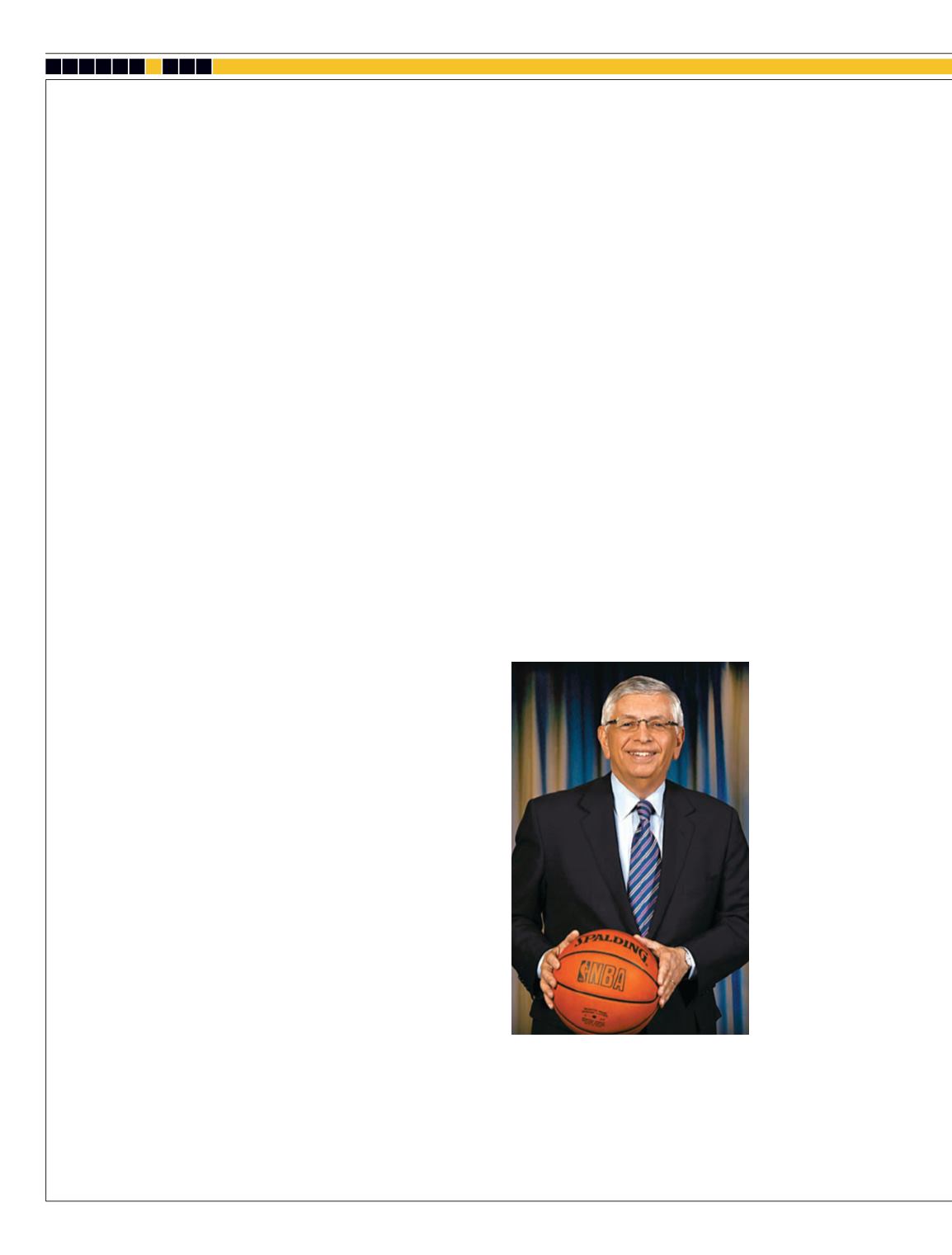
NBA commissioner Da-
vid Stern felt his heart
swellwithpride—equal
parts patriotism and
self-realization.
The globalization of
the NBA, long a goal
Stern had envisioned,
seemedanunquestioned
fact.
FOR DECADES,
Stern
hasunderstood theglobal appeal of basket-
ball ingeneral andof theNBA inparticular.
He recalls listening to stories the legendary
BostonCeltics coachRedAuerbach told in
the 1970s about takinghis teams to the for-
merCzechoslovakia, the formerYugoslavia,
and Israel for summertime exhibitions in
the late 1950s and early 1960s.
During a tripSternmade to Japan to su-
pervise some quasi-official basketball exhi-
bitions by NBA players in the early 1980s,
when he was deputy commissioner, he be-
gan toenvisionadaywhen therewouldbea
significant NBA presence in countries out-
sideNorthAmerica.
“I just was always surprised at how
knowledgeable people were and how well
received our sport was,” he says. “And each
time I hadoccasion to interfacewith some-
thing international, itwasconfirmingof the
fact that this sport, long before I became
involvedwith it, had an enormous interna-
tional following,warmth, andpotential.”
Thepotential just needednurturing, and
Sternbecame its godfather.
Terry Lyons, a 26-year NBA employee
who servedas the league’s vicepresident for
internationalmedia relations, recalls a time
in the early 1980swhen a youngTV execu-
tive inItalymadeweekly trips toNBAhead-
quarters inNewYork togather videotapeof
NBA games. He’d then show them to Ital-
ian basketball fans
who were anxious
to see Magic John-
son,LarryBird, and
other NBA stars in
action.
“Andrea Bassani
happened to be the
sonof aTWApilot,”
Lyons says. “His
very early role in
theNBA’sTVagree-
ment with Italian
TV was to use his
flight privileges to
fly back and forth
to get videotapes of
NBAgames. At that
time, these were
CBS tapes, because
they had the inter-
national rights. But
David, in one of his smartest moves, rese-
cured those rights back to the league office.
Thuswasbornavery importantpieceof the
globalizationof thegame,whichwasTVex-
posure internationally.”
rowing up outside Paris, Tony
Parker didn’t have to look far
tofindabasketball hero. Hisfa-
ther, Tony Parker Sr., who had
been a Loyola University Chicago standout
before playing professionally in France, im-
parted his knowledge of the game to him as
soon as hewas able towalk.
G
DavidStern
(continued on page47)


