78 AMERICANWAY
NOVEMBER 1 2008
Books
A
MarriedNatalieWood— twice
G
At 22, entered into a four-year re-
lationshipwith45-year-oldBarbara
Stanwyck
B
Describes former lover ElizabethTaylor
as “a three-ring circus”
H
Was urged to leaveVenezuela after
courting the president’s secretmistress
C
Was in a secret societywithDavid
Niven, TyronePower, andGregoryPeck
I
Describes beingwithElizabethTaylor
as “like sticking an eggbeater in your
brain”
D
Took bullfighting classes to impress
MissWorld 1955
J
ExchangedHollywood storieswith
RonaldReagan atWhiteHouse dinners
E
Datedfirst daughter LyndaBird
Johnson
K
Fled from loverAnitaEkberg’s apart-
mentwith an enragedHowardHughes
in pursuit
F
Binge drank for amonth so that his
hepatitiswouldflare up anddisqualify
him formilitary service
L
Flirtedwith costarNatalieWoodwhile
filming
InsideDaisyClover
On the
Shoulder
of
Giants
Two civil rights leaderswith
variedpasts find common
ground in a newbook by John
Stauffer.
BySteveWeinberg
Test your knowledge of threeHollywood icons by taking a page
from their recently releasedmemoirs.
ByKristinBairdRattini
OVERTHECOURSE
of a half century
inHollywood, Christopher Plummer,
GeorgeHamilton, andRobertWagner
portrayedpeople such as Captain von
Trapp, Evel Knievel, and Jesse James,
respectively. The roles they played
differedgreatly, but the actors shared
a gooddeal, too— from costars to
friends to girlfriends.
That’s just a taste ofwhat readers
will discover in the newly released
memoirs of these threeHollywood leg-
ends.We enjoyed a sneak preview of
Plummer’s
InSpite ofMyself: AMem-
oir
(Knopf, $37), Hamilton’s
Don’tMind
if I Do
(TouchstoneBooks, $26), and
Wagner’s
Pieces ofMyHeart: ALife
(Harper Entertainment, $26).Match
each star to his offscreen exploits.
TheGameofLife
Answers:
Plummer –C,
F, J,
L;
Hamilton –B,
D,
E,
H; Wagner –A,
G, I,
K
ONEOFTHEMOSTBRILLIANTLY
conceivedbooks
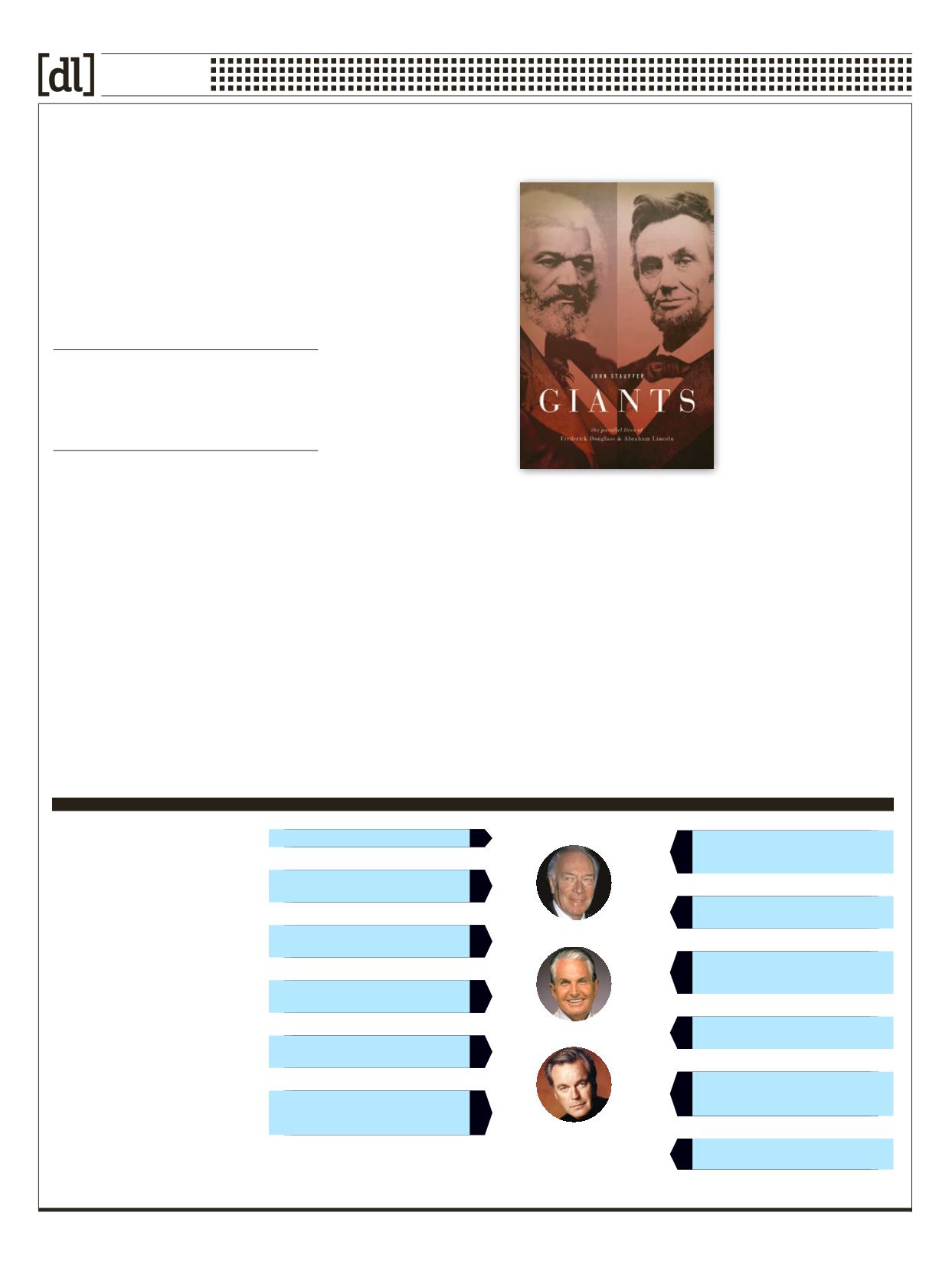
of 2008 is John Stauffer’s dual biography of Freder-
ick Douglass and Abraham Lincoln, entitled
Giants:
The Parallel Lives of Frederick Douglass and Abra-
ham Lincoln
(Twelve, $30). Douglass, the freed slave
with no formal education but a gigantic intellect, has,
of course, been written about in many books. And
President Lincoln, another self-made man, might be
the subject of more biographies than anyone else in
American history.
Though these two historical figures have appeared
inmanyof the sameworks, nopreviousbiographerhas
intertwined their lives as skillfully
as Stauffer, a Harvard Univer-
sity history professor, does here.
Braiding together their stories,
Stauffer says, “gives us multiple
voices from different vantage
points. … The result is a fuller,
rounder understanding of each
person and of the past, much as
taking multiple photographs of
a subject, each from a different
perspective, offers a more com-
plex portrait.”
Set against the ugliness of the
Civil War, Stauffer’s book shows
how effectively Douglass nudged
Lincoln to declare slaves free of their masters. It’s
touching to see how the unlikely friendship blossomed
between the two men. Stauffer writes that Douglass
was “overcome with grief” after Lincoln’s assassina-
tion. Douglass wanted to believe that Lincoln’s pass-
ing would lead to sincere reconciliation between the
races.
Throughout the book, Stauffer not only shares
these men’s stories with expert grace but also dem-
onstrates the centrality of dynamic individuals in the
study of history.
“In many respects, I agree
with RalphWaldo Emerson, who
said there is properly no history,
only biography,” Stauffer says.
“What he meant is that in order
for history to have social value,
it needs to be personal and inti-
mate, revealing the passions and
problems of people in the past so
that it connectswith the present,
enabling history to come alive.”
The dual biography began as a
larger project by Stauffer on the
subject of interracial friendships.
He wrote an essay on the thorny
topic for
Time
magazine. Still, he
muses about how these two leaderswere able to find
mutual affection and respect despite such vast differ-
ences, noting that their coming together at theWhite
House during the Civil War “was the first time that
an African-American and a U.S. president hadmet as
near-equals in the sense that they were cultural am-
bassadors of their respective races.”
Stauffer’snarrative is farmore thana feel-goodhis-
torical saga. Among its virtues, it offers hope for true
dialogue among thosewho could just as easily hate as
they could reason.
Plummer
Hamilton
Wagner


